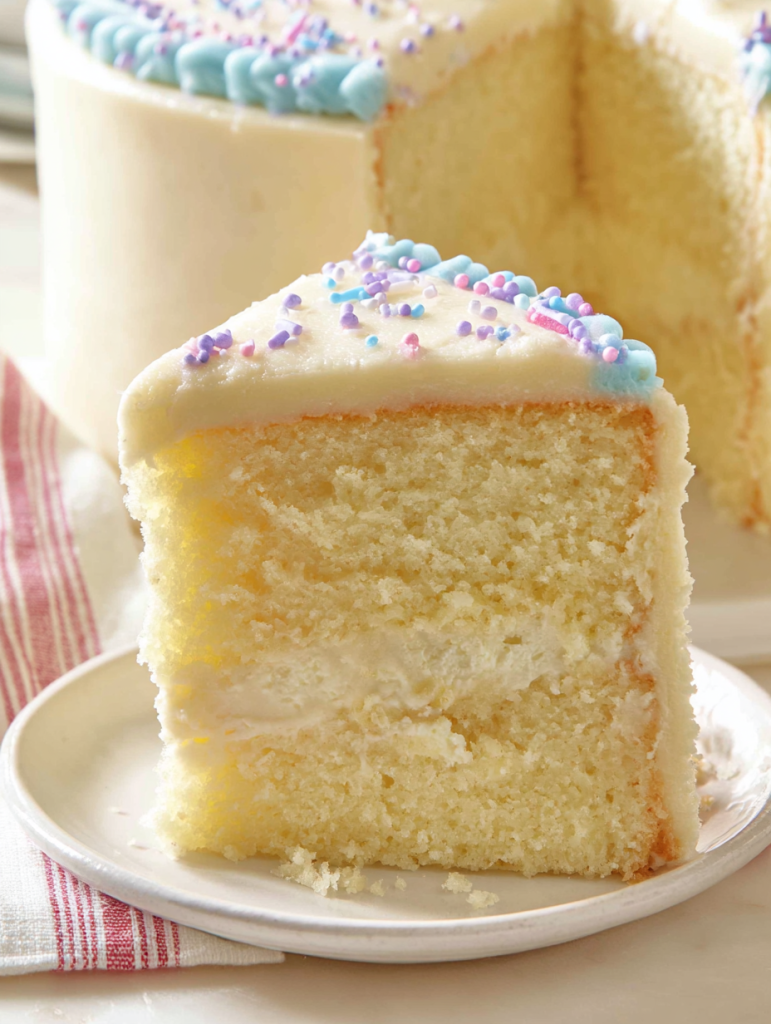
This homemade version gives you soft, bakery-style vanilla cake, a creamy vanilla mousse layer, and smooth vanilla buttercream without needing a membership card. The tender cake, tangy mousse, and classic bakery-style frosting make it perfect for celebrations or an everyday dessert. You’re going to love the triple-vanilla flavor in every bite.
Why You’ll Love It
- Triple vanilla flavor — vanilla cake, vanilla mousse, and vanilla buttercream in every slice.
- Bakery-style texture — cake flour creates a soft, tender crumb.
- Creamy mousse filling — cream cheese and whipped cream make the middle layer rich but light.
- Smooth, sturdy frosting — the cornstarch mixture helps prevent a gritty powdered-sugar texture.
- Celebration-worthy but simple — it looks special enough for any occasion.
Ingredient Notes
Cake flour matters here. But cake flour gives this cake its delicate crumb, so use it when available. Try our White Velvet Cake next.
Butter needs to be very soft, not merely sitting on the counter for ten minutes. It should smear easily, like soft cream cheese on toast. Cold-ish butter will not blend properly into the dry ingredients, and the cake can be frustrating.
Use room-temperature egg whites, yolk, and buttermilk. Baking is fussy in this particular way. The batter comes together more smoothly, and that is worth setting things out ahead of time.
For the frosting, use unsalted butter and plain vegetable shortening. The shortening gives it that classic bakery texture and helps it hold its shape. Is it glamorous? No. Neither is cleaning dried frosting off a mixer paddle, yet life goes on. If you like this, you'll love our Oatmeal Cookies.
The mousse is the Copycat Costco Vanilla Mousse called for in the recipe. Make that according to its recipe before assembling. Don’t try to substitute plain whipped cream—it’s lovely, but it will not give you that creamy, tangy middle layer.
Ingredients
- 2 1/2 cups plus 2 tablespoons cake flour
- 1 1/2 cups plus 2 tablespoons granulated sugar
- 1 tablespoon baking powder
- 3/4 teaspoon fine salt
- 3/4 cup unsalted butter, very soft
- 4 large egg whites, room temperature
- 1 large egg yolk, room temperature
- 1 tablespoon vanilla extract
- 1 cup buttermilk, room temperature
For the buttercream:
- 2 tablespoons water
- 2 tablespoons cornstarch
- 1 cup unsalted butter, very soft
- 1/2 cup vegetable shortening, room temperature
- 4 cups powdered sugar
- 1/2 teaspoon fine salt
- 1 tablespoon vanilla extract
- 3 to 4 tablespoons whole milk or heavy cream, room temperature—I usually start with 3
For assembling:
- 1 batch Copycat Costco Vanilla Mousse
- Sprinkles, however many seem reasonable

Instructions
Preheat the oven to 350°F. Spray two 8-inch cake pans with baking spray, line the bottoms with parchment paper, and set them aside.
In a large mixing bowl, combine the cake flour, granulated sugar, baking powder, and salt. Give it a quick stir so the baking powder isn’t lurking in one odd little pocket.
More recipes you might like


With the mixer running on low, gradually add the very soft butter. Keep mixing until all the butter is worked in. The mixture will look sandy—like damp beach sand, sort of. If the kitchen is warm, it may look softer. Both are fine. Do not panic and start adding liquid early.
Continue beating for 1 to 2 minutes, then scrape down the sides and bottom of the bowl. This scraping business is mildly irritating, but it prevents those weird floury streaks that always seem to end up in the slice.
Add the egg whites gradually, one at a time, beating well after each one. Beat in the egg yolk, then add the vanilla. The batter will begin looking more like proper cake batter now, which is reassuring. For another easy option, see our Coconut Cloud Cake.
With the mixer on low, add the buttermilk in 3 additions. Beat for 1 to 2 minutes after each addition. Go slowly; there is no prize for getting buttermilk splattered on the cabinets. Divide the batter evenly between the prepared pans.
Bake for 26 to 30 minutes, until the tops are golden and a toothpick comes out mostly clean with a few moist crumbs. Not wet crumbs. Wet means it needs more time. Start checking at 26 minutes.
Let the cakes cool in their pans for 5 minutes, then invert them onto wire racks. Remove the parchment and let them cool completely. For advance assembly, wrap the cooled layers in plastic wrap and refrigerate them. Cold cake layers are less likely to shed crumbs all over the frosting.
For the buttercream, whisk together the water and cornstarch in a small bowl. Set it aside. In a large bowl, beat the softened butter and shortening for 3 to 4 minutes, until light and fluffy. Scrape the bowl—again.
Mix in the cornstarch slurry. With the mixer on low, gradually add the powdered sugar, scraping as needed. Add the salt and vanilla. If the frosting is too thick, add the milk or cream one tablespoon at a time, up to 4 tablespoons total. The frosting should be spreadable but not droopy. A frosting that slides off the cake has a real talent for ruining an otherwise decent afternoon.
If the cake layers have domes, level them with a serrated knife. Put a small dab of buttercream on a cake board or serving plate, then set the first layer on top. That dab keeps the cake from skating around, which is handy on a slightly uneven counter.
Spoon some buttercream into a pastry bag and pipe a ring around the outer edge of the first layer. This forms a dam. Fill the center with the prepared vanilla mousse.
Set the second cake layer on top. Frost the outside with the remaining buttercream, using an offset spatula to smooth and remove excess frosting. Decorate with whatever frosting remains, add sprinkles, and slice it up.
Variations
You can also double the recipe and bake it in two 9-by-13-inch pans for a larger sheet-cake-style version. That’s especially useful for a big dinner or extra servings. You might also like our White Almond Wedding Cake.
Fruit filling changes the Costco-style cake flavor. Sometimes vanilla should just be vanilla.
Storage & Reheating
Because of the mousse filling, keep this cake covered in the refrigerator. It will hold well for several days, though the frosting is best when a slice sits out for 15 to 20 minutes before eating. Cold buttercream can be a little firm.
Unfrosted cake layers can be frozen wrapped tightly in plastic wrap, then thawed in the refrigerator before assembling. That works beautifully and can make advance prep easier for a birthday or holiday table. Leftover frosted slices can also be frozen.
Do not microwave a slice unless mousse making questionable decisions sounds appealing. Just let it come toward room temperature on its own.
Final Notes
There is something almost funny about how a white vanilla cake can stir up so much commotion. This kind of cake has a soft, old-fashioned sweetness to it. Try our 7 Minute Frosting next.
The cake sits in the refrigerator with its silly sprinkles and smooth white sides, ready for dessert. If you like this, you'll love our Walnut Cream Pie.
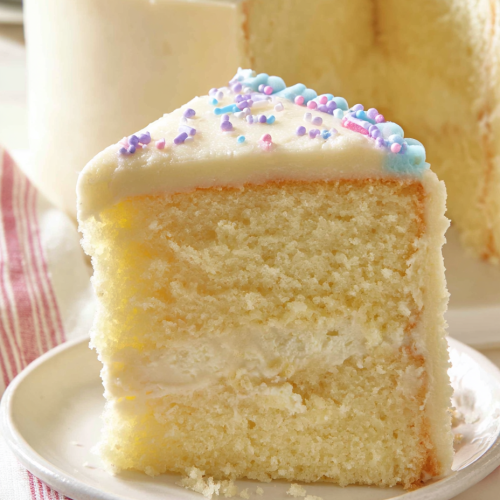
Copycat Costco Vanilla Cake
Want This Recipe Later?
Ingredients
- 2 1/2 cups plus 2 tablespoons cake flour
- 1 1/2 cups plus 2 tablespoons granulated sugar
- 1 tablespoon baking powder
- 3/4 teaspoon fine salt
- 3/4 cup unsalted butter very soft
- 4 large egg whites room temperature
- 1 large egg yolk room temperature
- 1 tablespoon vanilla extract
- 1 cup buttermilk room temperature
- 2 tablespoons water
- 2 tablespoons cornstarch
- 1 cup unsalted butter very soft
- 1/2 cup vegetable shortening room temperature
- 4 cups powdered sugar
- 1/2 teaspoon fine salt
- 1 tablespoon vanilla extract
- 3 to 4 tablespoons whole milk or heavy cream room temperature; start with 3 tablespoons
- 1 batch Copycat Costco Vanilla Mousse prepared according to its recipe
- sprinkles however many seem reasonable
Instructions
- Preheat the oven to 350°F, spray two 8-inch cake pans with baking spray, line the bottoms with parchment paper, and set them aside.
- In a large mixing bowl, combine the cake flour, granulated sugar, baking powder, and salt, then stir briefly so the baking powder is evenly distributed.
- With the mixer running on low, gradually add the very soft butter and mix until all of the butter is worked in and the mixture looks sandy; continue beating for 1 to 2 minutes, then scrape down the sides and bottom of the bowl.
- Add the egg whites gradually, one at a time, beating well after each addition, then beat in the egg yolk and vanilla extract.
- With the mixer on low, add the buttermilk in 3 additions, beating for 1 to 2 minutes after each addition, then divide the batter evenly between the prepared pans.
- Bake for 26 to 30 minutes, until the tops are golden and a toothpick comes out mostly clean with a few moist crumbs; start checking at 26 minutes.
- Let the cakes cool in their pans for 5 minutes, then invert them onto wire racks, remove the parchment, and let them cool completely; for advance assembly, wrap the cooled layers in plastic wrap and refrigerate them.
- For the buttercream, whisk together the water and cornstarch in a small bowl and set it aside, then beat the softened butter and shortening in a large bowl for 3 to 4 minutes until light and fluffy, scraping the bowl as needed.
- Mix in the cornstarch slurry, gradually add the powdered sugar with the mixer on low, scraping as needed, then add the salt and vanilla; if the frosting is too thick, add the milk or cream 1 tablespoon at a time, up to 4 tablespoons total, until spreadable but not droopy.
- If the cake layers have domes, level them with a serrated knife, then put a small dab of buttercream on a cake board or serving plate and set the first layer on top.
- Spoon some buttercream into a pastry bag, pipe a ring around the outer edge of the first layer to form a dam, and fill the center with the prepared vanilla mousse.
- Set the second cake layer on top, frost the outside with the remaining buttercream using an offset spatula to smooth and remove excess frosting, then decorate with any remaining frosting, add sprinkles, and slice.
Notes
Nutrition
Nutrition values are estimates based on the listed ingredients and serving count. Actual values vary with brands, cuts and portion sizes.