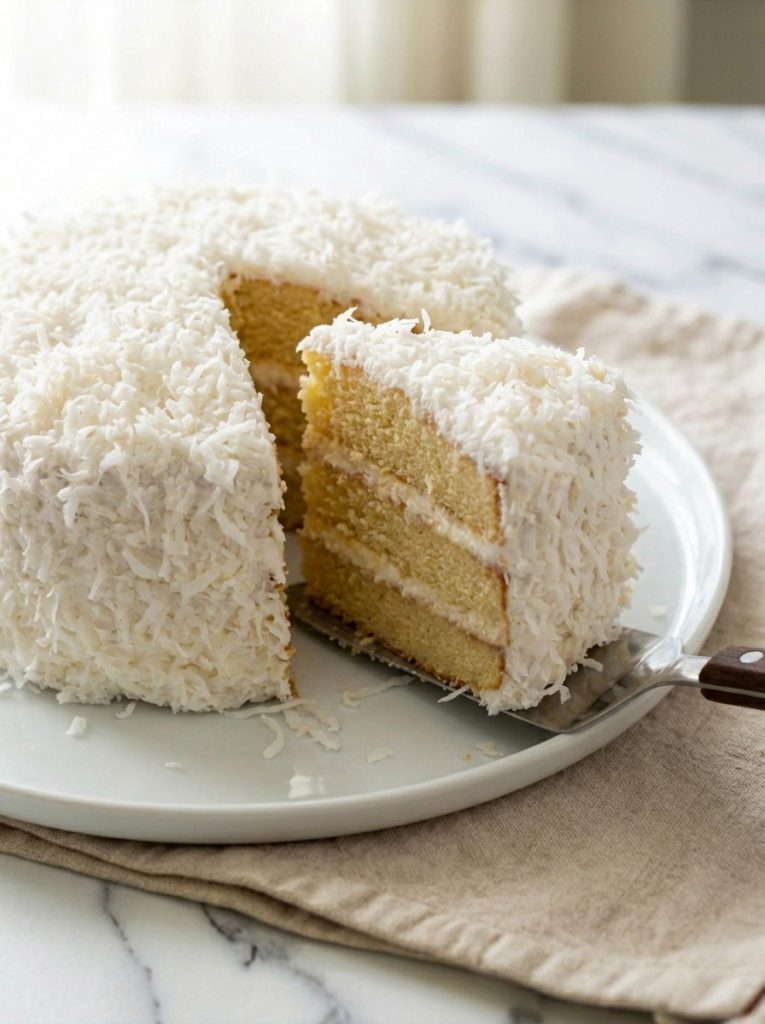
This coconut cake is everything a celebration cake should be — tender, fluffy layers wrapped in a glossy, cloud-like boiled frosting, finished with a generous shower of coconut. It looks like it came straight from a bakery case, but it’s made with simple pantry staples and a little patience. One bite and you’ll understand why it gets requested again and again.
Why You’ll Love It
Bakery-style looks, simple ingredients — three or four fluffy layers and a glossy boiled frosting that look far fancier than the basic pantry staples behind them.
True coconut flavor — coconut extract paired with a generous coating of shredded coconut gives a softer, rounder coconut taste than extract alone. Try our Lady Baltimore Cake next.
A frosting that actually holds its shape — the boiled frosting whips up glossy and stable, so it won’t slide or weep on the cake.
Tastes even better the next day — the layers settle and the frosting sets, making this a great make-ahead cake.
No fancy equipment required — just a mixer and a double boiler, nothing else.
A Few Notes on the Ingredients
Cake flour, not all-purpose — I learned that the hard way, made it with regular flour once around 2011 (or maybe later, I genuinely don’t recall, it was during the year my son had that awful Little League coach) and the texture came out dense, almost bready, nothing like the cloud it’s supposed to be. Don’t skip it. If you like this, you'll love our Date Cookies.
The coconut extract is the secret nobody tells you about. You’d think vanilla alone would do it, but it won’t — there’s a flatness without that half-teaspoon of coconut extract that I can’t put my finger on but can absolutely taste. Buttermilk should be real buttermilk if you can get it, though I’ve used the powdered kind in a pinch and lived to tell about it. Eggs at room temperature, always — Granny used to leave hers out on the counter the night before in a little bowl, which probably horrifies modern food safety people, and which I do anyway because old habits, you know.
What You’ll Need
For the Cake
2¾ cups cake flour (sifted — don’t skip this, I know it feels like an extra step nobody has time for)
1 teaspoon baking powder
a dash of salt, whatever “a dash” means to you
1 cup butter, softened — not melted, not cold, somewhere in between
2 cups granulated sugar
5 large eggs
½ teaspoon coconut extract
1 teaspoon vanilla extract
1 cup buttermilk
For the Frosting
2 cups granulated sugar
2 large egg whites
1 teaspoon cream of tartar
6 tablespoons water
½ teaspoon salt
1 teaspoon vanilla extract
Garnish
shredded coconut, more than you think you need

Directions:
Heat your oven to 350. Sift the flour with the baking powder and that dash of salt and just set it off to the side — I usually do this part first because if I leave it for later I forget and dump unsifted flour straight into the bowl, which I’ve done, more than once, and you can tell. For another easy option, see our I Accidentally Made the Best Cookies of My Life (And They Have Panko in Them).
More recipes you might like


Cream your softened butter with the sugar until it’s smooth — really smooth, longer than feels necessary, your arm will start complaining if you’re doing it by hand, which I did for years before my daughter bought me a stand mixer and changed my whole life. Add the eggs one at a time, beating well after each one — don’t rush this part, this is where the cake either comes together or fights you the whole way through. Mix in your vanilla and that coconut extract.
Now add the flour mixture a little at a time, alternating with splashes of the buttermilk — flour, buttermilk, flour, buttermilk — until it’s all just barely combined. Overmixing here is the mistake I make most often, even now, even after all this time. You want it smooth but you don’t want to beat the life out of it.
Grease and flour three or four 8-inch round pans (four if you want thinner, more delicate layers — Granny always did four, I usually only have pans enough for three and the cake doesn’t seem to mind either way). Divide the batter and bake 20 to 25 minutes, until a toothpick comes out clean. Let them cool completely — and I do mean completely, frosting a warm cake is a disaster I’ve lived through and don’t recommend repeating.
For the frosting, whisk together everything except the vanilla in the top of a double boiler — the sugar, egg whites, cream of tartar, water, salt. Then beat it with a hand mixer right there over the simmering water, briskly, for about three minutes, until it turns glossy and starts holding its shape like a soft meringue. Pull it off the heat and stir in your vanilla. This frosting moves fast once it’s ready, so have your cooled cake layers standing by — there’s no leisurely standing-around-and-deciding-later with this one. You might also like our Patriotic Berry Trifle.
Stack and frost your layers with what Granny always called her never-fail frosting, though I have, in fact, made it fail — once, during a humid July when it just wouldn’t set right and stayed sort of weepy and sad-looking. Live and learn. Sprinkle coconut over the whole thing generously, patting some into the sides too if you’re feeling ambitious.
If You Want to Change Things Up
My daughter Renee makes this with toasted coconut instead of plain, which honestly might be better than the original, though I’d never tell my granny that even now. My sister-in-law swears by adding a splash of rum to the cake batter, but I’ve never tried it — feels like cheating somehow, though I can’t say why. You could lime it up with a touch of lime zest in the frosting if you wanted something brighter, though that’s never been how we make it. Try our Easy Almond Custard Cake next.
Storing It
Keep it covered at room temperature for a couple of days, or in the fridge if your kitchen runs warm — ours does, especially come August. Honestly this cake rarely survives long enough in my house to test the outer limits of its storage life, so I can’t tell you with much authority what day five looks like. I’ve frozen single layers wrapped tight in plastic before frosting, for splitting up birthdays across a busy month, and that’s worked out fine. If you like this, you'll love our Coconut Pie.
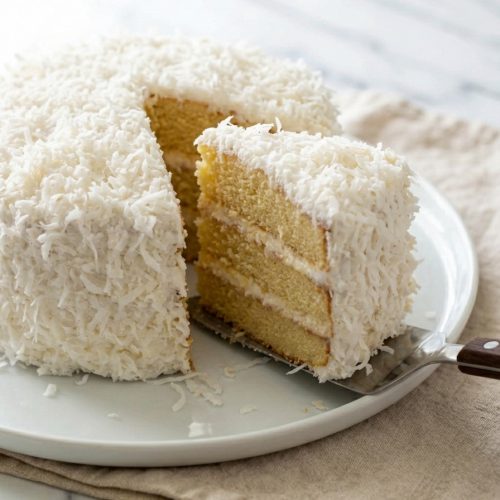
Granny’s Famous Coconut Cake
Want This Recipe Later?
Ingredients
- 2 3/4 cups cake flour sifted
- 1 tsp baking powder
- 1/8 tsp salt
- 1 cup butter softened
- 2 cups granulated sugar for the cake
- 5 large eggs
- 1/2 tsp coconut extract
- 1 tsp vanilla extract for the cake
- 1 cup buttermilk
- 2 cups granulated sugar for the frosting
- 2 large egg whites
- 1 tsp cream of tartar
- 6 tbsp water
- 1/2 tsp salt for the frosting
- 1 tsp vanilla extract for the frosting
- 3 cups shredded coconut or as needed for coating
Instructions
- Preheat the oven to 350°F. Grease and flour three or four 8-inch round cake pans.
- Sift together the cake flour, baking powder, and salt. Set aside.
- In a large bowl, beat the softened butter and granulated sugar until very light and smooth.
- Add the eggs one at a time, beating well after each addition.
- Mix in the coconut extract and vanilla extract.
- Add the flour mixture in several additions, alternating with the buttermilk. Begin and end with the flour mixture and mix only until combined.
- Divide the batter evenly among the prepared pans.
- Bake for 20–25 minutes, until a toothpick inserted in the center comes out clean.
- Cool the cakes in the pans briefly, then transfer them to wire racks and cool completely.
- Combine the sugar, egg whites, cream of tartar, water, and salt in the top of a double boiler set over gently simmering water.
- Beat the mixture with a hand mixer over the heat for about 3 minutes, until glossy, thickened, and able to hold soft peaks.
- Remove the frosting from the heat and beat in the vanilla extract.
- Working promptly, stack the cooled cake layers with frosting between each one.
- Frost the top and sides of the cake, then press shredded coconut generously over the surface.
- Let the frosting set before slicing and serving.
Notes
Nutrition
Nutrition values are estimates based on the listed ingredients and serving count. Actual values vary with brands, cuts and portion sizes.