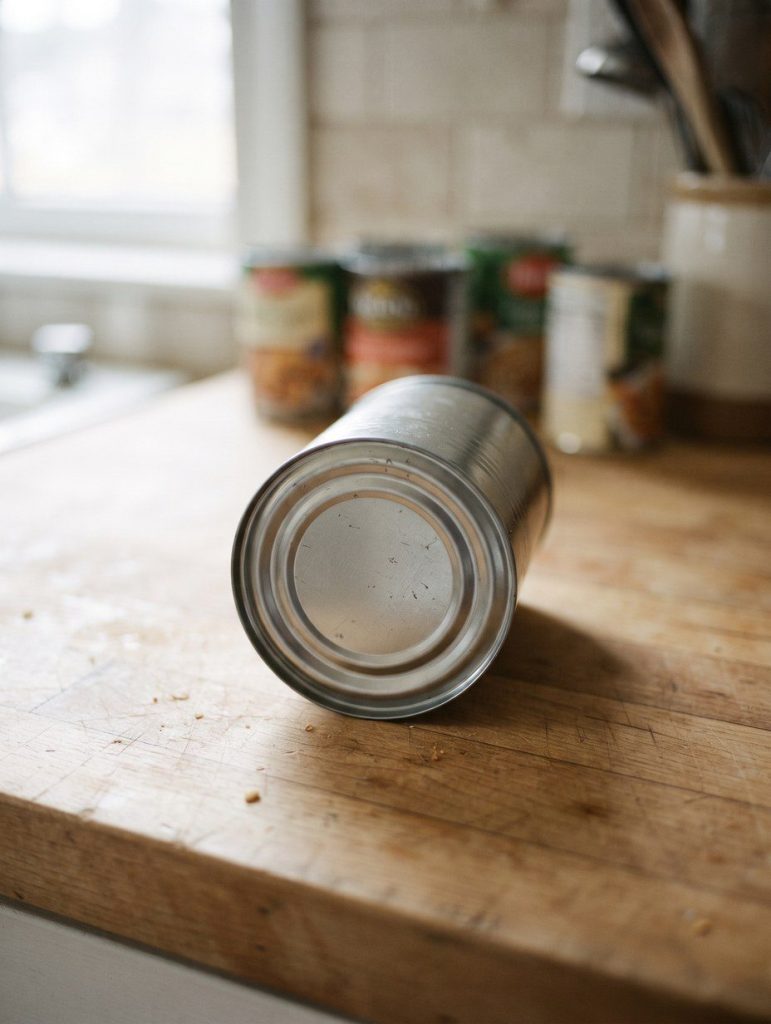
Run your hand over the bottom of a can of soup and you’ll feel it — a shallow dome pushed up into the middle, so the can actually sits on its rim rather than flat on its base.
It looks like a manufacturing shortcut. It’s the opposite. It’s one of the most deliberate bits of design in your cupboard, and it’s also a safety signal.
Why the Bottom Is Domed
Canned food is heated inside the sealed can to sterilise it. Heating makes the contents expand; cooling makes them contract. The can has to survive that, twice, without splitting.
A flat sheet of metal has nowhere to go. A domed one flexes — it can move in and out slightly, like a spring, and absorb the pressure change.
It also makes the can far stronger for its weight. An arch carries load better than a flat panel, which is why bridges and cathedrals use them. That’s how a thin aluminum can survives being stacked six deep on a pallet.
The Part That Matters for Safety
Because that dome flexes with pressure, it tells you what’s happening inside the can.
Pushed in, slightly concave — normal. A properly sealed can has a mild vacuum inside, which pulls the ends in a little. That’s what you want to feel.
Bulging outwards — do not open it. Something inside is producing gas. That means bacteria are active, and in the worst case that means botulism. A bulging can goes in the bin unopened. Don’t taste it, don’t smell it, don’t try to relieve the pressure.
Clicks in and out when you press it — be careful. A can end that pops like the lid of a jar is sometimes just a dent, but it can also mean the seal has been compromised. If in doubt, throw it.
The dome is a pressure gauge you already own.
The Other Thing It Does
It lets cans stack. The ring at the bottom of one can sits neatly into the rim at the top of the one below, which is why a stack of tins in a cupboard doesn’t slide.
And it gives the can a defined edge to sit on, so it doesn’t rock on an uneven shelf.
Dents: Which Ones Matter
People throw away perfectly good cans and keep dangerous ones, usually the wrong way round.
A dent in the flat side of the body is almost always fine. The seal isn’t there.
A dent on a seam — the top rim, the bottom rim, or the vertical side seam — is the one to worry about. That’s where the can is sealed, and a sharp crease there can open a path for bacteria you’d never see.
The rule I use: if you can rest your fingertip in the dent, it’s deep. If it’s on a seam, it’s out.
And Rust
Light surface rust on the outside wipes off and doesn’t matter. Rust that has pitted the metal, or any rust around a seam, means the barrier is going. That one’s out too.
Worth Thirty Seconds
Next time you’re in the cupboard, run a hand over the bottoms of a few cans. You’re feeling for anything that bulges out instead of pulling in.
It’s a thirty-second check on a shelf full of food, using a piece of design that has been quietly doing the job since long before anyone told us about it.