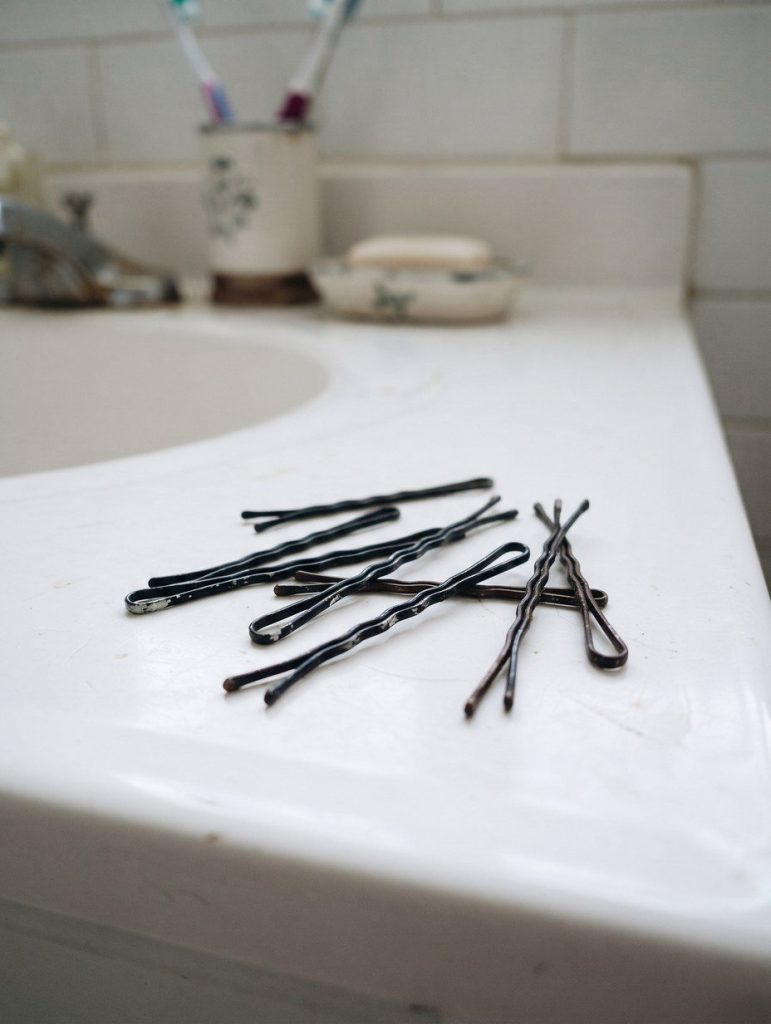
A bobby pin has one flat side and one side with waves in it. Almost everybody puts them in flat side down, and almost everybody is doing it backwards.
Wavy Side Goes Against Your Head
The waves are the grip. They’re what press into the hair and hold it. The flat side is the smooth outer face.
Put the wavy side down against your scalp and the pin bites. Put it up and the pin has nothing to hold on to — which is why they slide out after twenty minutes and you spend the day finding them on the floor.
Flat side out also looks tidier, because the smooth face is the one on show.
It’s a two-second change and it’s the difference between a pin that stays put all day and one that doesn’t.
Two More Things That Make Them Hold
Spray them first. A quick spritz of hairspray or dry shampoo on the pin — not the hair — gives it grip. Slippery clean hair is the hardest to pin; pins work far better on second-day hair.
Cross two in an X. One pin holds a section. Two crossed over each other lock it. This is how it’s done backstage and it holds through a whole day.
The Other Thing People Get Wrong
Push the pin in pointing toward the section you want held, not away from it. The pin should be capturing hair and pinning it down onto something, not just sitting in it.
And take the smallest section you can. A pin trying to hold a thick rope of hair will lose.
Why They’re Called Bobby Pins
From the bob — the short haircut that arrived in the 1920s. Cutting hair short suddenly created a need for something small and discreet to hold pieces in place, and the bobby pin was the answer.
They’ve barely changed since. A shape that works tends not to need improving.
Where They All Go
Everyone owns a hundred and can find two. A few things that help:
Keep them on a magnet. A small magnetic strip inside a bathroom cabinet door, or a magnet in a drawer. They’re steel and they’ll stick, and you can see them all at once.
Not in the bottom of a bag. That’s where they go to be lost.
Retire the bent ones. A pin that’s been prised open too many times has lost its spring and won’t hold. That’s usually why a pin fails, not the way you put it in.
A Few Other Uses
Because people keep finding them:
Threading a drawstring back through a waistband — clip the pin onto the cord and feed it through. Marking your place on a roll of tape so you can find the end. Cleaning grout or the tight corner of a window frame. Holding a zip pull that’s lost its tab.
None of that is what they were made for. All of it works.
Try It Tomorrow
Next time you pin your hair back, turn the pin over so the wavy side is against your head.
It is the smallest possible change and it is the reason yours have been falling out.