The short answer: it made cleanup easier and kept crumbs in one place, but it also trapped grease, slightly wobbled, and left me with enough heat questions that I pulled it out on day 14.
The idea seemed harmless. My toaster oven sits on a busy stretch of laminate counter, and I’d noticed faint grease specks behind it and a heat haze after long bakes at 400°F. A spare wooden board looked like a decent sacrificial layer — catch the mess, protect the counter, maybe slide out easier for cleaning. So this July, I tested it for two straight weeks. Some of it worked. Some of it didn’t.
The setup
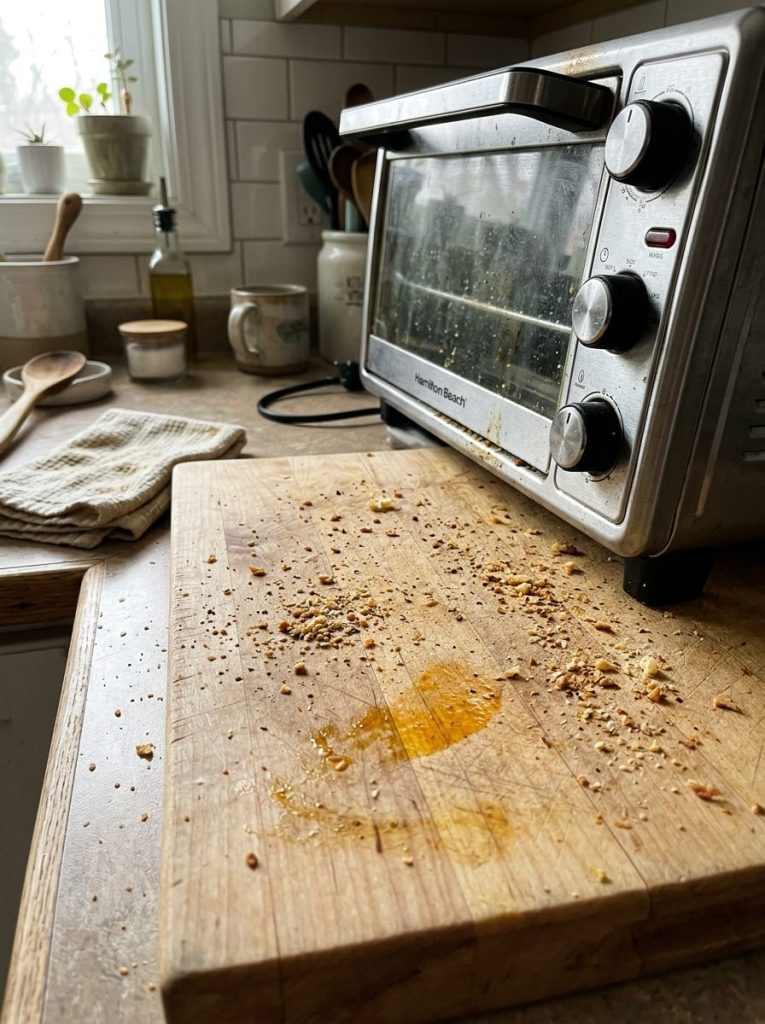
The toaster oven is a standard countertop model, about 17 inches wide and 14 deep, with rear and side vents. The board was untreated maple — not bamboo — roughly 18 by 12 inches and three-quarters of an inch thick, with no rubber feet and no juice groove. I centered the oven on it, left 4 inches of clearance behind, 3 on each side, and open space above.
I used the oven at least once a day for 14 days, and two or three times on 10 of those days. Toast, reheated pizza, chicken tenders, tater tots, biscuits, open-face melts. Temperatures ran from 300°F to 425°F, and the longest single session was 32 minutes.
What got better right away
Cleanup was the clear win. Normally, cleaning under the toaster oven means unplugging it, dragging it forward, wiping the greasy dust ring, and working around the feet — a 7- to 8-minute chore. With the board, I lifted one surface and wiped it down in about 2 minutes.
Crumbs behaved better too. Instead of scattering into the counter seam every time someone yanked out toast in a hurry, they landed on the board. Over two weeks it collected bread crumbs, cheese drips from a leaky melt, an orange oil spot from pepperoni pizza, and a dusting of salt from frozen fries. All of that would have been ground into the counter finish instead.
It also looked nice. The wood framed the appliance and softened all that metal and plastic. Small thing, but I noticed it every morning.

The heat question
I checked the board with the back of my hand after every session — front, center, rear edge. After longer bakes it was warm, especially the back half, but never too hot to rest my hand on. After 425°F runs for frozen food, the underside stayed noticeably heated for 10 to 15 minutes.
No scorching, no dark marks, no cracking in 14 days. But here’s the part that matters: toaster ovens push concentrated heat out of their vents, and every model vents differently. Wood is combustible, and it holds and traps heat differently than stone, tile, or a mat designed for appliances. “Warm but fine in my kitchen” tells you nothing about how your oven behaves on yours.
The problems that crept in
By day 5, a faint sticky film had formed near the back edge of the board, right where warm air and cooking particles settle. You couldn’t see it, but you could feel it. Because the wood was unfinished, I couldn’t soak it — it would have turned into a grease sponge. So I wiped it nightly and gave it a real clean every 3 days. Skip that, and I think it would have smelled stale by the end of the two weeks.
Then there was the wobble. The board had a slight natural warp, maybe a few millimeters, invisible when I chopped vegetables on it. Under an appliance, it mattered. The oven rocked a touch when I pressed on the open door to load a heavier dish — not what you want with a bubbling casserole on the door rack. I fixed it by rotating the board and sliding a thin silicone liner underneath, but my “simple fix” was turning into a managed project.
By day 10 I noticed a lingering “cooked kitchen” smell — warm wood plus summer humidity plus grease. And a faint darker rectangle had formed where the oven’s feet sat, from heat and pressure combined. When a blob of melted cheese wedged itself between a foot and the board on day 8, cleaning it out was fussier than wiping a smooth counter ever was.
One more surprise: the board extended about an inch past the oven’s base, and that visual border made the whole appliance look bigger. My daughter asked on day 3 why the toaster oven had grown. Fair question.
The safety part, plainly
Before you put anything under a toaster oven, read the manual. Many manufacturers call for a hard, heat-resistant, open surface with clear airflow, and some say directly not to place the appliance on or near certain materials. If your manual says no, that’s your answer. If your oven runs hot underneath, has damaged feet, or the vents sit close to the base, that’s your answer too. Convenience is never worth adding uncertainty around a heating element.
What I’d use instead
If I did this again, a regular cutting board wouldn’t be my first choice. A heat-resistant mat made for appliances, a metal tray with proper clearance, or a large tile all make more sense, depending on the model. If you’re set on wood for the look, pick a board that’s thick, perfectly flat, and big enough that all four feet sit fully supported — and keep every vent unobstructed with at least 3 to 4 inches of open space around the machine.
Honestly, the simplest fix is the boring one: pull the oven forward once or twice a week and wipe underneath with a degreasing cloth.
What I’m doing now
The board came out on day 14. It solved a real problem — crumbs and cleanup — but introduced new ones: grease absorption, extra maintenance, a wobble, and heat questions I couldn’t fully answer. For a busy kitchen with kids and distracted adults moving through, I want fewer variables around a hot appliance, not more. So the toaster oven is back on the counter it was designed for, with breathing room on all sides, an emptied crumb tray, and a weekly wipe underneath. Less charming. Better trade.