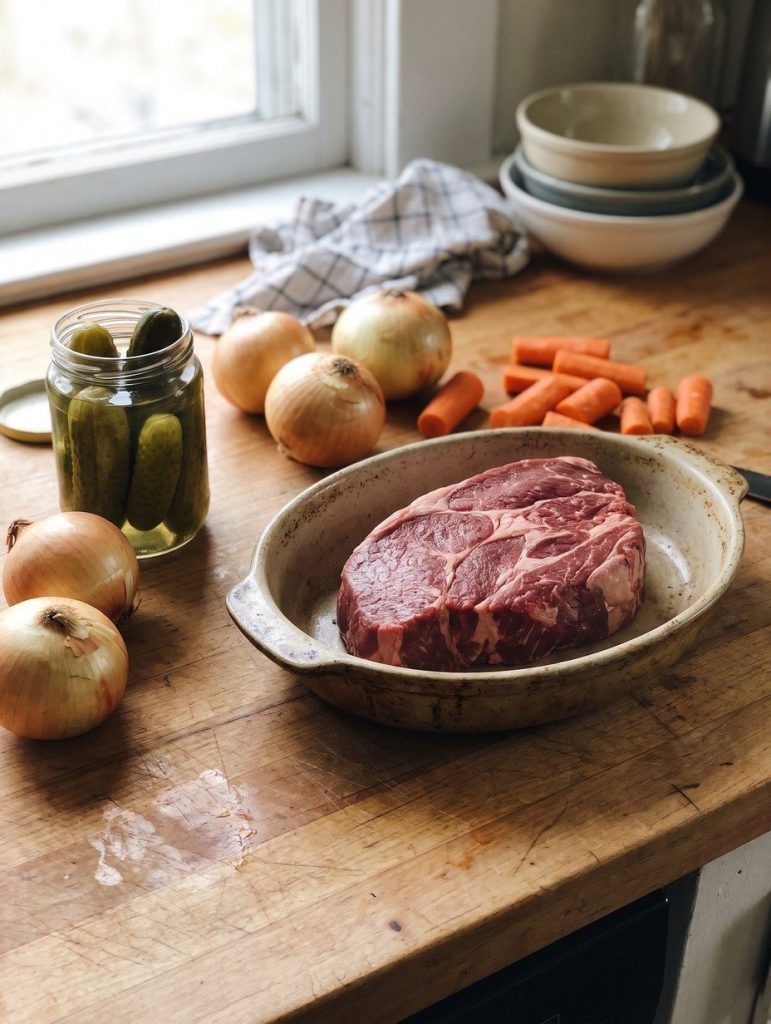
The first time I did this I was out of beef broth and had a chuck roast already sitting in the pan. What I had was most of a jar of dill pickles and the juice they were swimming in.
I poured in about half a cup, topped the rest up with water, and put the lid on expecting the worst.
That roast is the reason my mother-in-law asked me for a recipe for the first time in eleven years.
What Pickle Juice Actually Does to Meat
Two things, and they’re both real.
The acid loosens the meat. Pickle brine is mostly vinegar and water. Acid works on the proteins on the surface of a piece of meat, weakening the structure so it gives way more easily. It’s the same principle behind a buttermilk marinade or a lemon marinade — pickle juice just happens to be free and already in your fridge.
The salt does the heavier lifting. Pickle brine is a salt solution, which means it’s a brine in the technical sense. Salt helps muscle fibers hold onto water during cooking. That’s why a brined turkey is juicier, and it’s why a roast that’s had a few hours in salty liquid comes out less dry.
The dill and the garlic in the jar come along for free.
How I Do It Now
For a three to four pound chuck roast:
Sear it hard on all sides first. Don’t skip this — the brown crust is where most of the flavor comes from and the liquid won’t give you one.
Then add half a cup of dill pickle juice and top up with beef broth to about a third of the way up the roast. Onions, carrots, a bay leaf.
Low and slow until it falls apart — about three hours in a 300°F oven, or eight on low in a slow cooker.
Half a cup is the number I’d start with. It’s enough to do the work and not enough to announce itself.

Does It Taste Like Pickles?
No — and this is the part people don’t believe until they try it.
At half a cup in a pot that size, spread over hours, what you get is a savory, slightly tangy background that cuts through the richness of the beef. It tastes like a roast someone knew what they were doing with.
Go to a full cup or more and yes, it starts to read as pickle. That’s a different dish and some people like it, but it isn’t what I’m after.
Use Dill, Not Sweet
This matters more than the amount.
Dill pickle juice is vinegar, salt, garlic and dill. All of that belongs near beef.
Bread-and-butter or sweet pickle juice is loaded with sugar. In a long braise that sugar concentrates and you end up with a gravy that tastes faintly of candy. I’ve done it. Once.
Spicy dill works well if you like a bit of heat in the background.
Where Else It Earns Its Keep
Chicken. This is the famous one — a few hours of pickle brine before frying is the open secret behind a lot of very good fried chicken.
Don’t go past four hours on chicken. The acid keeps working and the texture eventually goes soft and chalky.
Pork. Pork shoulder takes to it the same way beef does.
Potato salad. A splash in the dressing, or over the warm potatoes before anything else goes in.
Deviled eggs. A teaspoon in the yolk mixture instead of some of the vinegar.
Stop Pouring It Down the Sink
That jar of brine is a seasoned, salted, garlicky acid that you have already paid for.
Next roast, use half a cup of it instead of half a cup of stock. Change nothing else. Then see whether anyone can tell you what’s different.