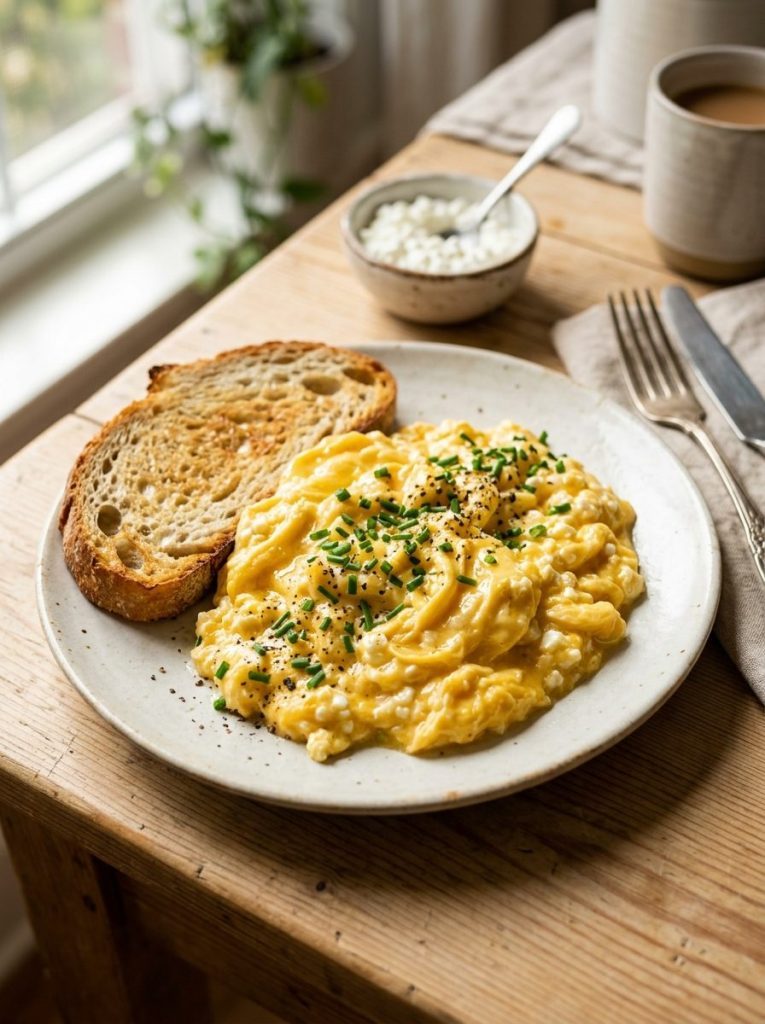
The short answer: it works. Stirring cottage cheese into beaten raw eggs gives you softer, creamier, fluffier scrambled eggs in about five minutes — and they taste richer, not like cottage cheese.
I went in skeptical. It sounded like one of those internet tricks that photographs better than it eats. But standing at the stove with a spatula in one hand, I watched the curds nearly melt into the eggs, leaving behind a scramble that was tender, glossy, and noticeably more filling than my usual. Here’s exactly what I did, what happened, and the ratio I’d use again.
The Ratio That Worked
I used 3 large eggs and 1/4 cup of cottage cheese, plus a small pinch of kosher salt, a few cracks of black pepper, and 1 teaspoon of butter for the pan. That ratio turned out to be the sweet spot: enough cottage cheese to change the texture, not so much that the eggs turned wet or lumpy.
As a scaling rule, figure 1 tablespoon of cottage cheese per egg for a subtle effect, or 2 tablespoons per egg for maximum creaminess. Push past 1/3 cup for 3 eggs and the scramble gets too loose — you’ll have to cook it longer, which defeats the whole purpose.
Full-fat cottage cheese (around 4%) melts in the smoothest and tastes the creamiest. Two percent works but releases a bit more moisture. I’d skip fat-free here; it turns slightly chalky once heated. Small curd blends in easiest, while large curd leaves more distinct pockets — not bad, just different.

What Happens in the Pan
I whisked the eggs and cottage cheese together with a fork for about 30 seconds. Not smooth — just curds loosely distributed through the eggs. If you want a completely uniform texture, a 10- to 15-second blitz in the blender does it, but I liked leaving mine slightly rustic.
The mixture looks thick and pale yellow with white curds throughout. It is not elegant. Ignore that. What eggs look like in the bowl tells you almost nothing about what they’ll look like on the plate.
Into an 8-inch nonstick skillet over medium-low heat with the butter melted and foamy, the whole thing took right around 5 minutes. The eggs set more slowly than a plain scramble, in a good way — they stayed glossy and formed larger, gentler curds. The cottage cheese didn’t sit there in obvious clumps like I expected. It warmed through and almost melted, leaving pockets of creaminess instead. Pull the pan off the heat while the eggs still look slightly wet; they keep setting for another 30 seconds on the plate.
What It Tastes Like
I braced for tang, or at least a flavor that announced the ingredient. Neither showed up. The eggs tasted richer and a little more savory, with a texture closer to what you’d get from a spoonful of ricotta or a splash of cream — but with more body.
If someone ate these without watching me cook, I don’t think they’d guess what was in them. They’d just say the eggs were especially creamy. That’s useful if you live with anyone who claims to hate cottage cheese but happily eats it when it disappears into something else. Blend the mixture smooth first and even the visible evidence is gone.
Why It Works
Eggs overcook fast. When they do, the proteins tighten and squeeze out moisture, and you get a dry, rubbery scramble. The added dairy cushions that process, so the eggs stay soft longer. Plain scrambled eggs can go from perfect to overdone in about 45 seconds; these gave me real breathing room, which matters when you’re making breakfast while packing a lunch.
There’s also the nutrition math. A 1/4-cup of cottage cheese adds roughly 6 to 7 grams of protein, depending on the brand. Three eggs already give you about 18 grams, so you’re at 24 to 25 grams before toast or fruit enters the picture. For 30 extra seconds of work, that’s an efficient breakfast.
Mistakes to Avoid
The biggest one is heat that’s too high. If you rush these, the watery part of the cottage cheese can separate into a puddle before the eggs set. Medium-low is the ceiling.
Second, go light on salt at the start. Cottage cheese already contains sodium, and some brands are much saltier than others. A small pinch now, adjust at the table.
Third, stop stirring so much. Constant, frantic stirring shreds the curds into tiny bits and leaves you with a fine, dense scramble. Slow folds every 15 to 20 seconds give you the big, fluffy curds you’re after.
How I’d Make It Again
This is the exact version I’d repeat on a normal weekday:
- Whisk 3 eggs with 1/4 cup cottage cheese, 1/8 teaspoon kosher salt, and black pepper.
- Melt 1 teaspoon butter in an 8-inch nonstick skillet over medium-low heat until foamy but not browned.
- Pour in the eggs and let them sit for 20 to 30 seconds.
- Slowly push the edges toward the center with a spatula, then keep folding gently every 15 to 20 seconds.
- Cook 4 to 5 minutes total, and pull them while they still look slightly glossy.
From there, they’re good plain, better with chopped chives and a little shredded cheddar, and very good piled on sourdough toast with sliced tomatoes and avocado. A spoonful of salsa works surprisingly well if you want something brighter. On a chaotic morning, wrap them in a tortilla and call it done.
The Bottom Line
Five minutes later, what happened was just better scrambled eggs — not weird eggs, not obviously cheesy eggs. Creamier, fluffier, softer, and more filling than the effort involved.
If you’ve got eggs and a tub of cottage cheese in the fridge, start with 1 tablespoon per egg tomorrow morning and adjust from there. It takes one bowl, one pan, and maybe 30 extra seconds. Some viral food tricks earn the repetition. This one does.