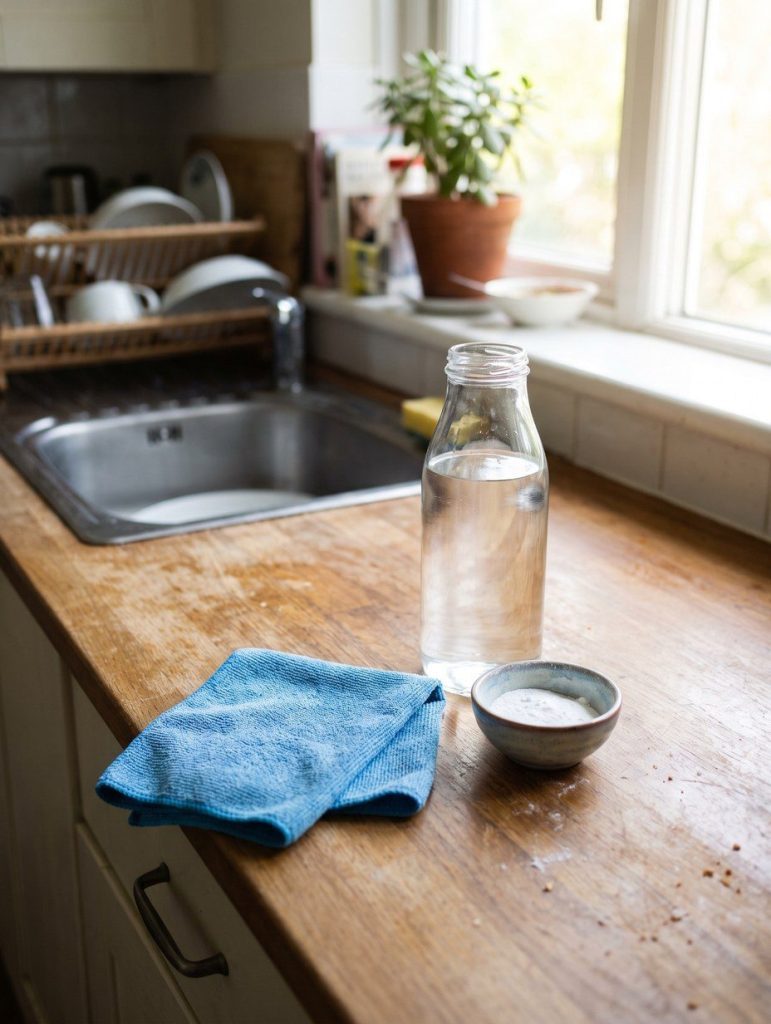
There is a jug of white vinegar under my sink that cost less than a coffee and has cleaned more of this house than any product I’ve ever paid real money for. Windows, coffee maker, the inside of the microwave, the crusty showerhead. It earns its place.
So I’ll be honest with you: for years I treated it as the answer to everything. Anything grimy got vinegar. And a few things in this house are permanently worse because of it.
Here are the six places I’ve learned to leave it alone.
1. Granite, Marble and Any Natural Stone

This is the expensive one, and it’s the one I learned by doing.
Vinegar is an acid. Granite, marble, travertine and limestone are all calcium-based, and acid eats them. Not dramatically — you won’t see a hole. What you get is etching: dull, cloudy patches where the shine used to be, usually right where you wiped hardest.
And it doesn’t polish out. Stone has to be professionally refinished to fix it.
Use warm water with a drop of mild dish soap on stone counters. That is genuinely all they need.
2. Cast Iron
That black, slick, non-stick surface on a well-loved cast iron pan is seasoning — layers of oil that have been baked on until they polymerised into something close to varnish.
Vinegar strips it. A long soak can take you right back to bare gray metal, and then the rust starts.
There is one exception worth knowing: if a pan is already rusted through and you’re restoring it on purpose, a vinegar-and-water soak is the standard first step. But that’s demolition, not cleaning.
For everyday, hot water and a stiff brush, dried on the stove, and a wipe of oil.
3. Hardwood Floors
You’ll find a hundred blogs recommending vinegar and water for wood floors. I used it for years.
What it actually does is slowly dissolve the polyurethane finish. The floor looks fine at first, then starts looking flat and tired, and eventually water starts getting into the wood itself because the protective layer is thinner than it should be.
Use a cleaner made for your floor’s finish. It costs more than vinegar. It costs a great deal less than refinishing a floor.
4. Screens — Phones, TVs, Laptops
Modern screens have an oleophobic coating on them. It’s the reason fingerprints wipe off with a dry cloth and the reason the glass feels slightly slippery.
Vinegar breaks that coating down. Once it’s gone, every fingerprint sticks and smears, and there’s no putting it back.
A dry microfibre cloth handles almost everything. For the rest, distilled water on the cloth — never sprayed at the screen.
5. Rubber Seals and Gaskets
The rubber gasket around your dishwasher door, the seal on the fridge, the ring inside a front-loading washing machine — these are exactly the spots that get grimy, so they’re exactly where people reach for vinegar.
Repeated acid exposure makes rubber dry, brittle and cracked. A cracked seal on a washing machine door is a leak waiting to happen, and it is not a cheap part.
Warm soapy water and an old toothbrush. It takes two minutes and does the job.
6. Knives — and Anything with a Glued Handle
Two problems here. Vinegar pits carbon steel blades, leaving them dull gray and more prone to rust. And on knives with wooden or riveted handles, it works its way into the glue and the joint, and eventually the handle loosens.
Wash knives by hand in warm soapy water and dry them immediately. That’s the whole ritual, and good knives will outlive you if you keep it.
The Rule I Use Now
Vinegar is brilliant on mineral deposits — limescale, hard water spots, coffee maker gunk, the showerhead. That’s what it’s actually for, and there’s nothing better.
It is not a degreaser and it is not a disinfectant, and on stone, wood, rubber and coated glass it is quietly destructive.
Now I ask one question before the bottle comes out: is this a mineral problem? If yes, vinegar. If no, soap and water.