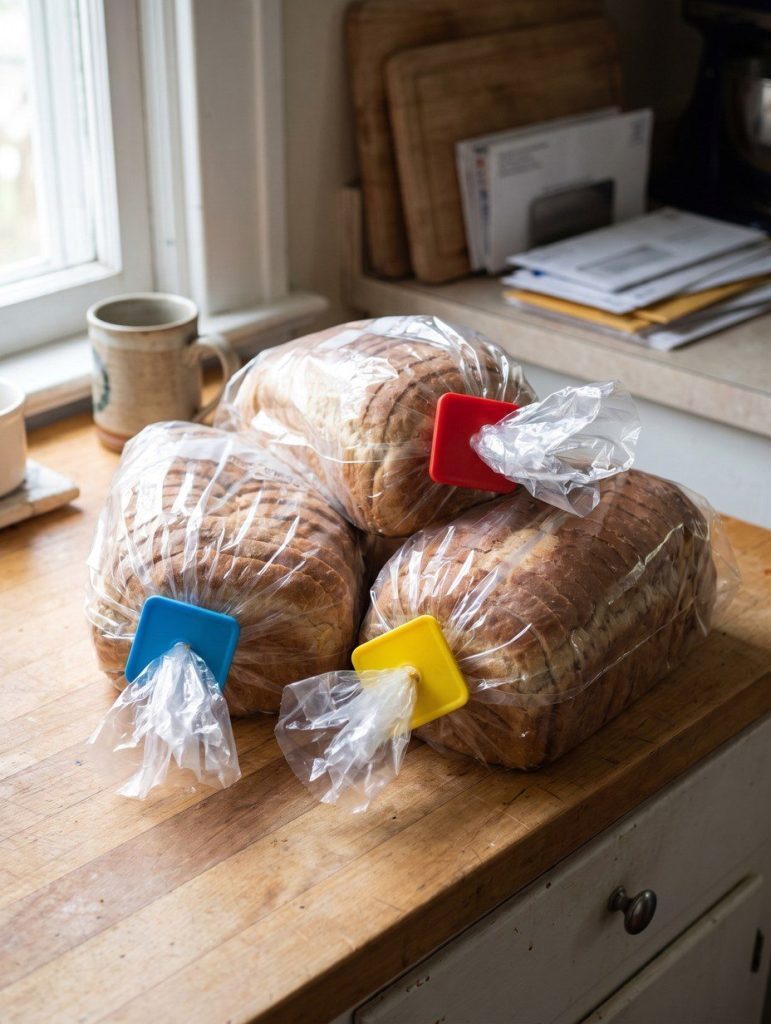
I bought bread for about thirty years before I noticed the tags weren’t always the same color.
I’d been treating them as packaging — whatever plastic clip the factory happened to have that morning. Then a friend who’d worked in grocery retail told me to check the color next time, and I have looked at every loaf I’ve bought since.
The Color Is a Code
At a lot of American bakeries, the color of the tag or twist tie tells you which day of the week the bread was delivered to the store.
The common version runs alphabetically by the name of the day, which is what makes it possible to remember at all:
- Blue — Monday
- Green — Tuesday
- Red — Thursday
- White — Friday
- Yellow — Saturday
Blue, green, red, white, yellow. In alphabetical order. That’s the whole system.
Wednesday and Sunday are usually missing because most bakeries don’t deliver fresh bread every day of the week.

Why It Exists at All
It was never meant for you. It’s for the person stocking the shelf.
A delivery driver arriving on Thursday can look down a shelf, see a blue tag, and know instantly that the loaf has been sitting there since Monday. It gets pulled without anyone having to read a single date.
It’s a system built for speed, at arm’s length, in a hurry. Color reads faster than print.
How to Actually Use It
Stand in front of the bread and look at what colors are on the shelf.
If today is Friday and you can see both red tags and white tags, the white ones came in today and the red ones have been there since Thursday. Take white.
That’s it. You don’t need to memorise the whole table — you just need to know the order, and take the tag that’s furthest along it.
The loaves at the front are usually the oldest, by the way. Stores rotate stock forward on purpose. The fresh bread tends to be pushed toward the back.
An Important Caveat
This is a convention, not a law. Nobody is required to follow it.
Plenty of bakeries use it. Some use their own color order. Some use the tags purely as branding and the color means nothing at all. Store-brand bread baked in-house often doesn’t use the system.
So treat it as a useful hint rather than a guarantee. If there’s a printed date on the bag, that date wins — it’s the thing the bakery is actually standing behind.
Where the color earns its keep is when two loaves have the same printed date, which happens constantly. Then the tag is the only thing that tells them apart.
What the Printed Date Means
While we’re here, because this trips people up: the date on a loaf of bread is almost always a “best by” date, not a safety date.
It’s the bakery telling you when the bread stops being at its best. It is not the day it becomes unsafe. Bread that’s a day or two past is usually fine — it’s just drier.
What you actually watch for is mold, and mold doesn’t care about the date at all. If you see any, the whole loaf goes. Mold in bread sends threads through the slices you can’t see.
One Last Thing About Keeping It
Don’t put bread in the fridge. It feels like the right move and it isn’t — cold speeds up the process that makes bread go stale, so refrigerated bread goes hard faster than bread on the counter.
Counter for a few days. Freezer for anything longer. The freezer stops staling almost completely, and a frozen slice toasts straight from the bag.
Worth Ten Seconds
Next time you’re at the bread shelf, look at the tags before you look at the dates. Once you know the order, you’ll never reach for the front loaf again.