Some wooden spoons have a notch cut into one side of the handle, up near the top. Others have a flat cut across one edge of the bowl.
I owned several for years and assumed they were decorative, or just where the wood had been shaped. Both have a job.
The Notch in the Handle Is a Pot Rest
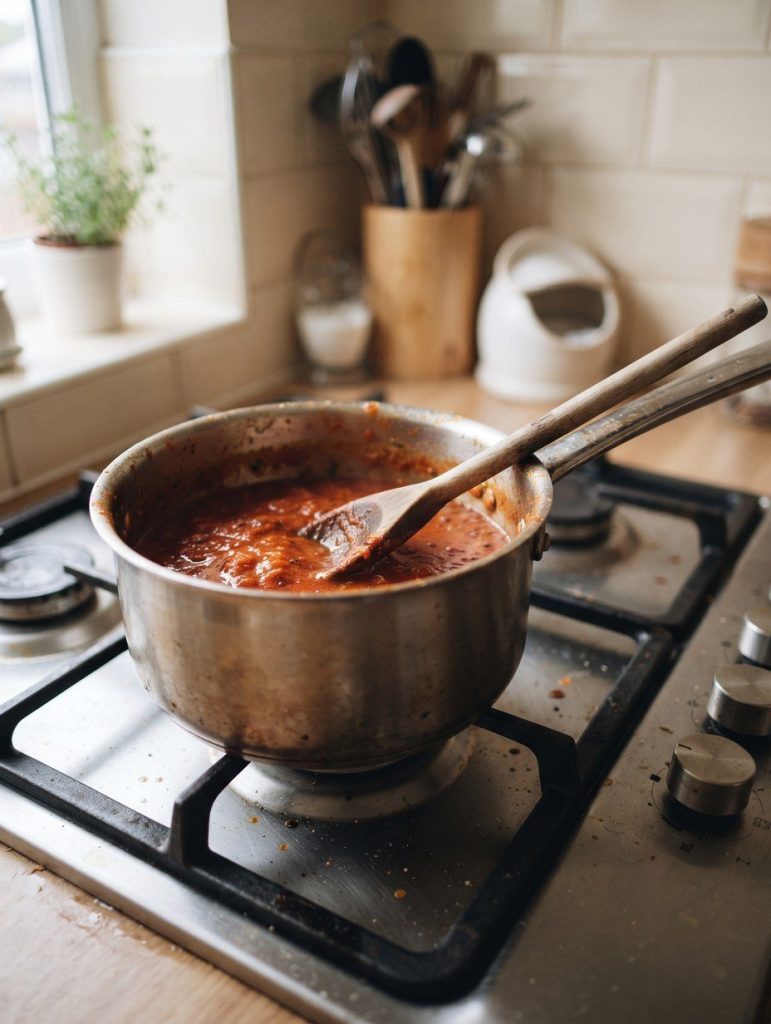
The notch sits over the rim of a pot so the spoon hangs on the edge instead of sliding down into whatever you’re cooking.
It’s the answer to the thing that happens to everyone — you leave the spoon in the pot for a minute, come back, and the handle has disappeared under the sauce.
Rest the notch on the rim and the spoon stays put, the handle stays clean, and it doesn’t go anywhere when the pot bubbles.
The Flat Edge on the Bowl Is a Scraper
A lot of good wooden spoons have one side of the bowl cut flat rather than rounded.
That flat edge is for the corner where the side of the pan meets the base — the exact spot where onions catch and a sauce starts to stick. A round spoon skates over it. A flat edge gets underneath.
It’s also the right shape for scraping up the browned bits after searing meat, which is where most of the flavor in a pan sauce comes from.
If your spoon has a flat side, turn it so the flat is against the pan when you’re deglazing.
The Hole in the Middle of Some Spoons
Another one people assume is decorative.
It lets liquid pass through while you stir, so you’re moving the food rather than pushing a wave of sauce around the pan. It makes stirring a thin soup or a risotto noticeably easier.
It also makes the spoon lighter and means less surface for food to cling to.
Why Wooden Spoons at All
Worth saying, because plastic and silicone have mostly taken over.
Wood doesn’t conduct heat, so the handle stays cool no matter how long it sits in a pot. It won’t scratch a non-stick surface. It won’t melt against the side of a pan. And it doesn’t react with acidic food the way some metals do.
The trade-off is that wood is porous, which is where people worry — but research has generally found wooden boards and spoons no worse than plastic for bacteria, as long as they’re washed and properly dried.
How to Keep One Alive
Hand wash, and dry it standing up. A wooden spoon left lying in a puddle is how you get a cracked one.
Never the dishwasher. The heat and the long soak split the grain. This is the single thing that kills most wooden spoons.
Oil it now and then. Food-grade mineral oil, rubbed in and left overnight, every month or two. It stops the wood drying out and going gray and rough.
Retire it when it cracks. A split holds food and water and can’t be cleaned properly.
Go and Look at Yours
Pull the wooden spoons out of your drawer and look at the handle and the bowl edge.
If there’s a notch, hang it on the pot. If there’s a flat side, turn it to the pan. Two habits that take no effort and fix small daily annoyances you’d stopped noticing.