I want to be clear about something before we go any further: this does not make your chili taste like coffee.
I know how it sounds. I thought the same thing when a cook I worked beside years ago stirred a spoonful of instant coffee granules into a pot the size of a sink and didn’t even look up.
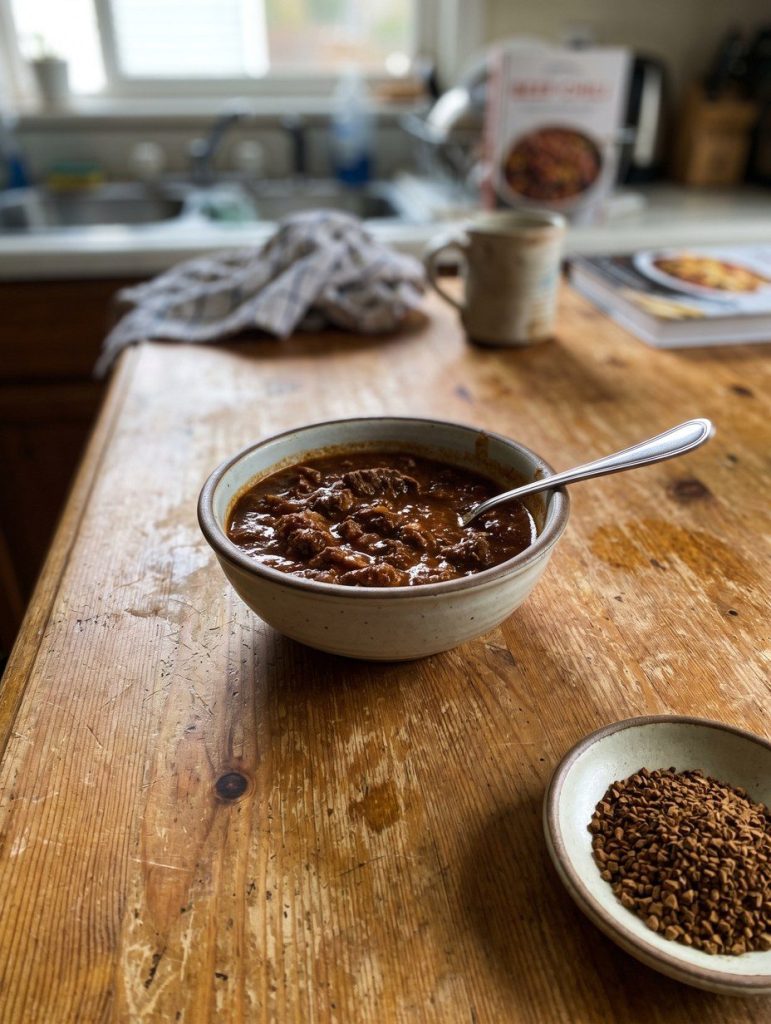
I made my own pot that weekend. Same recipe I’d made a hundred times. One spoonful of instant coffee. Three hours later my husband asked what I’d done differently, and he could not tell me what it was.
What It Actually Does
Coffee is bitter and dark and slightly roasted-tasting. Chili is sweet from the tomatoes and the onions, warm from the spices, and rich from the fat in the beef.
Add a small amount of bitterness to something sweet and rich and it doesn’t read as bitter. It reads as depth. The sweetness stops being the loudest thing in the bowl and the whole pot tastes like it’s been simmering twice as long as it has.
Cooks do the same thing with unsweetened cocoa, with a square of dark chocolate, with a splash of soy sauce. Coffee is the cheapest version of that trick and it’s already in most kitchens.

How Much, and When
For a pot serving six to eight: one tablespoon of instant coffee granules, or half a cup of strong brewed coffee in place of half a cup of the stock.
Start there. You can always add more at the end; you cannot take it out.
Put it in early, with the tomatoes and the spices, so it has the whole simmer to settle in. Coffee added at the last minute tastes like coffee. Coffee added at the start tastes like nothing you can name.
If you’re using brewed, use it strong and unsweetened. No cream, obviously.
The Mistake to Avoid
Too much. Two tablespoons in a small pot and suddenly it is coffee chili, and there’s no fixing that.
The whole point is that nobody should be able to identify it. If a person at your table says “is there coffee in this?”, you’ve gone too far.
Also: don’t use flavored coffee. Hazelnut chili is a real thing that can happen to you and it should not.
What Else It Works In
Once you understand what it’s doing, you start seeing where else it fits.
Beef stew. Same logic, same amount. It makes the gravy taste darker.
Pot roast. Replace part of the beef broth with strong black coffee. This is an old trick and it’s a good one — the acidity helps the meat along too.
Barbecue sauce. A splash of coffee in a homemade sauce gives you that smoky back-note without a smoker.
Chocolate cake. This one is nearly universal among bakers. Hot coffee instead of hot water in the batter. It doesn’t taste like coffee; the chocolate just tastes more like chocolate.
If You Don’t Want to Use Coffee
A tablespoon of unsweetened cocoa powder does almost the same job in chili. So does a square of very dark chocolate stirred in near the end.
A splash of soy sauce or Worcestershire goes at it from a different angle — that’s savory depth rather than bitter depth — and honestly, a pot with coffee and a little Worcestershire is the best chili I make.
Why It’s Worth Trying Once
Most chili recipes are already good. The difference between a good pot and one people ask about is usually not another spice — it’s one thing pushing back against all that sweetness.
A spoonful of instant coffee costs nothing and takes two seconds. Try it on your usual recipe, change nothing else, and see whether anyone at the table can tell you what’s different.
In my house, nobody ever has.