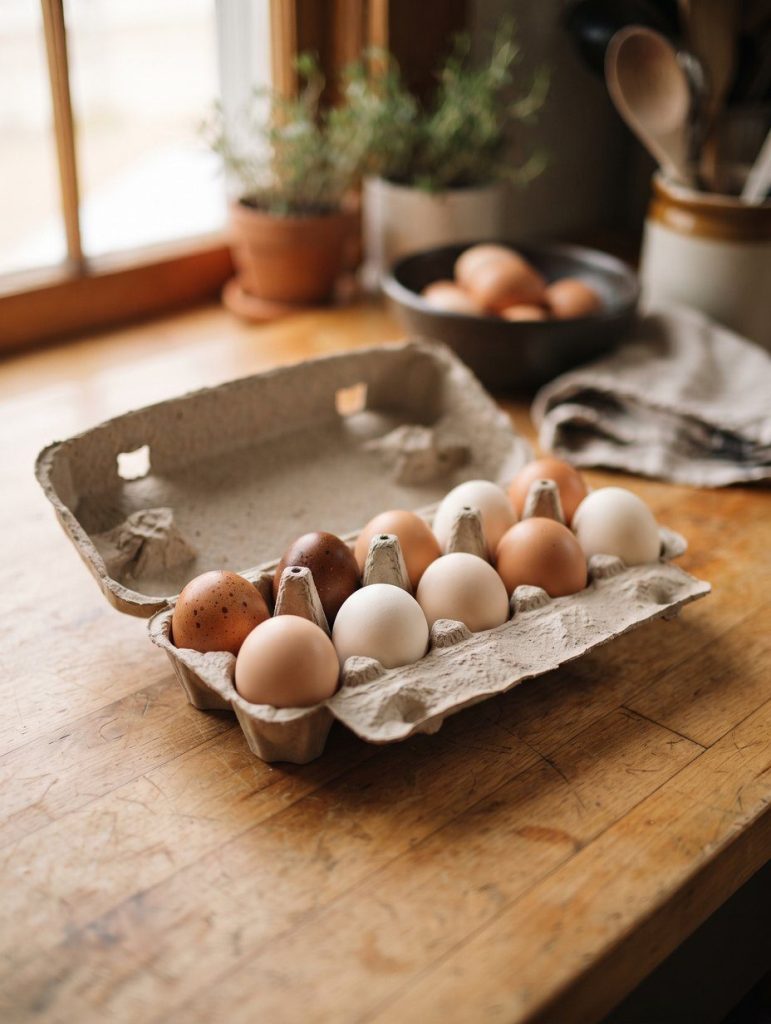
Brown eggs cost more, sit in nicer boxes, and look more like what people imagine a farm egg looks like.
The difference between brown and white is the one thing about an egg that tells you nothing at all.
What Decides the Color
The breed of the hen. That is the entire answer.
White Leghorns lay white eggs. Rhode Island Reds and Plymouth Rocks lay brown ones. Araucanas lay blue-green ones. Some breeds lay cream, some lay a speckled brown.
There is an old rule of thumb that works surprisingly often: look at the hen’s earlobes. White earlobes usually mean white eggs, red earlobes usually mean brown.
The shell color is pigment deposited in the last few hours before the egg is laid. It is paint on the outside and it goes no deeper.
Is There Any Nutritional Difference?
No. Not in protein, not in fat, not in vitamins, not in cholesterol.
Study after study has compared them and found nothing. An egg’s nutrition comes from what the hen ate, not from what color the shell is.
The same goes for taste. In a blind test nobody can tell them apart, and that has been done many times.
So Why Do Brown Eggs Cost More?
The birds are bigger and eat more. Brown egg breeds are larger and need more feed per egg, so they cost more to keep. That is most of it.
And people pay it. Brown eggs read as more natural and more farm-like, so stores price them accordingly, and the higher price then reinforces the idea that they must be better.
In parts of the world it runs the other way. Where brown eggs are the default, white eggs are the premium ones.
What Actually Does Change an Egg
What the hen was fed. Hens on pasture eating greens and insects lay eggs with more omega-3s and vitamins D and E, and with deeper orange yolks. This is real and measurable.
Freshness. A fresh egg has a thick white that stands up around the yolk and a yolk that holds a dome. An old egg spreads flat. This matters for frying and poaching far more than any label.
How the hen was kept. Pasture-raised, free-range, cage-free and conventional are meaningful differences in welfare — and pasture-raised does change the egg.
About Yolk Color
A deep orange yolk usually means a better-fed hen. Usually.
It can also mean the feed had marigold extract or paprika added to it, which is legal and common and does nothing except make the yolk look better. Color alone is a hint, not proof.
What to Buy
Buy on the date and on how the hens were kept. Ignore the shell color completely.
If white eggs are cheaper this week, buy the white ones. You are not missing anything.