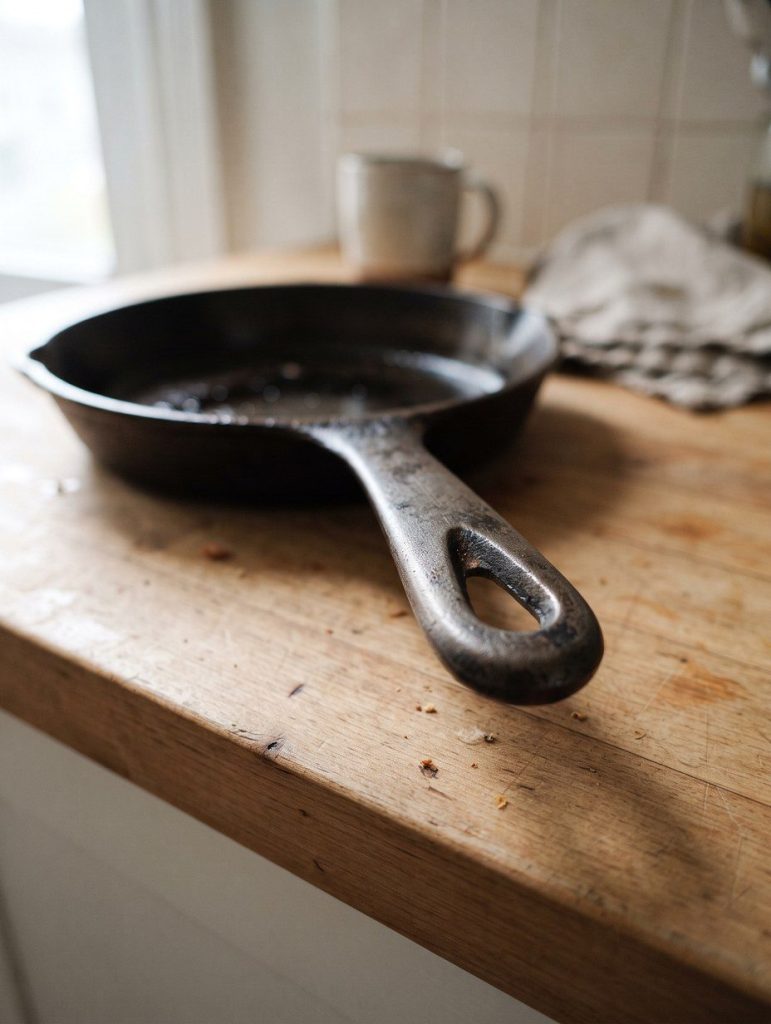
There’s a hole in the handle of almost every frying pan in my kitchen. I spent years assuming it was for hanging the pan on a hook — which it is, but only by accident.
A chef I worked next to showed me the real use in about four seconds, and I’ve done it every day since.
It’s a Spoon Rest
Slide the handle of your wooden spoon or spatula down through the hole, and it sits there at an angle with the business end hanging over the pan.
Every drip goes back into the food instead of onto your counter.
That’s it. The hole is a built-in spoon rest, and it’s the reason you can stop putting a saucy spoon down on a clean worktop and then wiping it up afterwards.
Why It Works So Well
The handle hole sits at the far end of the pan, away from the heat. The spoon hangs down at roughly the right angle to drain rather than pool.
It keeps the spoon in the pan’s own steam, so it stays warm and doesn’t cool the food when you go back to stirring.
And it means one fewer thing on the counter, which in a small kitchen is worth something on its own.
What Else the Hole Does
Hanging. The obvious one, and a genuinely good idea — pans stored hanging don’t get their interiors scratched by other pans stacked inside them.
Heat. A hole in the handle gives the metal somewhere to lose heat. It’s a small effect, but a solid handle runs hotter than a pierced one.
Weight. Less metal, lighter pan, better balance when you’re holding it out over a hob.
The Rest of the Kitchen Is Full of These
Once you spot one, you start noticing the others.
The hole in a pasta spoon. It’s a measure. Push dry spaghetti up through it until it’s full and that’s roughly one adult serving — about two ounces.
The hole in a saucepan lid. A steam vent, so the lid doesn’t rattle and the pan doesn’t boil over as easily. Not for hanging.
The notch on a wooden spoon. It’s shaped to sit on the rim of a pot so the spoon doesn’t slide in.
The flat top on a knife spine. That’s where your index finger goes for control on fine work.
The indent in the middle of a measuring jug’s spout. It’s there so you can pour a thin, controlled stream instead of a slop.
Why Nobody Ever Tells You
None of this is written on the packaging. Kitchen tools are designed by people who cook professionally and sold to people who mostly don’t, and the instructions get lost somewhere in between.
So a whole generation hangs pans by the hole, rests spoons on the counter, and never finds out.
Try It on the Next Thing You Cook
Make a sauce, stir it, and instead of looking for somewhere to put the spoon, slide it through the handle hole.
It’s a two-second habit and it ends the small sticky ring that lives on the counter beside the hob.
Twenty years I hung pans by that hole. It was doing a completely different job the whole time.