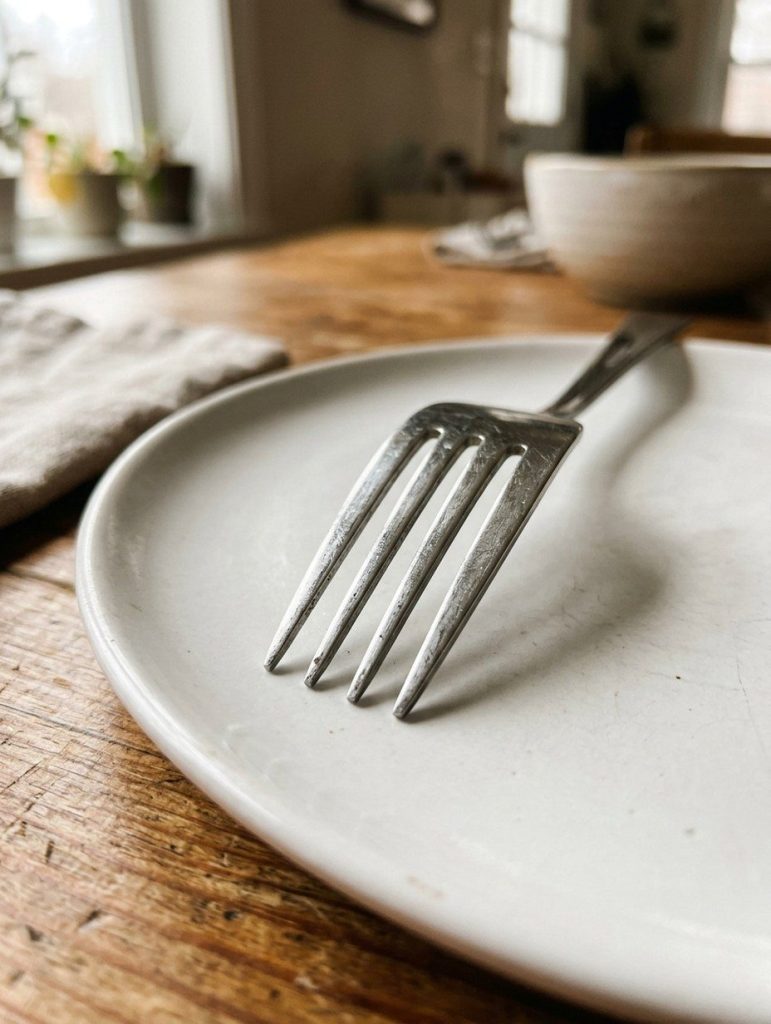
Pull a fork out of your drawer and look at the outer two tines. On a lot of forks — particularly older sets and better ones — the left-hand outer tine is noticeably wider and flatter than the other three.
It isn’t a manufacturing fault. It’s there on purpose.
It’s a Cutting Edge
That wider outer tine is thickened so you can press down with it and cut through soft food without reaching for a knife.
A piece of fish. A soft potato. Cake. Pasta. Anything you’d rather cut with the side of the fork while holding the plate steady.
On forks where it’s really pronounced you can feel that the edge is slightly sharper too. It’s doing the same job as the side of a spoon, but on a tool that’s already in your hand.
Why It’s Usually the Left One
Because of how the fork is held in the hand it was designed for.
Held in the right hand with the tines down, the left outer tine is the one that naturally contacts the plate when you roll the fork to cut. So that’s the one that got reinforced.
It’s also why some very old cutlery sets feel odd to left-handed people, and why modern sets often make both outer tines the same — manufacturers stopped assuming.
The Four Tines Themselves
Four is not obvious. Early forks had two, then three.
Two-pronged forks were for holding meat still while you carved it — they were a tool, not a utensil, and they were terrible at picking food up. Three was better. Four turned out to be the point where a fork can spear, scoop and hold without being clumsy, and nobody has improved on it since.
The slight curve of the tines matters too: a curved fork will hold peas and a flat one won’t.
Other Cutlery Details With a Job
The flat top edge on a knife spine. That’s where your index finger goes. It gives control for fine work and stops your hand sliding onto the blade.
The long thin handle on a butter knife. Balanced so the blade stays flat on the plate rather than tipping, which is why butter doesn’t slide off it.
The wider bowl on a soup spoon. Round rather than oval, so you can drink from the side of it rather than the tip.
The dip in a serving spoon’s handle. Shaped so it hooks on the edge of a bowl instead of sliding in.
Which Fork Is Which, While We’re Here
If you’ve ever wondered at a laid table: work from the outside in. The small fork on the far left is the salad or starter fork. The bigger one next to it is the dinner fork. Anything above the plate is for dessert.
The rule is the same for knives and spoons — outside in, in the order the courses arrive.
Go and Check
Take a fork out of the drawer and run your thumb across the four tines.
If one outer tine is wider than the others, that’s your cutting edge, and it has been there the whole time waiting for you to use it on a piece of cake.