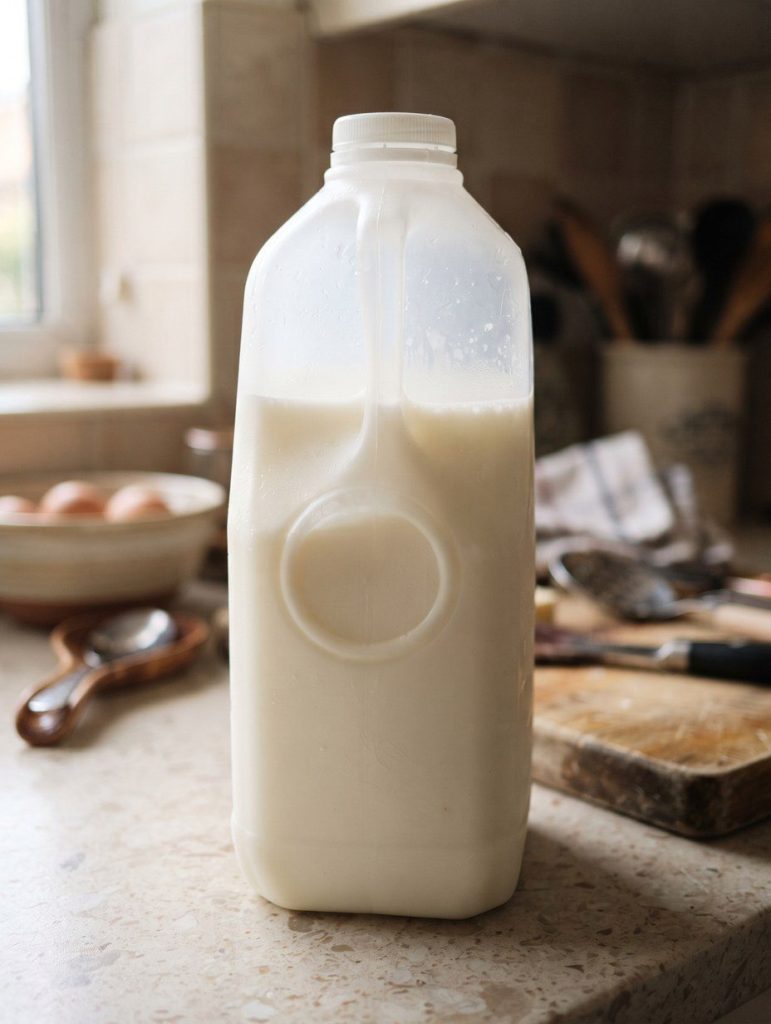
Pick up a plastic gallon jug of milk and you’ll find a circle pressed into one side, like a shallow dish set into the plastic.
The story that goes round is that it pops out when the milk has gone off. It doesn’t. It never has.
The real answer is more useful.
It’s an Expansion Panel
Milk moves. It gets cold, it gets warm, it gets knocked about in a crate on a lorry, and the pressure inside the jug changes with all of it.
Thin plastic with no give in it would bulge, split at a seam, or push the cap off. That circular panel is deliberately flexible — it flexes in and out and takes up the change so the rest of the jug doesn’t have to.
It also absorbs a knock. A dropped jug pushes that panel in instead of bursting a seam, which is why a dropped gallon of milk usually survives.
So Why Does It Sometimes Pop Out?
Because the pressure inside has gone up.
That can be temperature — a jug left on the counter for an hour will bulge slightly. It can be a jug packed tightly against others.
And yes, it can be gas from bacteria if the milk really has spoiled. So an outward bulge is worth a second look. But it is a weak signal with a lot of innocent explanations, and plenty of properly spoiled milk never bulges at all.
It is not an expiry indicator. Treat it as “worth checking”, not as an answer.
How to Actually Tell If Milk Has Turned
Smell it. This is the honest test and nothing beats it. Sour milk is unmistakable and it happens well before anything visible does.
Then look: any yellowing, any thickening, any lumps, any separation that doesn’t swirl back together.
Then taste a small amount if you’re still unsure. Milk that’s just turning tastes sharp before it smells strongly.
And remember the date on the jug is usually a “sell by” date, which is an instruction to the shop, not to you. Milk kept properly is often fine for several days past it.
Where You Keep It Matters More Than the Panel
This is the part that actually changes how long your milk lasts.
The fridge door is the warmest part of the fridge, because it swings out into a warm room every time you open it. Milk on the door goes through that cycle ten or fifteen times a day.
The back of the bottom shelf is the coldest and steadiest spot. Milk kept there routinely lasts days longer than the same milk kept in the door — and the door is where nearly every fridge puts the milk-shaped slot.
Two Other Marks on the Same Jug
The number in the triangle on the base. Milk jugs are usually a 2 — HDPE, one of the more stable food plastics.
The ridges around the neck and handle. Structural, like corrugations in cardboard. They’re what let the jug be that thin and still hold eight pounds of liquid.
The Short Version
The circle is a shock absorber and a pressure valve. A bulge means pressure, not necessarily spoilage.
Use your nose for that — and move the milk off the door while you’re there.