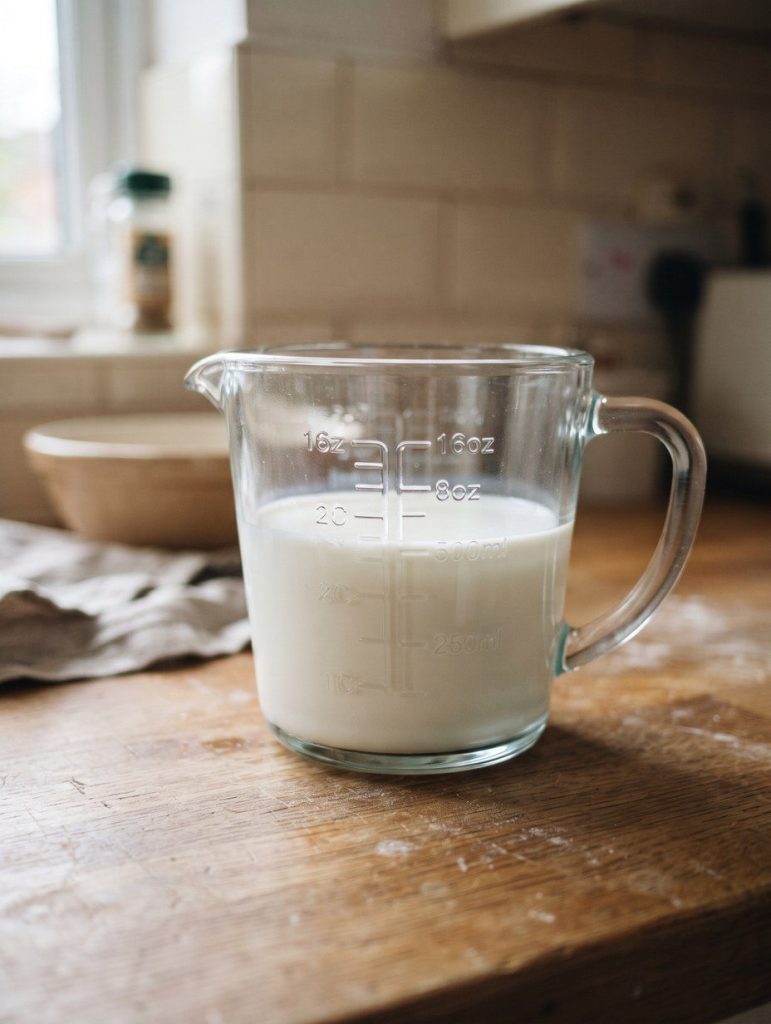
Look at a glass measuring jug. The highest marking — the 2 cup line, or 500ml — is not at the top. There’s an inch or so of empty glass above it.
It looks like the manufacturer got the design wrong. They didn’t. That gap is the entire reason a glass jug is better than a plastic cup for wet ingredients.
The Gap Is for Carrying
Liquid sloshes. Fill a jug to the actual brim and the walk from the tap to the mixing bowl loses you a tablespoon on the counter every time.
The headspace means you can fill to the top line, pick it up, and carry it across the kitchen without losing a drop or having to walk like you’re defusing something.
It’s also why the handle sits where it does and why the spout is above the top marking — so a full jug pours from a lip that isn’t already underwater.
Which Is Why Dry and Wet Cups Are Different Tools
This is the part that actually changes your baking.
Dry measuring cups — the nested metal or plastic set — are meant to be filled to the very brim and levelled off with the back of a knife. There’s no gap because you need a flat top edge to scrape against.
Wet measuring jugs — the glass one with the spout and the gap — are meant to be filled to a line and read at eye level.
Use a dry cup for liquid and you either underfill it or spill it. Use a jug for flour and you can’t level it, so you end up packing it down and using significantly more than the recipe wanted.
That difference is enough to make a cake dry.
Read It at Eye Level, Not from Above
Put the jug flat on the counter and crouch so your eye is level with the marking. Do not hold it up and look down at it.
Looking down makes you fill past the line — usually by a noticeable amount — because you’re reading the liquid where it climbs the far wall.
And read the bottom of the curve. Liquid pulls up at the edges of the glass; the flat part in the middle is the true level.
The Other Thing Hiding on Your Jug
Most glass jugs carry three scales at once: cups on one side, millilitres on another, and often ounces down the middle.
Worth knowing that a fluid ounce measures volume, not weight. Eight fluid ounces of water happens to weigh eight ounces, which is where the confusion starts — but eight fluid ounces of flour weighs about four and a half.
That’s why serious bakers weigh instead of measuring. A cup of flour can vary by a quarter depending on how it got into the cup.
Three Small Things That Fix Most Measuring
Spoon flour into the cup, don’t scoop it. Scooping compacts it. Spoon it in loosely and level the top.
Grease the cup before measuring honey or syrup. A thin film of oil and the whole lot slides out instead of clinging to the sides.
Don’t measure over the mixing bowl. If you overpour, it goes in the batter and there’s no getting it back.
Next Time You Bake
Put the jug on the counter, get your eye down to the line, and use the gap for what it’s for — carrying it without spilling.
It’s a small piece of design that has been quietly solving a problem you probably didn’t know you had.