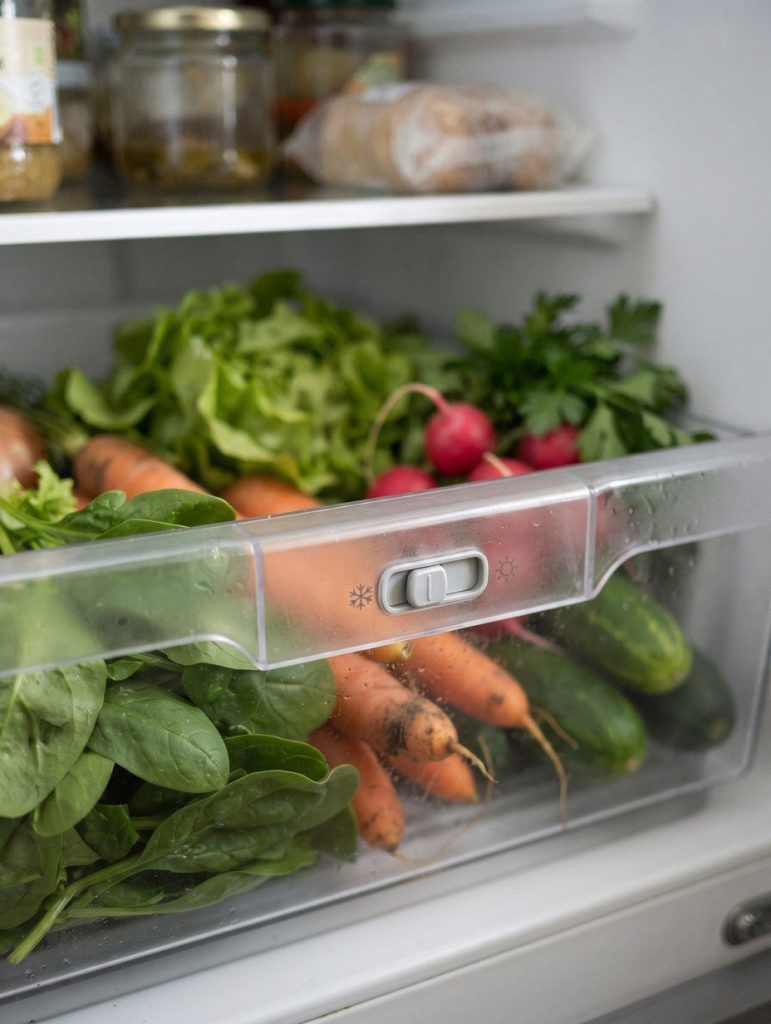
There’s a small slider on the front of the drawer at the bottom of your fridge. Mine said nothing at all — just a tab you could push from one end to the other.
I moved it once, decided nothing happened, and never touched it again. It does something. It’s just invisible.
It Controls Humidity, Not Temperature
That slider opens and closes a small vent in the drawer.
Closed vent means moisture stays trapped — a humid drawer. Open vent means moisture escapes into the rest of the fridge — a dry drawer.
It is not a temperature control. The drawer is the same temperature either way. What changes is how damp the air inside it is, and that decides how long your produce lasts.
Which Setting for What
The rule is simpler than it sounds, and it comes down to one thing: does this item rot, or does it wilt?
High humidity — vent closed — for things that wilt. Leafy greens, spinach, lettuce, herbs, broccoli, carrots, cucumber, courgette, green beans, asparagus. These lose water and go limp, so you want the moisture kept in.
Low humidity — vent open — for things that rot. Apples, pears, avocados, melons, peaches, plums, bananas if they’re in there at all. These give off ethylene gas as they ripen, and trapping that gas in a damp box makes everything in there go over faster.
The short version: if it has a skin you peel, low humidity. If it has leaves, high humidity.
Why Most Fridges Have Two Drawers
Because you’re meant to run one of each. One set to high for the greens, one set to low for the fruit.
Which also keeps the ethylene producers away from the ethylene sensitive, which is the other half of the problem. Apples and bananas in with your lettuce will finish it off in days.
The Mistake That Undoes All of It
Leaving things in the plastic bag from the shop, sealed.
A sealed bag traps moisture against the leaves and you get slime — which is the thing the drawer setting was supposed to prevent. Either take produce out of the bag, or open the bag, or poke a few holes in it.
And don’t wash anything before it goes in. Water on the surface is what starts the rot. Wash it when you’re about to use it.
Two More Things That Buy You Days
Line the drawer with kitchen paper. It absorbs the water that collects at the bottom, which is where the slime usually starts. Change it when it’s damp.
Don’t overfill. A packed drawer has no air moving through it, and the vent can’t do anything for produce buried at the bottom.
Go and Look
Pull open the drawer at the bottom of your fridge and find the slider on the front edge.
Set the one with your salad in it to closed, and the one with your fruit to open. It costs nothing and it’s the difference between throwing away half a bag of spinach and finishing it.