My adult children had years to retrieve the things I was keeping for them. So I gave them one clear deadline: claim what you want from the basement, garage loft, and hall closet by August 31, or it goes to charity.
It worked better than I expected. There were a few sentimental moments and a little resistance, but most of what I had stored for years turned out not to be worth storing after all.
My house had become a storage unit for grown children
This wasn’t one tote of baby clothes tucked under a bed. I had 18 plastic bins along a basement wall, 11 banker boxes and four oversized totes in the garage loft, plus a linen closet full of old school projects, blankets, cords, and things nobody could identify.
I had told myself I was saving it until the kids were ready. But they were adults now: one lived in a one-bedroom apartment, one had a townhouse, and one had roommates. Meanwhile, I was moving the same high chair, dance costumes, and unused bread machine every time I needed something.
At some point, “I’m holding onto this for the kids” becomes “I’m managing a warehouse.”

I picked a real deadline, not a vague promise
I chose August 31 because it gave everyone six full weeks to look through photos, make decisions, and arrange pickup. It also landed before fall schedules and holiday plans made everything harder.
The date mattered. “Sometime this fall” invites delay. “By August 31” means a decision has to happen.
I sent one group text so nobody got a different version of the conversation:
> I’m clearing the storage areas. If there’s anything you want, claim it by August 31. After that, I’m donating, recycling, or throwing things away. I can send photos and measurements.
Then I sent photos over the next 10 days. There were 143 in all: holiday ornaments, books, trophies, framed photos, old bedding, kitchen gear, furniture, sports items, school papers, and bins of childhood keepsakes.
For furniture, I included dimensions. “Oak bookcase, 72 inches tall by 30 inches wide” got a much faster answer than “Do you want the shelf from the garage?”
Three rules kept the cleanout from dragging on
The rules were simple, but they saved me from turning a six-week project into another five years of storage.
First, a claimed item had to be picked up by August 31, or a firm pickup date had to be scheduled within the following week.
Second, if two children wanted the same item, I gave it to the person with the clearest use for it. I was not running a contest based on who could text “mine” first.
Third, “maybe” did not count.
That last rule came up often. I got requests to hold bins until winter or break one big box into smaller boxes for easier storage later. I stayed polite, but I repeated the same sentence: “I’m happy to help you sort, but I’m not continuing to store it.”
That was the whole point.
They wanted useful things before sentimental things
The first items claimed surprised me. Nobody rushed to grab spelling tests, trophies, or elementary-school art projects. Within a day, one child wanted the cast-iron skillet, another claimed a floor lamp, and another asked for a set of mismatched Pyrex containers because the lids still fit.
The furniture went quickly, too. A maple dresser, narrow oak bookcase, kitchen cart, side tables, everyday dishes, and a box fan all found homes.
It made sense once I thought about it. Young adults often need a dresser more than they need a bin labeled “miscellaneous middle school.” A skillet that made hundreds of family breakfasts can carry more meaning than a paper-mâché volcano ever will.
One child borrowed a friend’s pickup truck and took a dresser, bookcase, and fan in about 35 minutes. Watching those things leave the house felt fantastic.
The sentimental items were hit or miss
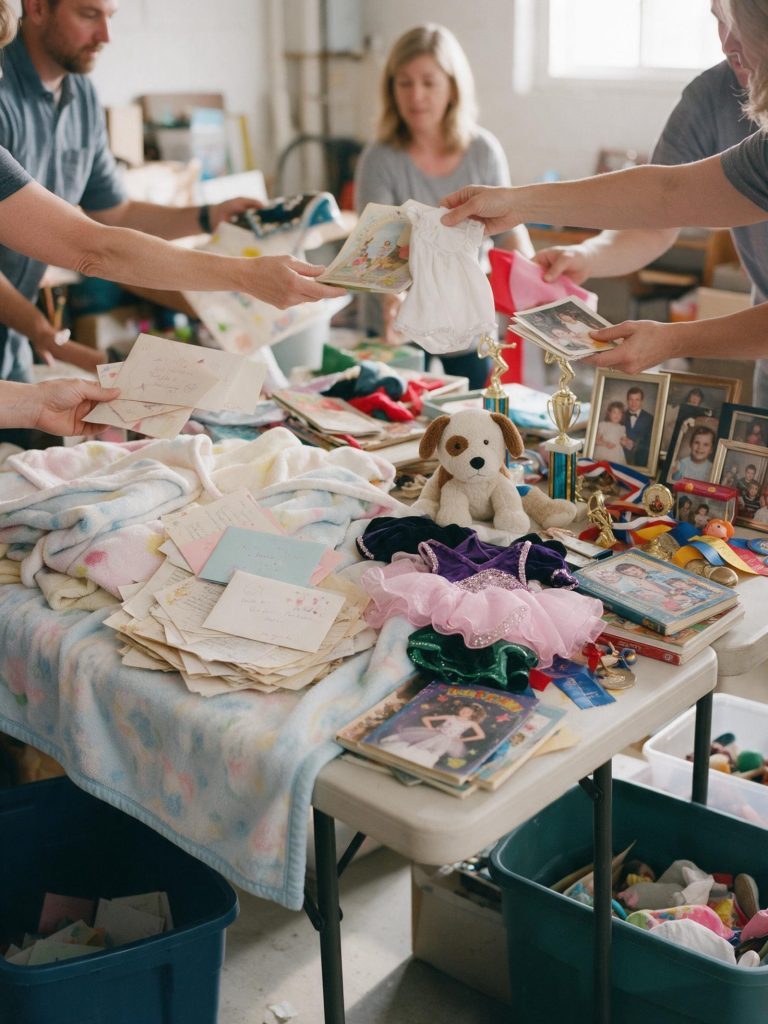
I had five bins devoted to childhood memories: school papers, costumes, recital outfits, toys, cards, books, and old awards. I eventually laid everything out on folding tables and invited the kids over for one afternoon of sorting.
Some things mattered immediately. Baby blankets, handwritten birthday cards, a particular stuffed dog with one missing eye, a shoebox of letters, and a few childhood books all made the cut.
But nobody wanted most of the trophies, participation ribbons, spelling tests, plastic dinosaurs, or stacks of schoolwork. One old soccer trophy got a laugh, not a claim. Fair enough.
The difficult part was realizing that some items mattered more to me than to them. The rain boots, construction-paper valentines, and hand-sewn Halloween cape were my memories dressed up as their belongings.
So I made one clear 66-quart memory tote for each child. If something did not fit in that bin and no one claimed it, I had to decide whether I truly wanted to keep it—or was just avoiding a decision.
Most of the remaining items went where they could be used
By September 1, I had 17 donation boxes and nine trash bags ready to go.
The donation pile included children’s books, kitchenware, lamps, folding chairs, throw pillows, a coffee maker, winter coats, framed prints, board games, towels, dishes, and small furniture. I sent some items to a local charity resale shop and household basics to a nonprofit that helps families furnish apartments after housing transitions.
That second donation made the process easier. A lamp, set of dishes, or kitchen cart may not mean much sitting under my garage rafters, but it can be useful immediately in someone else’s home.
I also shredded sensitive paperwork before recycling two banker boxes of old documents. Old papers are not family history just because they are old.
What my children actually took
Together, my kids claimed far less than I had expected.
My oldest took a dresser, cast-iron skillet, two quilts, a framed family photo, childhood books, and a baby book. My middle child chose the oak bookcase, a lamp, a bin of ornaments, letters, and baking dishes. My youngest took the kitchen cart, everyday dishes, a blanket, sports memorabilia, and the one-eyed stuffed dog.
Out of roughly 33 boxes and bins connected to “kid stuff,” only about eight left intact, along with selected items from several others.
More than half of what I had saved was not important enough for anyone to take. That could have felt sad. Instead, it was clarifying.
Set a boundary, then make room for the stories
The best part of the cleanout was not the empty basement wall, though I appreciated that too. It was the stories that came up while we sorted.
A chipped mug brought back theater rehearsals. A faded quilt led to memories of my grandmother’s sewing table. Recipe cards started a debate over who makes the better cinnamon rolls.
We did not need to keep every object to keep those moments. Sometimes we took a photo, told the story, laughed, and let the item go.
If your home has become the family archive, give your adult children a deadline, send photos, include measurements, and be clear about what happens after the date. Offer help sorting if you can. But do not keep storing things indefinitely out of guilt.
The memories can stay. The boxes don’t have to.