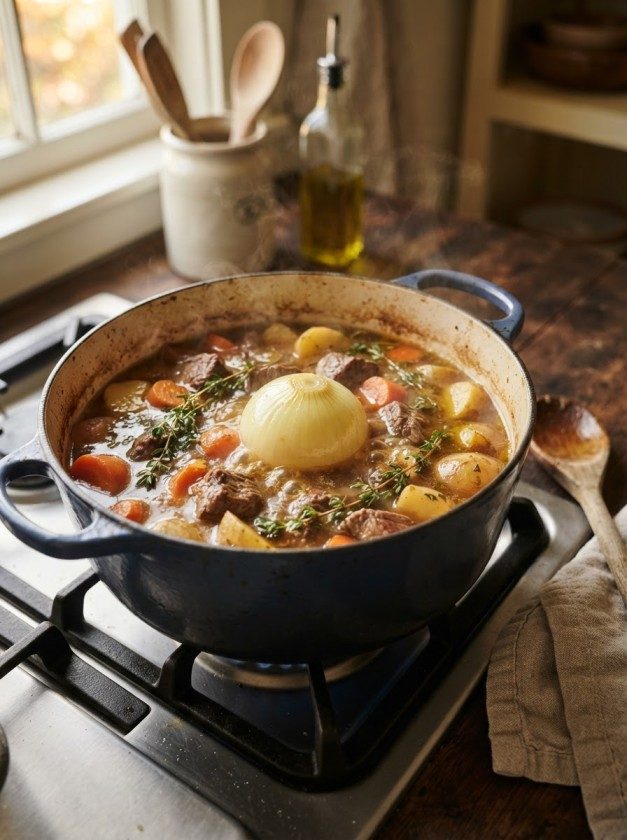
Short version: it worked. The onion softened into silky, sweet layers, the broth turned richer and slightly sweeter, and nothing about the stew tasted overly “oniony.” One medium onion, peeled and dropped in whole, four hours at a low simmer.
I didn’t chop it because I wanted the flavor without the punch. Diced onion can take over a pot, especially a pungent one, and I was after a slow, gentle infusion instead. Also, no cutting board and no tears, which is a nice bonus on a lazy afternoon.
What I Actually Did
Nothing fancy. I took a medium yellow onion — about 150 grams — peeled it, rinsed it, and set it whole into the pot with the beef, carrots, potatoes, and broth. Then I put the lid on and left it alone at a low simmer for four hours.
That’s the whole technique. The onion just sits there among the other ingredients, soaking up the broth while slowly giving back its own flavor.
What Happened During the Simmer

For the first hour, not much. The kitchen filled with the usual beef-stew smell, and the onion bobbed along looking like it had no plans to change.
By hour two and three, it had clearly softened and settled in among the meat and vegetables. The stew itself took on a deeper golden color, and the broth started tasting rounder — the natural sugars in the onion were slowly caramelizing, which added depth without any sweetness you could point a finger at.
What It Did to the Broth
This was the biggest difference. The broth turned silky, with a mild sweet undertone that balanced the richness of the beef and the earthiness of the root vegetables.
Chopped onion announces itself. This onion didn’t. It blended into the background and made everything else taste more like itself — the beef beefier, the carrots sweeter. The flavor was obviously there, just fully integrated instead of sitting in little chunks.
Did the Onion Fall Apart?
Mostly no, and that surprised me. After four hours it was still recognizable as an onion — visibly softened and slightly collapsed, with the layers separating like petals.
The outer layers had gone almost translucent and turned so soft they pulled away with a spoon. It held its shape well enough to scoop out in one piece, but one poke and it surrendered.
I tasted it on its own. Sweet, mellow, silky — nothing like the bite of raw onion. It had absorbed the broth while keeping its own gentle sweetness, and honestly it was one of the best bites in the pot. If you have someone at the table who hates onion pieces, this is also the easiest fix: fish the whole thing out before serving and nobody knows it was there.
Why a Whole Onion Behaves This Way
The science is simple. Over hours of moist heat, the onion’s cell structure breaks down, which is why a firm bulb turns spoon-soft.
Two more things happen at the same time. The natural sugars caramelize slowly, building sweetness and depth. And the sharp sulfur compounds — the ones that make raw onion pungent and your eyes water — mellow out and dissipate with long cooking. Because the layers stay intact, all of this releases gradually into the pot instead of all at once, the way it does when you dice and sauté.
A whole onion is basically a time-release flavor capsule.
When to Use This Trick — and When Not To
It works well in anything that simmers low and slow for a few hours: beef stew, pot roast, brothy soups, braises. Anywhere you want onion flavor woven through the dish without distinct pieces.
Skip it when:
- Dinner cooks in under an hour. The onion won’t soften through, and you’ll just have a hot raw-ish bulb in your pan.
- You want a strong, browned onion base. That flavor comes from chopping and sautéing in fat first. A whole simmered onion gives you a different, quieter thing.
- The recipe depends on onion texture, like a chunky vegetable soup where the onion is one of the vegetables.
What I’ll Do Differently Next Time
I’m planning to try a sweet onion for an even mellower result, and a red onion just to see what it does to the color and flavor of the broth. For a bigger pot, I’d drop in two.
One small tip: if you want the onion to stay as intact as possible, leave a bit of the root end on when you peel it. That’s the part that holds the layers together. Mine was fully trimmed, which is probably why it slumped a little — not that anyone complained.
The Takeaway
Next time you make stew, skip the dicing. Peel one onion, drop it in whole, and let the simmer do the work. You get a richer broth, one less thing to chop, and a soft, sweet bonus onion at the end — for the cook, if no one else.