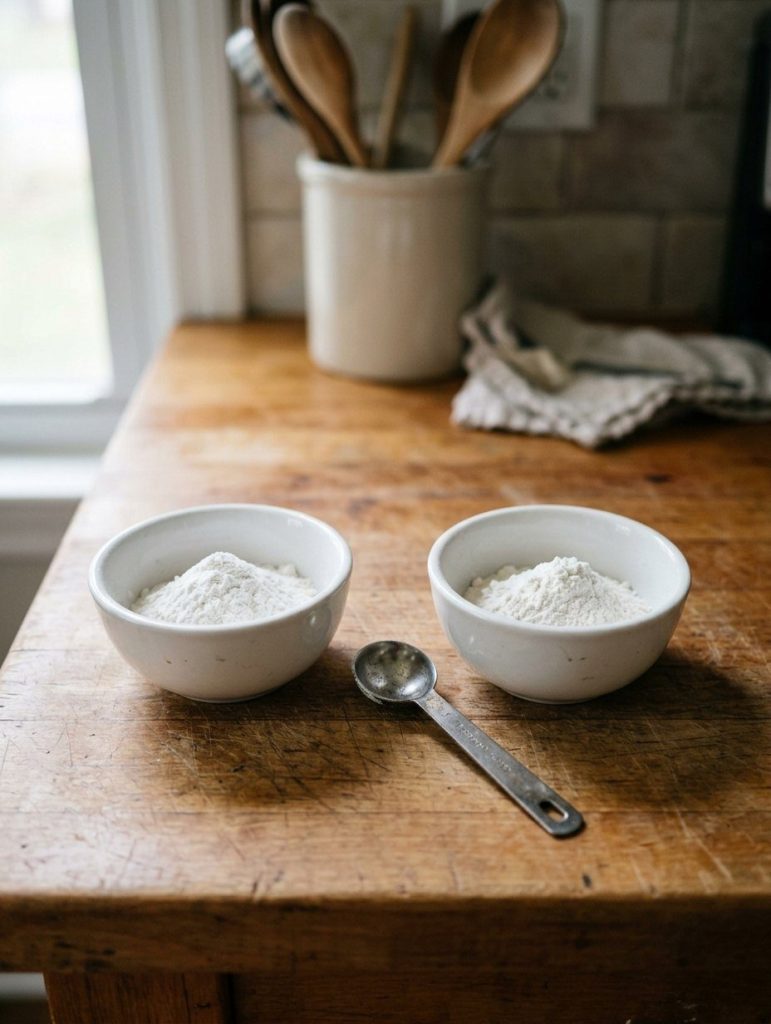
They sit next to each other in the cabinet, both white powders, both make things rise, and the names are nearly the same. So people swap them.
They are not interchangeable, and it is worth knowing exactly what happens when you get it wrong.
What Each One Is
Baking soda is one ingredient. Sodium bicarbonate. It is a base, and it does nothing on its own — it needs an acid to react with. Given an acid and moisture it releases carbon dioxide immediately.
Baking powder is baking soda plus a dry acid (usually cream of tartar) plus a little cornstarch to keep them apart in the tin.
So baking powder is baking soda that brings its own acid. Add water and it reacts by itself.
Most modern baking powder is “double acting” — some gas comes out when it gets wet and the rest when it gets hot, which is why it forgives you if the batter sits a few minutes.
When a Recipe Calls for Which
Look at the other ingredients. If there is an acid in the recipe, it will call for soda.
Acids in baking: buttermilk, yogurt, sour cream, lemon juice, vinegar, brown sugar, molasses, honey, cocoa (natural, not Dutch process), and coffee.
A recipe with no acid — plain milk, white sugar — needs powder.
Some recipes use both. That means there is an acid to neutralize but not enough of it to provide all the lift.
What Happens If You Swap Them
Soda where powder was called for: this is the bad one. With no acid to react with, most of the soda does not convert, and what is left tastes soapy and metallic and faintly bitter. It also browns more than it should and can go a strange yellow-green. Unmistakable once you have tasted it.
Powder where soda was called for: less dramatic. You get about a third of the lift, so it comes out flat and dense. And the recipe’s acid is now unneutralized, so it tastes sharper — noticeably tangy in something like buttermilk pancakes.
If You Have Run Out
No powder, but you have soda: use a quarter teaspoon of soda plus half a teaspoon of cream of tartar for every teaspoon of powder. Very close to the real thing.
No soda, but you have powder: use three times as much powder. It works but you will taste the extra salt, and the recipe’s acid stays unbalanced.
Neither substitution is as good as having the right one.
Are Yours Still Good?
Both lose strength, powder faster than soda.
Test soda: a spoonful in a little vinegar. It should fizz hard and fast.
Test powder: a spoonful in hot water. Same — an immediate strong fizz. A weak fizz means flat cakes.
Powder is done about six months after opening. Soda lasts years dry but write the date on the box.