It’s one of those weird little moments that happens fast and then suddenly sits in your head all day.
You’re loading groceries into the trunk, half-thinking about dinner, half-thinking about how expensive cereal has gotten lately, and then you see it.
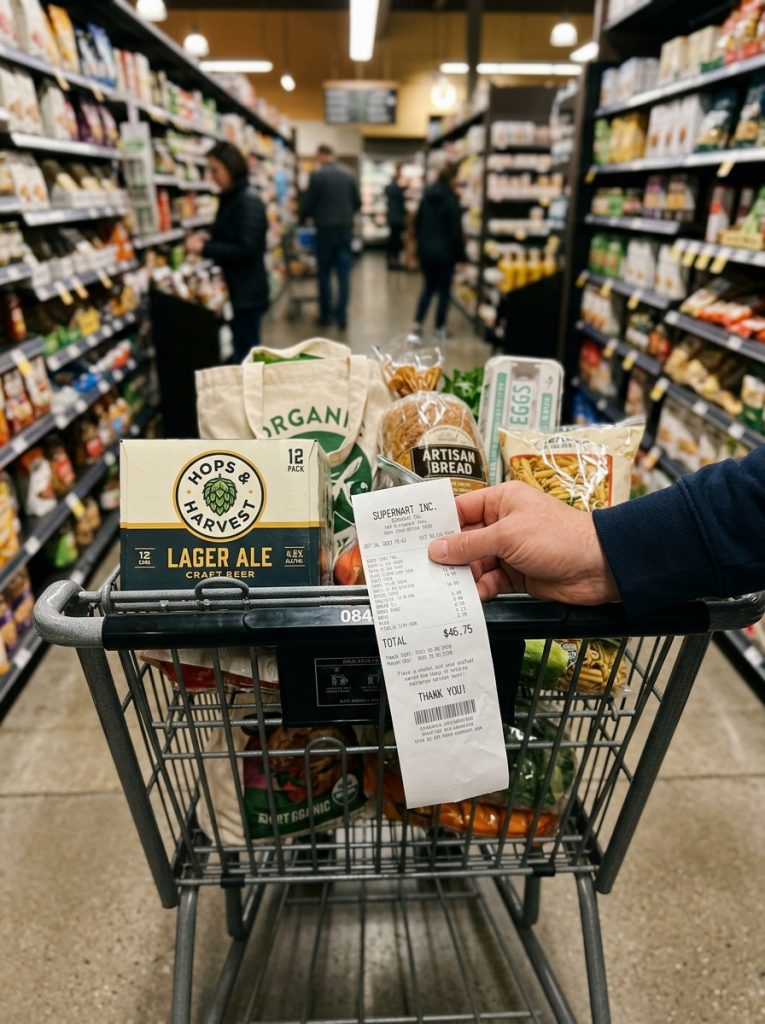
The case of beer.
Still sitting under the cart.
Not scanned.
And immediately your brain does that thing where it splits into two people.
One side goes:
“Ah, honest mistake. Happens all the time.”
The other side goes:
“…okay but technically I just walked out with unpaid beer.”
Now you’re standing in a parking lot having a full ethical debate with yourself next to a shopping cart that squeaks like it’s judging you.
Honestly, self-checkout has created a thousand tiny moral tests nobody asked for.
Why This Feels Bigger Than Thirty Bucks
That’s the interesting part.
Because most people don’t panic over the money itself. It’s not really about the beer. It’s about the moment you realize you have a choice.
You can go back.
You can call the store.
Or you can quietly drive home and pretend the universe handed you a coupon.
And even if nobody else ever knows, you know.
That’s why it sticks in your brain more than people expect. Humans are strangely wired that way. We like thinking of ourselves as honest, decent people, so when something bumps against that image—even accidentally—it creates this annoying mental itch.
You try to justify it.
“They should’ve had a better system.”
“The employee missed it too.”
“These stores make millions.”
And maybe all of that is technically true. Still doesn’t fully settle the feeling.
Self-Checkout Is Convenient… But It’s Also Kind of Chaos
Stores love self-checkout because it’s fast and cuts labor costs. Customers love it because nobody wants to wait behind someone writing a check in 2026.
But the system is messy.
People forget items under carts constantly. Cases of water, dog food, giant paper towel packs, beer—it happens every day. Cashiers used to catch that stuff automatically. Machines don’t.
And honestly, stores know this.
Retailers even have a term for it: “shrink.” That’s the bucket for losses from theft, damage, mistakes, inventory errors—all of it mixed together. Self-checkout made shrink worse almost immediately. Not just because of stealing, but because people are distracted. Kids crying, phones buzzing, ten bags open at once… your brain skips a beat and suddenly a 30-pack rolls out unpaid.
Not exactly criminal mastermind behavior.
Legally Speaking? Yeah… It Can Count As Theft
This is where people get uncomfortable.
Technically, leaving with unpaid merchandise can legally fall under shoplifting, even if it started as an accident.
But intent matters a lot.
There’s a pretty big difference between:
- forgetting to scan something
and - realizing it later and choosing to keep quiet
Stores and employees usually know the difference too. Somebody voluntarily coming back inside saying, “Hey, I missed this,” is not usually treated like a hardened thief from a movie montage.
Most employees are honestly just relieved you came back instead of screaming about expired coupons.
The Moment You Realize It Is the Real Test
That’s really what this comes down to.
The mistake itself? Human.
What happens after you notice—that’s the part that feels personal.
Because once you know, you’re making an actual decision.
And people rationalize this stuff in wildly creative ways. Some say giant corporations expect losses anyway. Others treat it like karma balancing itself after years of overpriced groceries.
I’ve heard people call it a “self-checkout employee discount,” which… okay, kind of funny.
But deep down, most people still know the difference between a lucky accident and a choice.
Going Back Inside Is Awkward for About 45 Seconds
That’s the truth nobody says out loud.
Most people don’t avoid returning because they’re evil masterminds. They avoid it because it’s awkward.
You walk back in carrying unpaid beer like you’re turning yourself in for a federal crime.
Meanwhile the cashier is usually like:
“Oh. Okay. Thanks for coming back.”
That’s it.
No dramatic music. No handcuffs.
Honestly, employees have probably seen far stranger things before lunch.
And afterward? The weird guilt evaporates almost immediately. That part matters too.
Calling the Store Is Also Fine, By the Way
Sometimes you’re already halfway home when you notice.
At that point, calling is reasonable.
A lot of stores will literally tell you:
“Just pay next time you’re in.”
Some may not even care enough to track it down, especially if you made the effort to report it. But making the call changes the situation mentally. You acknowledged it instead of silently benefiting from it.
That distinction matters more than people think.
And Yet… Plenty of People Would Keep Driving
Let’s be honest about that too.
A decent number of people would shrug and go home.
Some wouldn’t lose a second of sleep over it either.
You can find endless debates online where people argue that self-checkout shifts labor onto customers anyway, so mistakes are part of the cost. Others say corporations account for this already, especially massive chains.
And look—people justify things differently depending on stress, money, mood, even how badly the checkout machine annoyed them five minutes earlier.
Humans are complicated like that.
Still, most discussions eventually circle back to the same point:
“What kind of person do I want to be when nobody’s watching?”
A little cheesy maybe. But also true.
The Funny Thing? This Happens Constantly
Not just beer.
People accidentally walk out with:
- soda under the cart
- cases of water
- toilet paper
- rotisserie chickens balanced weirdly in the child seat
- entire bags left in carts unscanned
Self-checkout changed shopping behavior in subtle ways. Customers became part-cashier, part-bagger, part-loss-prevention team without really signing up for it.
And human beings are distractible. Very distractible.
That’s probably why this scenario sparks such strong opinions online. Almost everyone can imagine themselves in it.
So… What’s the “Right” Thing To Do?
You probably already know your answer before anybody else gives you one.
That little pause in your stomach when you spot the unpaid item? That’s usually the answer.
For most people, going back—or at least calling—feels better afterward. Not because of the store’s bottom line. Mostly because carrying around low-grade guilt over a forgotten case of beer is surprisingly exhausting.
And honestly, peace of mind is probably worth more than thirty bucks.
A Small Habit That Helps
One thing that actually works?
Before leaving self-checkout, do one quick cart scan:
top rack, bags, bottom rack.
That’s it.
Because the stuff people forget is almost always the oversized item underneath. Beer, water, dog food, diapers—basically the heavy awkward things your brain stops seeing after ten minutes of shopping.
Simple habit. Saves weird parking-lot existential crises later.
Final Thought
Maybe the strange part of this whole situation is that it reveals who we are when the rules briefly disappear.
Nobody stopped you.
Nobody noticed.
You could probably get away with it.
And yet for a lot of people, that uncomfortable feeling shows up anyway.
Which is probably a good sign.