So here you are. Basement door sealed. Supplies stacked. A few good books within reach. Honestly, not the worst setup—until you realize something small but very important is missing.
The can opener.
And suddenly those neatly stacked cans start to feel a little… smug.
Here’s the thing, though—you’re not out of options. Not even close. People were opening cans long before the modern opener became a kitchen drawer staple. It just takes a bit of grit, a little patience, and yes, some caution.
(Quick heads-up: every method below creates sharp, jagged edges. Think “tin can teeth.” Move slowly, keep your hands clear, and if you’ve got gloves—use them.)
The Spoon Trick (Looks Ridiculous… Works Anyway)
You might not expect a spoon to save the day, but here we are.
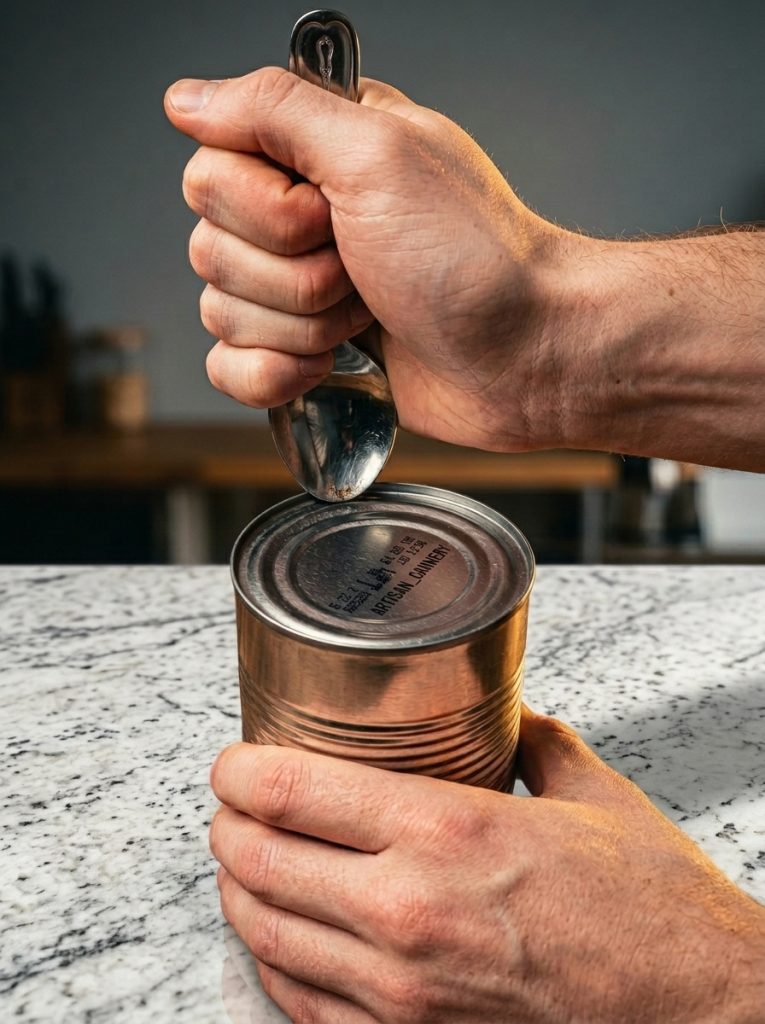
Grab a sturdy metal spoon—not the flimsy kind that bends when you scoop ice cream. Hold it tightly in your fist, pressing the tip against the edge of the can lid. Now rub it back and forth along that rim.
It feels slow at first. Like nothing’s happening.
Then suddenly… it is.
The friction wears down the metal, thinning it until—pop—you break through. Once you’ve made that first hole, you just keep working your way around the edge, levering the lid open bit by bit.
It’s not pretty. It’s not fast. But it works.
And honestly? There’s something weirdly satisfying about it.
(Same idea works with a screwdriver or butter knife, if you’ve got one lying around.)
The Chef’s Knife Method (Fast, But Respect It)
This one’s quicker—but you’ll want steady hands.
Hold a chef’s knife firmly, placing your thumb flat on the blade near the handle (that sturdy back part, called the heel). Angle the blade away from you—always away—and press the heel into the rim of the can.
Give it a firm push.
You should feel it puncture through.
Now repeat that motion around the lid, creating a series of holes until the top loosens enough to pry open.
It’s efficient. Surprisingly so.
But here’s the trade-off: you’re working with a sharp blade and a metal surface that doesn’t forgive mistakes. So go slow. No rushing just because you’re hungry.
The Concrete Method (No Tools? Still Fine)
No spoon. No knife. Just a can and… a rough surface?
You’re still in business.
Flip the can upside down and rub the top (the sealed edge) against concrete or any rough stone surface. Think of it like sanding the lid down.
Back and forth. Steady pressure.
After a bit, you’ll notice the rim wearing away. Eventually, you might see a little moisture starting to seep through—that’s your sign you’re close.
At that point, stop. Wipe off any metal dust, then give the can a firm squeeze.
The lid should pop right off.
It takes effort. And a little patience. But if you’re stuck with nothing else, this one’s surprisingly reliable.
A Quick Reality Check
All these methods work. People use them. They’ve gotten folks out of tight spots more than once.
But let’s be honest—they’re not exactly ideal.
Sharp edges. Slippery surfaces. Improvised tools. It’s not the kind of thing you want to do in a hurry or in bad lighting.
So yes, this is survival knowledge. Useful. Practical. Worth knowing.
But also…
The Smart Move (Before Things Get Weird)
Next time you’re packing supplies—whether it’s for camping, a power outage, or, you know, the end of civilization—just toss in a manual can opener.
They’re small. Cheap. Easy to forget… until they’re not.
And if you’ve ever tried opening a can with a spoon while hungry and slightly stressed, you’ll understand why that tiny tool earns its place.
Final Thought
You’re not stuck. That’s the takeaway.
Even without the “right” tool, you’ve got options. A spoon becomes a tool. Concrete becomes a tool. A bit of persistence goes a long way.
And honestly? That’s kind of the whole survival mindset.
You work with what you have.
Even if what you have… is just a spoon and a stubborn can.