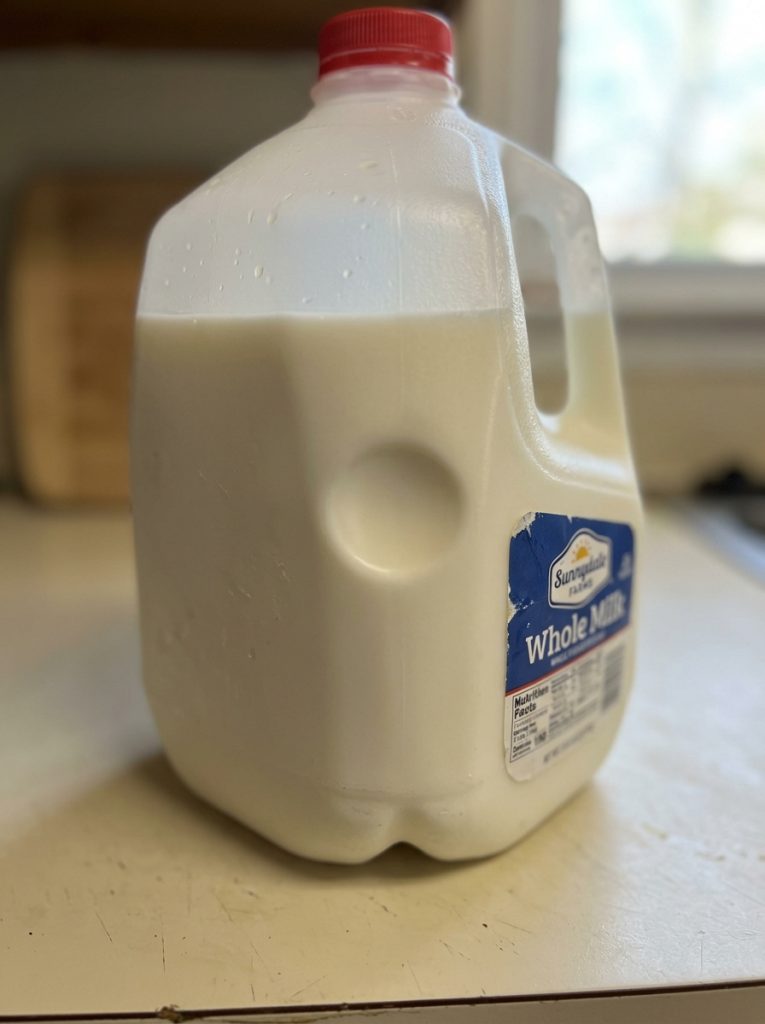
You’ve probably seen it a thousand times—maybe even this morning.
You grab a gallon of milk, pour it into your coffee or cereal, and there it is… that odd little circle pushed into the side of the jug. Not big. Not dramatic. Just… there.
And most of us never question it.
Honestly, it’s one of those everyday details that fades into the background, like the hum of a fridge or the way your kitchen light flickers for half a second before settling in. But here’s the thing—this small dent? It’s doing a lot more work than it gets credit for.
Let me explain.
So… what’s the dent actually doing?
At first glance, it looks decorative. Or maybe like a manufacturing shortcut.
But it’s neither.
That circular dent—sometimes called a “panel”—is built into the jug for a very practical reason: it helps the container handle pressure changes without cracking or leaking.
Milk isn’t just sitting quietly inside the jug. Temperature shifts during transport, refrigeration, or even just sitting on your counter for a few minutes can cause the liquid—and the air inside—to expand or contract.
Without a flexible spot? The jug would be under stress. And plastic under stress tends to do one thing: fail.
The dent acts like a pressure buffer. It moves in and out slightly as needed, absorbing changes so the rest of the jug doesn’t have to.
Kind of like a shock absorber—but for milk.
A quick step back: before plastic took over
It wasn’t always like this.
Years ago, milk came in glass bottles. They were sturdy, reusable, and… heavy. Also, if you dropped one? That was the end of it—plus a mess you didn’t want to deal with before coffee.
As demand grew and distribution expanded, the dairy industry needed something lighter, cheaper, and less fragile. That’s where plastic jugs came in, around the mid-1900s.
But switching materials introduced new challenges.
Plastic is flexible, yes—but it’s also sensitive to pressure, temperature, and stacking. Engineers had to rethink everything: shape, thickness, even tiny details like that circular dent.
And that’s where smart design stepped in.
The real reasons that dent matters
1. It keeps the jug from bursting under pressure
Milk expands when it warms up. Even slightly.
That dent gives the jug room to breathe—literally. Instead of the entire container bulging or cracking, the dent flexes inward or outward.
You don’t notice it happening. But it’s constantly adjusting.
Without it? You’d likely see more leaks, warped containers, or worse—jugs splitting open during transport.
2. It makes the jug stronger (with less plastic)
This part feels a little counterintuitive.
You’d think adding a dent weakens the structure. But it actually does the opposite.
That indentation reinforces the shape, allowing manufacturers to use less plastic while maintaining strength. It’s similar to how arches work in bridges—small structural tweaks that carry a lot of weight.
Less plastic means lower costs. And yes, it also means less environmental impact.
Not perfect, of course. But better than it used to be.
3. It helps prevent messy accidents
You know that moment when a jug slips out of your hand?
Yeah. We’ve all had it.
The dent can absorb part of that impact. It’s not magic—it won’t save every drop—but it reduces the chance of the jug splitting open on contact.
Especially in busy households, that matters more than you’d think.
Because cleaning up spilled milk? Not exactly how anyone wants to start their day.
4. It makes recycling easier
Here’s something most people don’t think about.
After you’re done with the milk, the jug needs to be transported, sorted, and processed for recycling. That dent helps the container collapse more efficiently when crushed.
Which means:
- Less space during transport
- More efficient recycling batches
- Lower handling costs
It’s a small design choice with a ripple effect.
5. And yes… it plays a role in branding too
This part is subtle.
While function comes first, brands still care about how their products look on the shelf. That circular panel can act as a visual signature—something recognizable, even if you don’t consciously notice it.
Some companies even mold logos or patterns into that space.
So yeah, it’s practical—but it’s also part of the jug’s identity.
Wait—so it’s not a defect?
A lot of people assume the dent means something went wrong.
Like the jug got pressed during shipping or came out of the factory slightly off.
But no—it’s intentional. Carefully designed. Tested.
In fact, if the dent weren’t there, that would be the real issue.
Funny how perception works, right?
The bigger picture (and why this even matters)
You could argue this is a tiny detail. And you wouldn’t be wrong.
But that’s kind of the point.
So many everyday objects are filled with these quiet design decisions—things you don’t notice unless someone points them out. And once you see them, you can’t unsee them.
It’s a reminder that even simple products—like a milk jug—carry layers of engineering, cost decisions, environmental considerations, and real-world problem-solving.
All packed into a shape you barely think about.
Final thought
Next time you pick up a jug of milk, take a second and look at that dent.
It’s not just there for looks. It’s doing its job—silently, efficiently, every single day.
And honestly? That’s the kind of design that deserves a little more appreciation.