Every family kitchen seems to have at least one mystery object.
You know the kind—slightly heavy, oddly shaped, tucked into the back of a drawer nobody opens much anymore. And somehow, the older generation always knows exactly what it is without even looking twice.
This one usually causes a pause.
It’s metal. U-shaped. Fits in your hand almost like some kind of antique gadget from a detective movie. Maybe even a little intimidating at first glance. Honestly, if you didn’t know better, you might think it belonged in a toolbox—or somewhere far less wholesome than a baking cabinet.
But your grandmother probably used it to make pie crust.
And once you realize what it is, the whole thing suddenly feels charming instead of confusing.
The Tool That Makes Everyone Go, “Wait… What Is That?”
At first glance, it’s definitely odd-looking.
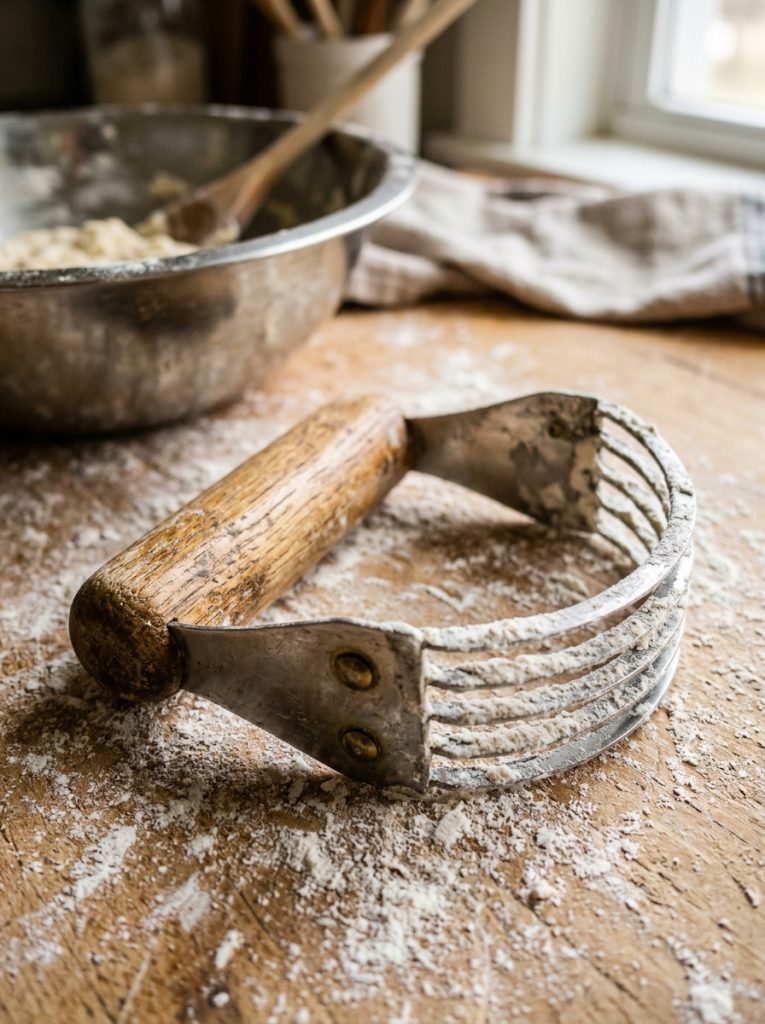
There’s usually a sturdy wooden handle across the top, smooth from years of use, with several curved metal strips looping underneath. Most versions have around five blades, though older ones vary a bit. Some look polished and neat. Others have that worn vintage look that says this thing has seen a lot of biscuits.
And weirdly enough, it does resemble brass knuckles a little.
Not exactly the vibe you expect from baking equipment.
But the shape isn’t random. Every curve and spacing actually serves a purpose.
It’s Called a Pastry Blender — And Bakers Swear By It
The mystery tool is a pastry blender.
Not flashy. Not electric. No buttons, no settings, no Bluetooth nonsense. Just one simple tool designed to do one very important thing:
cut cold butter into flour.
That’s it. That’s the whole job.
But in baking, especially old-school baking, that one step matters more than people realize.
Pie crusts, biscuits, scones—those soft, flaky layers everybody wants? They depend on tiny pockets of fat staying intact inside the dough. A pastry blender helps create those pockets without turning everything into a sticky mess.
And honestly, once you use one, you kind of get why people held onto them for decades.
Why Not Just Use Your Hands?
Good question.
A lot of people do use their hands. Some bakers even prefer it. But hands are warm, and warm hands melt butter fast.
That’s the problem.
When butter melts too early, the dough loses that flaky texture and starts leaning dense or chewy instead. Not terrible, just… not the dream pie crust grandma bragged about for thirty years straight.
The pastry blender solves that by working the butter into the flour quickly while keeping everything cold.
Simple idea. Big difference.
The Motion Is Weirdly Satisfying
If you’ve never used one, the movement is almost hard to explain until you try it.
You press downward into the flour and butter mixture, rocking slightly side to side. The metal blades slice through the butter again and again until everything starts looking crumbly—kind of like coarse sand with little pea-sized bits throughout.
Bakers always say things like “don’t overwork the dough,” and this tool helps with that too.
It gives you control. You can feel the texture changing as you work, which is something mixers and food processors don’t really give you.
And maybe this sounds dramatic for a kitchen utensil, but there’s something oddly calming about it.
The Wooden Handle Wasn’t Just for Looks
Older kitchen tools were built differently. You notice that pretty quickly.
The wooden handle on a pastry blender isn’t decorative—it’s practical. Wood stays comfortable in your hand and doesn’t get icy cold when working with refrigerated butter.
Plus, it lasts forever if you take care of it.
Some vintage ones have tiny grooves worn into the wood from years of use. That kind of wear tells a story all by itself.
The blades, meanwhile, are usually stainless steel because they need enough strength to push through cold butter without bending. They aren’t sharp exactly, but they’re firm enough to do the job cleanly.
Why People Mistake It for Something Else
Alright, we have to address the obvious.
Yes, it vaguely looks like a weapon.
Especially the older metal-heavy versions.
But once you hold one, the confusion disappears pretty quickly. The blades are dull, the shape is awkward for anything except baking, and the whole thing feels more “farmhouse pie crust” than “street fight.”
Still, it’s funny how many vintage kitchen tools look slightly threatening by modern standards.
Honestly, old kitchens were full of gadgets that would confuse half the internet today.
Vintage Versions Had Personality
This is one of the things collectors love.
Older pastry blenders weren’t always plain. Some had carved wooden handles, decorative rivets, or unusually curved blades depending on the manufacturer. Certain models even had colored handles back in the mid-century kitchen era when everything suddenly became pastel for some reason.
You’ll also notice differences in blade count.
Some older blenders used three thick blades. Others used six or seven thinner ones for a finer texture. Bakers had opinions about this too, naturally. They always do.
And somehow, every grandmother insisted hers worked better than newer ones.
Funny Enough, A Lot of Bakers Still Prefer Them
Even now—with expensive stand mixers and food processors everywhere—a surprising number of people still reach for a pastry blender.
Why?
Control.
Machines can overmix dough in seconds. One distracted moment and suddenly your biscuits come out dense enough to qualify as construction material.
A pastry blender slows things down just enough to keep that from happening.
And there’s also the tactile part. You can feel when the mixture is ready instead of relying on guesswork.
That matters more than baking shows make it seem.
Taking Care of One Is Pretty Simple
Most vintage pastry blenders are tougher than they look.
The main thing is keeping the wooden handle dry. You don’t want it soaking in water or going through the dishwasher repeatedly because eventually the wood can crack or loosen.
A quick wash, thorough drying, and occasional rub with mineral oil keeps it in great shape.
And honestly? They look kind of beautiful sitting in a crock beside wooden spoons and rolling pins. There’s a warmth to old baking tools modern gadgets don’t really have.
Maybe it’s nostalgia. Maybe it’s craftsmanship. Probably both.
Sometimes a Kitchen Tool Becomes More Than a Tool
That’s really the heart of it.
Finding an old pastry blender in your grandmother’s kitchen isn’t just discovering a baking gadget. It’s finding evidence of all the things made before you arrived—holiday pies, Sunday biscuits, rushed birthday cakes, flour on countertops, handwritten recipes with butter stains in the corners.
These tools carry that history quietly.
And unlike a lot of modern kitchen equipment, they don’t become obsolete every few years. They just keep working.
Which feels strangely comforting these days.
So if you ever stumble across that odd little U-shaped tool buried in a drawer somewhere, don’t toss it aside.
There’s a good chance it helped make some of the best things that ever came out of that kitchen.