Four ingredients, zero peeling, and the slow cooker does all the work. These Amish farmhouse potatoes come out creamy, buttery, and rich every single time — the kind of side dish that tastes way more impressive than the effort it took to make it.
Why You’ll Love This
Only 4 ingredients — baby red potatoes, sour cream, butter, and salt. That’s it.
Completely hands-off — toss everything in the slow cooker and walk away for hours. Try our Oven Baked 3-Ingredients Stuffed Potato Boats next.
No peeling required — the skins stay on for that rustic, farmhouse texture.
Crowd-pleasing every time — creamy, buttery, and rich in a way that makes people ask for the recipe.
Perfect for make-ahead — prep everything the night before and just flip the switch in the morning.
A Few Notes on the Ingredients
Baby red potatoes are key here, I think. I’ve tried it with Yukon Golds — not bad, actually — and once with russets, which was a mistake. Russets got too mushy too fast and the whole thing turned into something closer to a very thick mashed potato situation. Not terrible, but not what I wanted. The red potatoes have enough waxy starch that they hold together even when they’re totally tender, which gives you that chunky, rustic texture. Leave the skins on. Please. That’s the whole aesthetic. If you like this, you'll love our Potato Salad Extraordinaire.
For sour cream, I buy whatever’s on sale. I’ve used the full-fat and the reduced-fat and honestly the full-fat wins every time. The Greek yogurt swap is real and it works if you’re going lighter, but it changes the flavor just enough that I notice. Tangier. Less round.
The butter should be salted. I know some people are very particular about always cooking with unsalted butter and controlling your own salt, which is a fine principle, but in this recipe the buttery-salty-creamy combination is exactly right with salted butter and I’m not messing with it.
Ingredients
2½ pounds baby red potatoes, unpeeled and left whole (halve any that are noticeably bigger than the others — I’m always surprised how inconsistent a bag of “baby” potatoes can be)
1 cup sour cream, full-fat
½ cup salted butter, cut into smallish pieces — I do about eight pieces but I’m not precise about it
1½ teaspoons salt, plus more at the end

How I Make It
First, spray the slow cooker or rub a little butter around the inside. I’ve skipped this step and regretted it — the cleanup is much harder and some of the good crusty bits stay stuck to the sides. For another easy option, see our Slow Cooker Scalloped Potatoes.
Rinse the potatoes and dry them off. I do this out of habit more than necessity but it makes me feel like I’m doing things properly. Check the bag for any that are significantly larger — I usually halve maybe three or four out of the whole batch. The goal is for everything to be roughly similar in size so they cook at the same rate. I learned that the hard way after one batch where the big ones were still firm in the middle while the small ones had already started breaking down.
More recipes you might like



Put all the potatoes in the slow cooker. Then stir together the sour cream and the salt in a small bowl — this took me a few times to figure out. If you just dump the salt directly on top, it doesn’t distribute evenly. Mix it into the sour cream first.
Dollop the sour cream mixture over and around the potatoes. I don’t try to spread it evenly. Just drop spoonfuls here and there, let some fall between the potatoes. Then scatter the butter pieces all over the top.
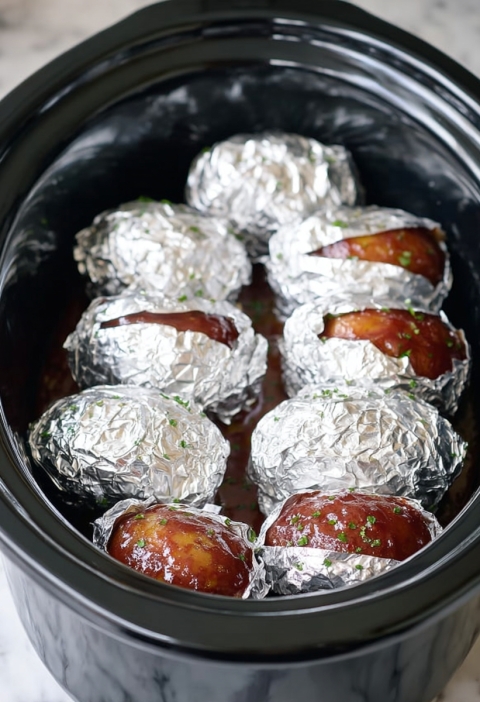
Lid on. Low for four to five hours, or high for two to three. I almost always do low because I’m usually starting this in the morning before work, or right after lunch when I know I won’t want to think about dinner later. The house smells incredible after a few hours — like something good is happening even when you’ve completely forgotten about it.
When the potatoes are tender all the way through (I test with a fork — it should go in with almost no resistance), give everything a gentle stir from the bottom. This is where the magic happens. The melted butter and liquified sour cream have pooled at the bottom, and when you stir, some of the softer potatoes break a little and thicken the whole sauce. Don’t over-stir — you want some potatoes to stay mostly intact. Just enough to coat everything and let the sauce come together.
Taste it. Add salt if it needs it. Then switch to warm and leave it alone until dinner. You might also like our Chef’s Creamiest Mashed Potatoes.
Variations
Adding garlic powder to the sour cream is really good — I just don’t always remember to do it. A few grinds of black pepper are never a bad idea. If I have cooked bacon in the fridge, I stir it in during the last half hour and it’s a completely different, more substantial dish.
Cheese on top — shredded cheddar, sprinkled over in the last ten minutes on HIGH — is also excellent. It turns the whole thing into something closer to a loaded baked potato dish.
Storage
Leftovers keep in the fridge for three or four days. The sauce gets even thicker overnight, which I actually prefer. Reheat in the microwave with a splash of water or a little more sour cream stirred in to loosen things up. Try our Sheet Pan Scored Potatoes next.
I was going to say something about how this is the perfect Easter side dish, and it is, but really — I make this on random Tuesdays in January when I need something warm and I haven’t meal-planned and everyone’s tired. That’s when it earns its keep the most. Easter is just when people notice it and ask for the recipe. The answer is always a little anticlimactic: four ingredients. Really. That’s all. If you like this, you'll love our Mustard Potato Poppers – Crispy, Tangy, and Seriously Habit-Forming.
Slow Cooker Creamy Ranch Potatoes
Want This Recipe Later?
Ingredients
- 2 1/2 lbs baby red potatoes unpeeled, halved if large
- 1 cup sour cream full-fat
- 1/2 cup salted butter cut into pieces
- 1 1/2 tsp salt plus more to taste
Instructions
- Lightly grease the inside of the slow cooker with butter or non-stick spray.
- Rinse and dry potatoes. Halve any larger potatoes so all pieces are similar in size.
- Place potatoes into the slow cooker.
- In a small bowl, stir together sour cream and salt until combined.
- Dollop the sour cream mixture over the potatoes and scatter butter pieces evenly across the top.
- Cover and cook on LOW for 4–5 hours or HIGH for 2–3 hours, until potatoes are fork-tender.
- Gently stir from the bottom to combine the melted butter and creamy sauce without breaking up all the potatoes.
- Taste and adjust salt if needed. Keep warm until ready to serve.
Notes
Nutrition
Made this recipe? Tap a star to rate it.
Nutrition values are estimates based on the listed ingredients and serving count. Actual values vary with brands, cuts and portion sizes.