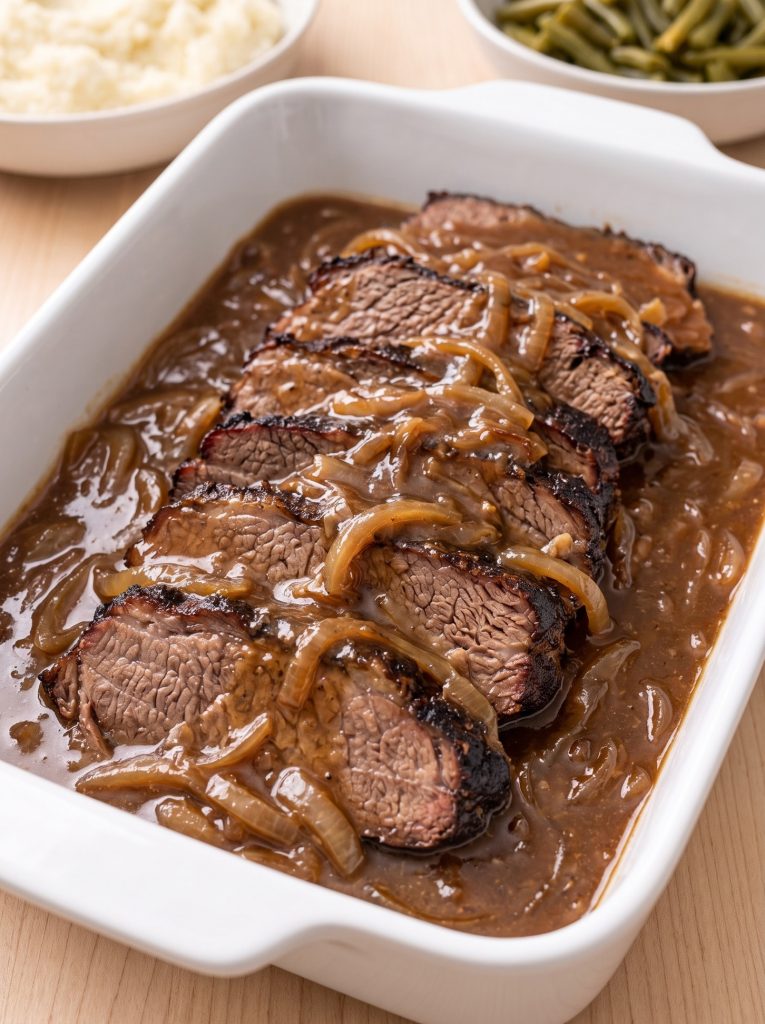
If you’ve ever thought brisket was too complicated to bother with, this recipe is about to change your mind. Three ingredients, ten minutes of prep, and the oven does all the heavy lifting. The result is fall-apart tender beef swimming in a rich brown onion gravy that tastes like you spent all day on it — because in a way, you did, just without actually being there.
Why You’ll Love It
Only 3 ingredients brisket, canned French onion soup, and dry onion soup mix. That’s the whole list.
Minimal hands-on time about ten minutes of actual work, then the oven takes over for three to four hours.
Fall-apart tender every time the sealed foil traps steam and slowly breaks the meat down into something you can pull apart with a fork. Try our Slow Cooker Corned Beef Brisket (Tender, Easy, One-Pot Meal) next.
The gravy makes itself those two soups combine into a thick, deeply savory sauce that tastes like it simmered all day.
Great for a crowd easy to make ahead, holds well, and reheats beautifully with the meat nestled right back in the gravy.
A Few Notes on the Ingredients
The brisket — you want the flat cut, not the point. The point has more fat and more flavor in some ways but it’s harder to slice and can get a little greasy with this method. Flat cut, trimmed of the really thick hard fat but don’t go crazy removing everything. A little fat cap on top is actually good here — it self-bastes as it cooks.
The French onion soup — the canned condensed kind. I use Campbell’s and I’m not going to mess with it. Two of the 10.5-ounce cans. Don’t dilute it, don’t add water. It goes in concentrated.
The dry onion soup mix — one packet. I’ve used Lipton and I’ve used store brand and honestly both are fine. This is where most of the salt comes from, so don’t add extra salt to the meat. Just don’t.
That’s the whole ingredient list. Three things. I know I said that already but it still gets me every time. If you like this, you'll love our Easy Slow Cooker Corned Beef – Fall-Apart Tender Every Time.
Ingredients
– 3½ to 4 pounds beef brisket, flat cut, trimmed of excess hard fat
– 2 (10.5-ounce) cans condensed French onion soup (not diluted)
– 1 (1-ounce) packet dry onion soup mix

Let’s Make It
Preheat the oven to 300°F. Low and slow is the whole point here — don’t rush it with higher heat, I’ve tried, and the meat gets tight and chewy instead of falling apart. 300°F, no shortcuts.
Get out a roasting pan or a deep 9×13 baking dish — something that fits the brisket without it being crammed in but also without a ton of extra space. You want the liquid to pool around the meat, not spread out too thin. I use my older 9×13 glass dish, the one with the slightly chipped corner that I keep meaning to replace.
Set the brisket in the dish fat side up. This matters. That fat cap, whatever’s left of it, will slowly render as it cooks and keep the top of the meat from drying out.
In a bowl, whisk together both cans of French onion soup with the dry onion soup mix. It’ll be thick — almost paste-like at first, then it loosens a little as you stir. It’ll smell very salty and very oniony and that’s correct. Pour it over the brisket, getting the top coated and letting it run down the sides and pool in the bottom of the pan. Use a spoon to scoop the onion bits from the bottom of the bowl over the top of the meat. For another easy option, see our Slow Cooker Beef Brisket.
More recipes you might like


Now — and this part is important, I’ve made the mistake of being lazy about it — cover the pan with heavy-duty foil and seal the edges really well. The steam that builds up inside is doing a lot of the work. If the foil is loose or has gaps, you lose moisture and the brisket can dry out. I actually sometimes use two layers of regular foil if that’s all I have.
Slide it into the oven. Set a timer for three hours and go do something else. Three hours, then check it with a fork — the meat should yield easily, no resistance. A thicker brisket might need three and a half hours, sometimes four. Don’t panic if it needs more time; just recover it and keep going.
When it’s done, take it out of the oven and let it sit — still covered — for at least fifteen to twenty minutes. I know you want to dig in immediately, I know, but the rest matters. The juices redistribute. The meat relaxes a little. It’ll be better.
Move the brisket to a cutting board and slice across the grain — those thin slices, against the direction of the muscle fibers, so it doesn’t pull apart in the wrong way. If it’s very tender, honestly you can just use two forks and pull it into chunks. Either way works. Return everything to the pan with all that gravy and spoon the sauce over the top before you serve it.
Variations and What I’ve Tried
If you want to add a little more depth, a splash of Worcestershire sauce stirred into the soup mixture before it goes in the oven is a good move — a little deeper, a little more umami-forward. I still prefer the original but I understand the impulse.
If the gravy comes out thinner than you want — and it can, depending on the brisket — you can pull the meat out, set the pan on a burner over medium heat, and just let it reduce for a few minutes. Or whisk a tablespoon of cornstarch into two tablespoons of cold water and stir it in; it thickens up pretty fast. I’ve done both.
I’ve also made this with a chuck roast when I couldn’t find brisket and needed to feed a crowd. Same method, same ingredients, just a different cut. It works beautifully, though the texture is different — more pull-apart, less sliceable. Both are good. I’ve stopped apologizing for the chuck roast version because honestly sometimes people like it better. You might also like our Oven Baked 4-Ingredient Chicken Fairmont.
One thing I tried once that I wouldn’t try again: adding mushrooms. They got weird. Soggy in an unpleasant way. Maybe with a different method but not this one.
Leftovers (If You Have Any)
Store the meat in its gravy — this is the most important thing. Dry brisket is sad brisket. Keep everything together in a covered container in the fridge and it’ll reheat beautifully for three or four days. I warm mine in a covered baking dish in the oven at 325°F with a small splash of water added to the pan, just to help things along. The microwave works too, especially if you add a spoonful of the gravy on top before you cover it.
My absolute favorite leftover situation is the next-day sandwich — sliced brisket on a soft roll with some of the gravy spooned over it, maybe a little horseradish if you have it. I don’t know why leftover brisket sandwiches taste so good, but they do. They always do.
I’ve started setting this one down without fanfare — no big announcement, no explanation — and letting people discover it themselves. It’s more fun that way. And honestly, something that asks this little from you and gives this much back kind of earns the understatement. Try our Oven-Baked 3-Ingredients Celery Soup Pot Roast next.
Serve it with mashed potatoes. Warm rolls. Something green so you feel like you tried. If you like this, you'll love our Slow Cooker 3-Ingredient Stuffed Pork Chops.
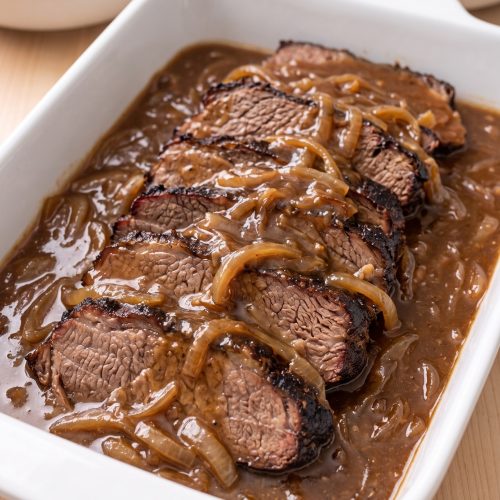
Oven Baked 3-Ingredients French Onion Brisket
Want This Recipe Later?
Ingredients
- 3 1/2 to 4 lb beef brisket flat cut, trimmed of excess hard fat
- 2 cans condensed French onion soup 10.5 oz each, undiluted
- 1 packet dry onion soup mix 1 oz
Instructions
- Preheat the oven to 300°F.
- Place the brisket fat side up in a roasting pan or deep 9x13-inch baking dish.
- In a bowl, whisk together the condensed French onion soup and dry onion soup mix until combined.
- Pour the onion mixture over the brisket, coating the top and letting the sauce run down the sides.
- Spoon any onion bits from the bowl over the top of the brisket.
- Cover the pan tightly with heavy-duty foil, sealing the edges well to trap steam.
- Bake for 3–4 hours, until the brisket is fork-tender and yields easily.
- Remove the pan from the oven and let the brisket rest, still covered, for 15–20 minutes.
- Transfer the brisket to a cutting board and slice across the grain, or pull into chunks if very tender.
- Return the sliced brisket to the pan and spoon the onion gravy over the top before serving.
Notes
Nutrition
Nutrition values are estimates based on the listed ingredients and serving count. Actual values vary with brands, cuts and portion sizes.