
Save This Recipe
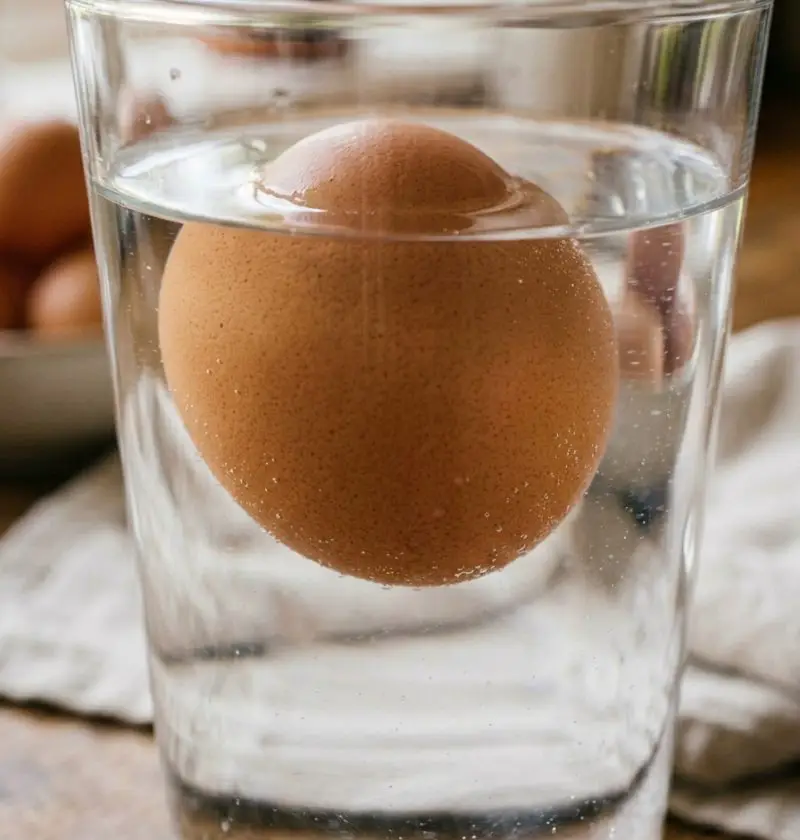
Have you ever cracked open your egg carton in the morning, filled a bowl with water to do that viral “egg test,” and watched one slowly lift off the bottom like a tiny submarine?
It can be weirdly alarming.
One second you’re making breakfast, the next you’re wondering if your eggs have turned against you.
Honestly, the egg float test has been passed around kitchens for generations—long before social media got hold of it—and there’s a reason it stuck around. It works. Mostly. But like a lot of old kitchen wisdom, there’s more nuance than the internet usually tells you.
And that matters, because eggs are too useful (and too expensive these days, let’s be honest) to toss out based on half the story.
So if you’ve ever wondered what a floating egg actually means, whether it’s automatically bad, and why some older eggs are secretly better for certain recipes… let me explain.
First Things First — Why Do Eggs Float At All?
It comes down to something surprisingly simple: air.
Every egg has a tiny air pocket inside. Freshly laid eggs have a very small one. But over time, moisture and gases slowly escape through the shell—yes, eggshells are porous—and air sneaks in.
That air pocket gets bigger.
And bigger.
Eventually, the egg becomes buoyant enough to lift in water.
That’s all floating usually means: the egg is older.
Not necessarily rotten.
That distinction gets lost a lot.
Here’s how the classic float test usually reads:
- Sinks and lies flat: Very fresh
- Sinks but stands upright: Older, but usually fine
- Floats to the top: Very old; use caution
Simple enough, right?
Well… mostly.
Because eggs are a little trickier than that.
The Viral Float Test Isn’t Wrong—It’s Just Incomplete
You’ve probably seen the dramatic videos.
“Floating egg? Throw it out immediately!”
That makes a catchy post. But kitchen life isn’t always that black-and-white.
A floating egg doesn’t automatically equal spoiled.
It signals age.
Spoilage is a separate issue.
That’s important.
An older egg may float and still be perfectly usable, especially for baking or hard-boiling. Meanwhile, an egg that sinks can still be bad if it was mishandled.
See what I mean? Freshness and safety overlap, but they aren’t identical.
That’s where common sense—and your senses—come in.
So… How Do You Actually Tell If An Egg Is Bad?
The float test is Step One.
Step Two is the sniff-and-look check.
And honestly? This is the part chefs trust most.
Crack the egg into a bowl.
Take a look.
A good egg usually has:
- A rounded yolk that sits up high
- Whites that aren’t overly watery
- A neutral smell (or almost no smell)
Warning signs?
- Sulfur smell — big red flag
- Pink, green, or iridescent tones — discard
- Extremely runny whites plus flattened yolk — old, maybe past it
- Anything just… off
You know what?
Your nose usually knows.
People overcomplicate this, but spoiled eggs smell unmistakably awful. You won’t debate it.
You’ll know.
Here’s The Funny Part — Older Eggs Can Actually Be Better
This sounds contradictory, but stay with me.
Very fresh eggs are wonderful for frying and poaching.
But slightly older eggs?
Sometimes better.
Especially for hard-boiled eggs.
Why?
That larger air pocket makes peeling easier.
That’s why many cooks quietly prefer eggs that are a week or two old for deviled eggs or egg salad. Fresh-from-the-farm eggs can be beautiful… and maddening to peel.
A little age can help.
Kitchen paradox, right?
Same with baking.
An older but safe egg can disappear into muffins, quiche, pancakes, Cakes—no issue.
So floating doesn’t always mean “trash.”
Sometimes it means “make potato salad.”
Why Eggs Turn Into Floaters Faster Than They Should
Sometimes eggs age naturally.
Sometimes our fridge habits speed things up.
And this happens more than people realize.
A few sneaky culprits:
1. Storing Eggs In The Fridge Door
That cute built-in egg tray?
Not ideal.
Every time the door opens, temperature shifts.
Eggs hate that.
Better to keep them in the coldest part of the fridge.
2. Tossing The Carton
Keep them in the original carton.
Seriously.
It protects them from moisture loss and keeps them from absorbing odors.
Because yes—eggs can pick up smells.
Garlic-adjacent eggs? Not the dream.
3. Leaving Eggs Out Too Long
Breakfast prep… distractions… coffee…
It happens.
But repeated warming and chilling speeds deterioration.
Consistency matters.
A lot.
What About Sell-By Dates?
Ah yes, the carton date panic.
Here’s the thing:
Sell-by dates often reflect quality, not a sudden safety deadline.
Eggs can usually stay good 3 to 5 weeks refrigerated, sometimes longer, depending on handling.
Which is why the float test can actually be more useful than the printed date.
And if your carton has a Julian packing code—that three-digit number from 001 to 365—that tells you the day of the year the eggs were packed.
Little old-school trick.
The lower the number, the earlier in the year.
The closer to today, the fresher.
Kind of satisfying once you know how to read it.
A Few Handling Mistakes That Age Eggs Fast
Some habits quietly shorten egg life.
And nobody talks about them enough.
Washing eggs at home
Not usually necessary.
Commercial eggs (in places like the U.S.) are already washed.
Extra washing can remove protective barriers.
Using cracked eggs “just this once”
Please don’t.
Even hairline cracks can invite bacteria.
Not worth gambling breakfast over.
Buying eggs and running errands for two hours after
Warm car + groceries + summer heat?
Not great.
Tiny things matter.
Food safety often lives in boring details.
Smart Shopping Helps More Than You Think
If you hate floaters, freshness starts at the store.
A few habits help:
- Check packing dates, not just expiration dates
- Reach toward the back of the shelf (stores often rotate newer cartons there)
- Open the carton and inspect for cracks
- Buy from stores with good turnover
And honestly, farmers markets can be fantastic too.
Fresh eggs often behave differently—firmer whites, richer yolks, all that good stuff.
Once you notice, it’s hard not to care.
Best Ways To Use Older (But Safe) Eggs
Don’t waste good eggs just because they stand upright.
Use them strategically.
Some favorites:
Hard-Boiled Eggs
Maybe the best use.
Easy peeling.
Creamy yolks.
Win-win.
Baking
Cakes, muffins, brownies, quick breads.
No one will know.
Quiche Or Frittata
Perfect.
Everything gets thoroughly cooked.
Egg Salad or Deviled Eggs
Classic move.
Honestly, older eggs often shine here.
Aging has its perks. For eggs too.
But Let’s Be Clear — Sometimes You Really Should Toss It
There is a point where frugality becomes bad judgment.
If an egg floats high and smells bad?
Done.
If you feel uncertain?
Done.
When in doubt, throw it out.
Chefs swear by this for a reason.
Food poisoning is a miserable way to save twenty cents.
Not worth it.
Never worth it.
So… What Is Your Floating Egg Really Telling You?
Usually?
Not “I’m dangerous.”
Just:
“I’m older.”
That’s it.
The float test is less a death sentence and more a clue.
A conversation starter between you and your breakfast.
A weird little science experiment in a cereal bowl.
And kind of a neat one.
Because once you understand air cells, density, and how eggs age, that floating egg stops being alarming and starts making sense.
Which is oddly reassuring.
So next time an egg rises instead of sinks, don’t panic.
Check it.
Crack it.
Trust your senses.
Maybe use it for deviled eggs.
And smile a little at the fact that one of the internet’s favorite kitchen “hacks” is really just old-school kitchen wisdom wearing modern clothes.
Funny how that happens.