
Save This Recipe
There’s something about Meatloaf that feels… steady. Reliable. It shows up on the table the same way it did when you were a kid—warm, filling, not trying too hard. And honestly? That’s kind of the point.
But every now and then, you stand in your kitchen, staring at the same old ingredients, and think, What if I just changed one thing?
That’s exactly where I found myself one evening—ground Beef thawed, onions chopped, egg ready to go—and then, a small problem. No breadcrumbs. Not even a stale heel of bread hiding somewhere.
And that’s when I noticed it. A can of condensed cream of celery soup sitting quietly in the pantry like it had been waiting for its moment.
I hesitated. Then I grabbed it anyway.
Why This Odd Swap Actually Made Sense (Kind Of)
At first, it felt like a shortcut. And if I’m being honest, it was a shortcut.
But the more I thought about it, the more it started to make sense. Meatloaf needs two things to work: something to bind it and something to keep it from drying out. Breadcrumbs usually handle both jobs, but they’re not the only option.
That soup? It’s thick, creamy, and already packed with flavor. Celery, herbs, salt—all the things you’d normally add separately, already in one can.
Still, I had my doubts. Would it make the meatloaf too soft? Too salty? Too… weird?
There was only one way to find out.
Mixing It In—And Immediately Questioning Everything
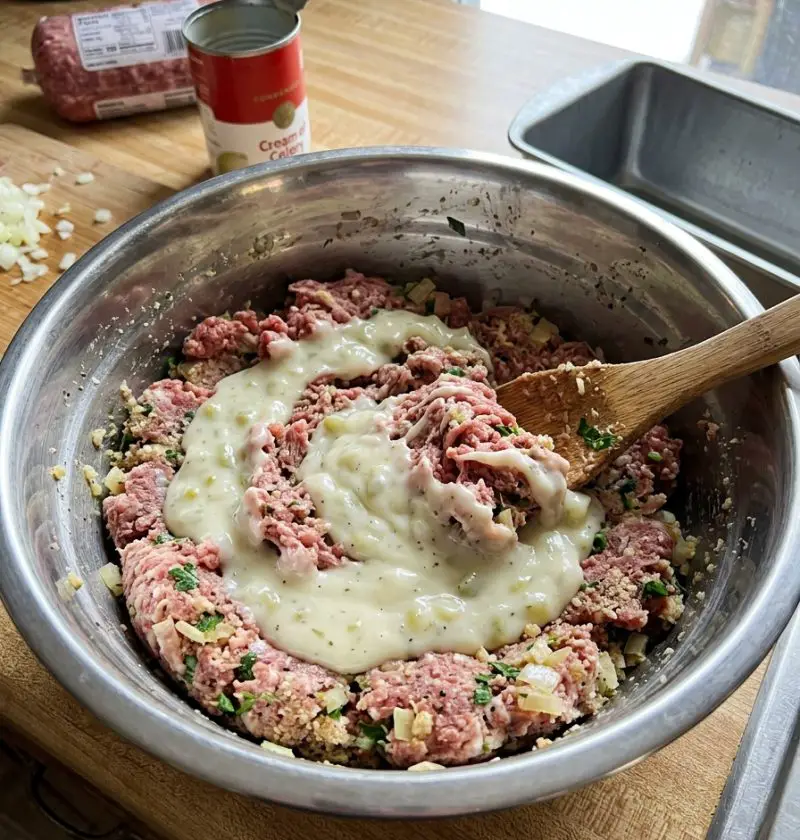
I went with my usual base: ground beef, diced onions, one egg. Then I poured in about three-quarters of the can.
And right away—something felt off.
The mixture was softer. Looser. Not that firm, slightly sticky texture you expect from a classic meatloaf. This was closer to… well, not quite batter, but not far from it either.
You know that moment when you think, I may have just ruined dinner? Yeah. That one.
I almost added flour to fix it. Almost. But instead, I leaned into it and grabbed a loaf pan for backup. If this thing needed structure, I was going to give it structure.
The Kitchen Started Smelling Like Something Worth Waiting For
About twenty minutes into baking, the doubts started to fade.
The smell hit first—that familiar savory meatloaf aroma, but softer somehow. Warmer. There was this subtle celery note in the background, not sharp, not overwhelming, just… there.
It felt like a Sunday dinner kind of smell. The kind that makes people wander into the kitchen asking, “What are you making?”
And suddenly, I wasn’t worried anymore.
The Moment of Truth (And a Surprisingly Good One)
After about an hour at 350°F, I pulled it out.
The top had browned beautifully—slightly darker than usual, with a bit more caramelization. The sides had pulled away from the pan just enough to say, Yep, it held together.
That alone felt like a small victory.
Cutting into it, I expected it to fall apart. It didn’t. It was softer, yes—but still sliceable, still structured. Not mushy. Just… tender.
And then came the first bite.
The Flavor Shift You Don’t Expect (But Kind Of Love)
Here’s the thing—it still tasted like meatloaf.
But better? Different, at least.
There was a subtle creaminess running through it, not heavy, not obvious. The celery added this quiet, herby note that made the whole dish feel more layered without shouting about it.
It didn’t overpower the beef. It didn’t turn it into something unrecognizable. It just nudged the flavor in a slightly richer, more comforting direction.
One of those changes you notice, but can’t fully explain.
So… Did It Stay Moist or Turn Into a Mess?
This was the part I was most nervous about.
But somehow, it landed right in the sweet spot.
The inside stayed moist—really moist—but not soggy. The outer edges held their shape, giving you that contrast you want in a good meatloaf. Soft inside, a little firm outside.
Honestly, it solved one of the most common meatloaf problems: dryness. Especially if you’re using leaner beef, that alone makes this trick worth considering.
The Real Test: Family Reactions
You can analyze flavor all you want, but let’s be real—the real test is always the people at the table.
Mine were… skeptical at first. They know when I’ve “experimented.”
But after a few bites, the mood shifted.
- “This is really good.”
- “It’s softer than usual… but in a good way.”
- “Did you do something different?”
That last one always feels like a win.
And yes, there were seconds.
Let’s Talk About the One Downside (Because There Is One)
Okay, here’s the honest part.
That can of soup brings a lot of sodium with it. More than you might expect. If you’re already seasoning your meat like usual, things can tip into salty territory pretty fast.
It also adds a bit of extra fat and calories—not outrageous, but noticeable.
So is it an everyday trick? Probably not.
But for a once-in-a-while upgrade when you want something easy and a little different? It works.
Would I Do It Again? Yeah… But With a Small Tweak
I would absolutely make it this way again. No question.
But next time, I’d probably:
- Use low-sodium soup if I can find it
- Go lighter on added salt elsewhere
- Maybe mix in a second type of meat (beef + pork would be great here)
Because here’s the thing—it’s not about replacing the classic recipe.
It’s about having another version in your back pocket.
If You Want to Try It, Here’s What I’d Do Differently
If you’re thinking about giving this a shot, a few small tips will make a big difference:
- Use a loaf pan – the mixture is softer than usual
- Don’t overmix – it’s already tender; no need to push it
- Hold back some soup – you can drizzle a little on top if you want extra flavor
- Adjust your salt – seriously, this matters
- Try other soups – cream of Mushroom or even tomato could be interesting
And maybe most important—don’t stress if it feels different while mixing. It will.
A Small Change That Feels Bigger Than It Should
It’s funny how one simple ingredient can shift a recipe you’ve made a hundred times.
Not dramatically. Not in a way that replaces the original. Just enough to make you pause after the first bite and think, Okay… that’s actually really good.
And honestly, those little moments? That’s what keeps cooking interesting.