
Save This Recipe
Nobody asked the question out loud, but someone must have been standing at their kitchen sink one afternoon, scrubbing tarnished silverware for the fourth time that month, and thought: there has to be a better way to do this. Then they crumpled up a piece of aluminum foil, threw it in the dishwasher, and apparently it worked. Now it’s all over TikTok.
I’ll be honest — my first reaction was eye-roll. Viral kitchen hacks have a terrible track record. For every one that actually does something, there are fifteen that accomplish nothing except getting you to waste an ingredient and feel vaguely foolish. But this one nagged at me, because the chemistry behind it is real. Not “someone on Reddit said so” real. Actual, textbook redox reaction real.
So let’s get into it.
What tarnish is, and why it matters
Tarnish isn’t grime. That distinction trips people up, because it looks like dirt and the instinct is to scrub it. But scrubbing tarnish is like scrubbing a bruise — you’re not addressing what actually happened.
What actually happened is that your silver reacted with sulfur compounds in the air. Food, certain fabrics, even humidity speeds it up. The silver bonds with sulfur and becomes silver sulfide — that dull, gray-black film that makes a once-nice fork look like it came out of a yard sale box. It builds slowly if the pieces see regular use. It builds fast if they sit in a drawer for six months untouched.
Traditional polishing works by physically removing that layer. You’re essentially abrading the surface — which is fine for heavy tarnish, but it’s tedious, the chemicals smell unpleasant, and you’re technically removing a microscopic amount of silver each time. Do it enough and it adds up.
The chemistry behind the foil trick
Aluminum is more chemically reactive than silver. That’s the whole thing, really — everything else flows from that one fact.
When aluminum foil sits in hot, alkaline water alongside tarnished silver, electrons move. The aluminum oxidizes, releasing electrons that get absorbed by the silver sulfide on your silverware. Those electrons convert the silver sulfide back into silver. Meanwhile, the sulfur that was bonded to your fork goes looking for something else and finds the aluminum. It bonds there instead, forming aluminum sulfide on the foil.
The tarnish physically migrates from the silverware to the foil ball. The spoon gets its silver back. The foil comes out looking dull and a bit grubby. That’s the reaction working.
Hot water helps. Agitation helps. Alkaline detergent — which most dishwasher tablets are — provides the environment the reaction needs. The dishwasher, conveniently, provides all three simultaneously. You’re essentially running the old aluminum-foil-and-baking-soda method that’s been around for decades, just with the machine doing the work instead of you.
That older method works too, by the way. If you’ve never tried it: line a bowl or basin with foil, dissolve baking soda in hot water, drop in the silverware so it touches the foil, wait a few minutes. Watch the tarnish move. It’s oddly satisfying to see it happen in real time.
The dishwasher version is less dramatic to watch but more convenient for an entire cutlery drawer.
How to do it without screwing it up
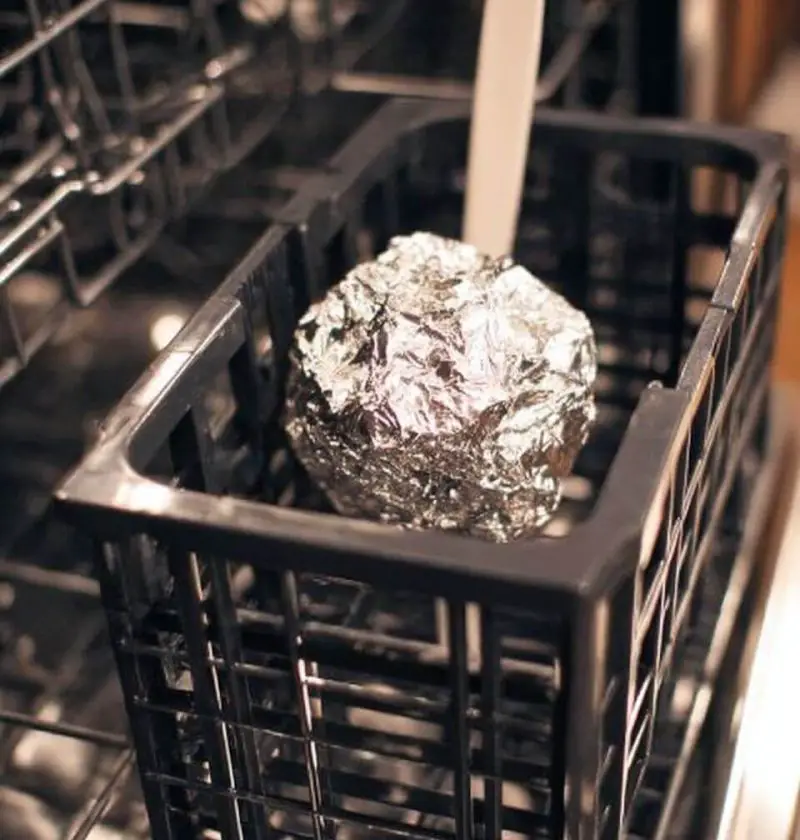
Tear off about a foot of regular aluminum foil — nothing special, whatever’s in your kitchen — and crumple it firmly into a ball around the size of a golf ball. The “firmly” part is important. Loose, spiky foil can scratch surfaces or unfold during the cycle and end up somewhere you don’t want it, like blocking a spray arm. Tight ball, no sharp bits poking out.
Put it in the cutlery basket with your silverware, or wedge it securely on the top rack. The goal is for it to stay roughly where you put it for the duration of the cycle. Add your normal detergent. Run a normal cycle. Open the dishwasher when it’s done and check your silverware.
That’s genuinely the whole process. It takes about forty-five seconds longer than loading the dishwasher normally.
What works and what doesn’t
Silver cutlery, silver-plated flatware — yes. This is what the hack is for. If those forks and spoons have that characteristic dull film, one cycle will make a visible difference.
Stainless steel that’s discolored — sometimes. Stainless doesn’t tarnish the same way silver does, so the reaction is less predictable. Worth trying, low stakes either way.
Glassware, ceramics, your everyday plates and mugs — nothing happens. The reaction is specific to sulfide tarnish on reactive metals. Running a foil ball with your normal load of dishes won’t hurt anything, it just won’t do anything either.
Aluminum cookware and aluminum utensils — no. Hard no. The same chemistry that cleans your silver will corrode aluminum. Don’t put aluminum items in the same load as the foil ball unless you want them to come out looking worse.
Non-stick pans don’t belong in the dishwasher regardless, but especially not in this scenario.
Is it safe for the machine itself?
A tightly crumpled foil ball sitting in the cutlery basket is not going to destroy your dishwasher. These machines handle food debris, small seeds, the occasional rogue olive pit — a compact piece of metal foil isn’t a crisis. Modern dishwashers are more robust than people give them credit for.
The scenario to avoid is a loose ball that unfolds mid-cycle and gets sucked somewhere mechanical. Annoying, potentially a minor blockage, nothing catastrophic — but easily avoided by crumpling tightly to begin with.
If your dishwasher is already acting up in some way, sort that out before introducing anything new into the equation.
Compared to just polishing them
Polishing wins for serious tarnish. If you’ve got silverware that’s been sitting untouched for years and looks nearly black, a foil ball in the dishwasher will improve it, but it probably won’t fully restore it. You’d need a dedicated silver polish and some actual elbow work for that — more effort, more control, better results for the worst cases.
Where the foil hack genuinely earns its place is maintenance. If you use silverware occasionally and want to keep it looking decent without dedicating an evening to polishing it every month, tossing a foil ball in during regular dishwasher cycles keeps tarnish from building to the point where you need serious intervention. It lowers the ceiling on how bad it ever gets.
Think of it as the difference between brushing your teeth and going to the dentist. One is regular upkeep. The other is what happens when you’ve skipped the first one for too long.
What people who’ve tried it actually say
Results split pretty clearly by how tarnished the silverware was going in. Moderately tarnished pieces — the kind that look a bit dull but not dramatically dark — tend to come out noticeably shinier. Some before-and-after photos people have posted online are genuinely striking.
People whose silverware wasn’t very tarnished see less dramatic change, which makes complete sense. Mild tarnish means less silver sulfide, means less material for the reaction to work with. Less input, less output.
A smaller group reports no improvement at all. There are a few possible reasons — detergent without sufficient alkalinity, water chemistry, silverware that’s plated so thinly the underlying metal is affecting things. It doesn’t work perfectly for everyone, every time.
When to skip it entirely
Anything valuable enough that you’d be upset if something went wrong — get it professionally cleaned or do it by hand with proper silver polish. The foil hack is a convenience method, not a restoration technique, and there’s no upside to gambling with something irreplaceable.
Old silverware that’s heavily tarnished also responds better to traditional methods. The redox reaction does its job, but severe tarnish sometimes needs more than one cycle and would just be better addressed with a polish cloth and twenty minutes.
And if the cutlery is aluminum — not silver, not stainless, but actual aluminum — just don’t. Keep it well away from this whole process.
For most people with ordinary silver or silver-plated flatware that occasionally gets dull: a crumpled ball of foil costs nothing, takes no real effort, and is backed by chemistry that actually holds up. It’s one of the rare viral hacks where the science matches the claim. Not magic, just aluminum being more reactive than silver — which it’s been doing since long before TikTok existed.