
Save This Recipe
You’d think this would be simple.
Hot pan, a little oil, meat goes in… done.
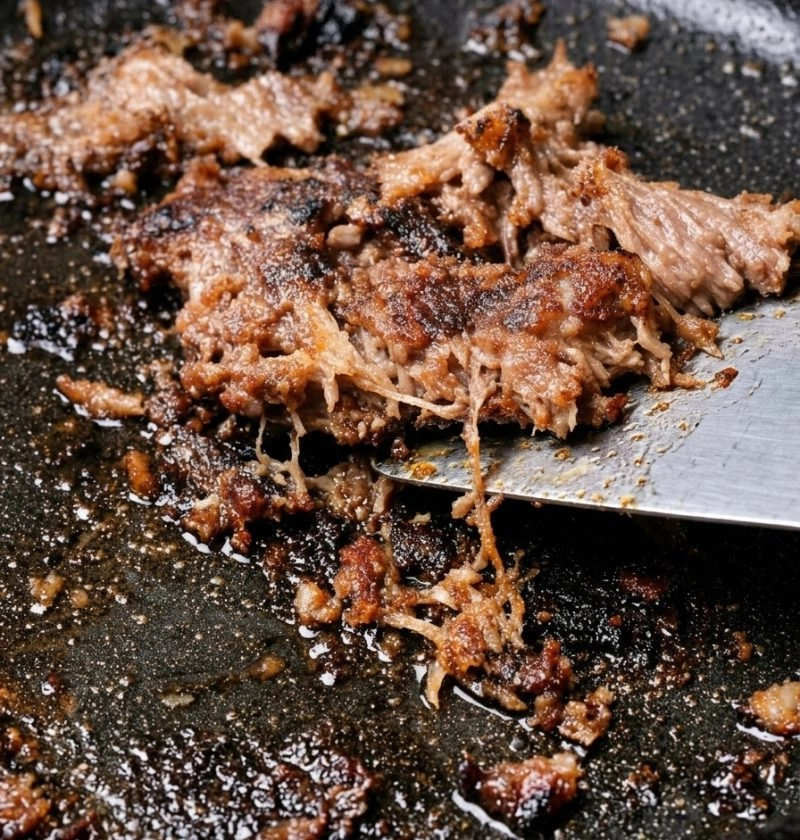
But somehow, instead of that beautiful golden crust, you get a mess. The meat clings to the pan like it has something to prove, tears when you try to flip it, and suddenly dinner feels a lot more stressful than it should.
If you’ve ever stood there scraping bits off a skillet thinking what did I do wrong this time? — you’re not alone.
The annoying part? It’s usually not one big mistake. It’s a bunch of small things that quietly stack up.
Let’s walk through them, the way you’d actually figure it out in your own kitchen.
It Starts Earlier Than You Think (Like… Before the Pan Even Gets Hot)
Here’s something that doesn’t get talked about enough: cold meat is kind of the enemy of a good sear.
When meat goes straight from the fridge into a hot pan, everything tenses up—literally. The proteins tighten quickly, and instead of forming a nice crust, they grab onto the surface of the pan.
It’s not dramatic. It’s subtle. But it’s enough to make a difference.
Letting your meat sit out for 15–20 minutes helps more than people expect. Not because it magically fixes everything—but because it removes that shock factor.
Think of it like jumping into a freezing pool versus easing in. The reaction is completely different.
The Pan Isn’t Actually Ready (Even If You Think It Is)
This one gets almost everyone at some point.
You turn on the heat, wait a minute or two, add oil, and go for it.
But the pan? It’s still catching up.
A properly heated pan has a very specific feel to it:
- the oil shimmers
- it moves quickly when you tilt the pan
- it almost looks thinner
If the oil just sits there, heavy and slow, the pan’s not ready.
And when the pan isn’t hot enough, the meat doesn’t sear—it sort of… settles. And that’s when sticking begins.
Too Much Oil, Not Enough Oil—Yes, Both Can Be a Problem
This part feels a little contradictory, but stay with me.
Too little oil → there’s nothing separating the meat from the pan
Too much oil → the meat doesn’t make proper contact, so it steams instead of sears
And when steaming happens, sticking follows right behind.
You don’t need a pool of oil. Just enough to lightly coat the surface.
Honestly, once you see it, you can’t unsee it—the difference between “just right” and “why is this sliding around like soup?”
The Moisture Problem (This One Is Huge)
If there’s one thing that quietly ruins a sear, it’s moisture.
Even a slightly wet surface will turn into steam the second it hits the pan. And steam is the opposite of what you want here.
Instead of browning, the meat kind of hovers… cooks unevenly… and sticks.
Quick fix, and it’s not fancy at all:
grab a paper towel and pat the meat dry.
That’s it.
It feels like a small step, but it’s one of those things that changes everything.
You’re Flipping It Too Soon (I Know, It’s Hard Not To)
This one’s more about patience than technique.
When meat first hits the pan, it will stick. That’s normal. It’s part of the process.
But after a couple of minutes, something shifts. A crust forms, and the meat naturally releases.
If you try to move it too early, you’re basically fighting that process—and the pan usually wins.
A good rule of thumb:
if it resists, it’s not ready.
Leave it alone for another minute. Then try again.
Not All Pans Behave the Same (This One Took Me a While to Accept)
There’s a big difference between pans, and it matters more than people think.
- Nonstick: forgiving, but you won’t get the best crust
- Stainless steel: amazing browning… but very unforgiving if your timing is off
- Cast iron: kind of the sweet spot once you get used to it
A lot of sticking problems aren’t really “you messing up”—it’s just the pan asking for a different approach.
Stainless steel, for example, rewards patience and heat control. Skip either one, and it punishes you immediately.
Marinades Can Betray You (Especially Sweet Ones)
This one feels unfair, but it’s true.
If your marinade has sugar—think honey, barbecue sauce, even some store-bought mixes—it can burn fast and glue itself to the pan.
So even if everything else is right, you still end up with sticking.
Two easy workarounds:
- shake off excess marinade before cooking
- add sugary sauces later instead of at the beginning
It’s a small adjustment, but it saves you from that sticky, burnt layer.
Crowding the Pan—The Sneaky Mistake
You’re trying to cook everything at once. Totally understandable.
But when the pan gets crowded, the temperature drops fast. And instead of searing, the meat starts releasing moisture.
Which leads to… yep, sticking again.
Sometimes the fix is as simple as cooking in batches. Slightly annoying in the moment, but worth it.
If It’s Already Stuck… Don’t Panic
It happens.
Before you start scraping aggressively (we’ve all done it), give it a second.
Sometimes it just needs more time to release.
If it’s really stubborn, you can:
- gently loosen the edges with a thin spatula
- add a splash of broth or water to deglaze the pan
That usually lifts everything without tearing the meat apart.
The Small Habits That Change Everything
If you put all of this together, it’s actually pretty simple:
- let the meat sit out briefly
- pat it dry
- preheat your pan properly
- use just enough oil
- don’t move it too soon
- don’t overcrowd
That’s it.
No complicated tricks. No fancy equipment.
Just a handful of small habits that, once they click, make cooking feel a lot easier—and honestly, a lot more enjoyable.
The Part No One Tells You
Even when you do everything right, you might still get a little sticking sometimes.
And that’s okay.
It’s part of cooking. It’s part of learning how heat, fat, and food behave together.
But once you understand why it happens, it stops feeling random. You start adjusting without thinking about it.
And that’s when things really get better—quietly, over time.