
Save This Recipe
It started with something small.
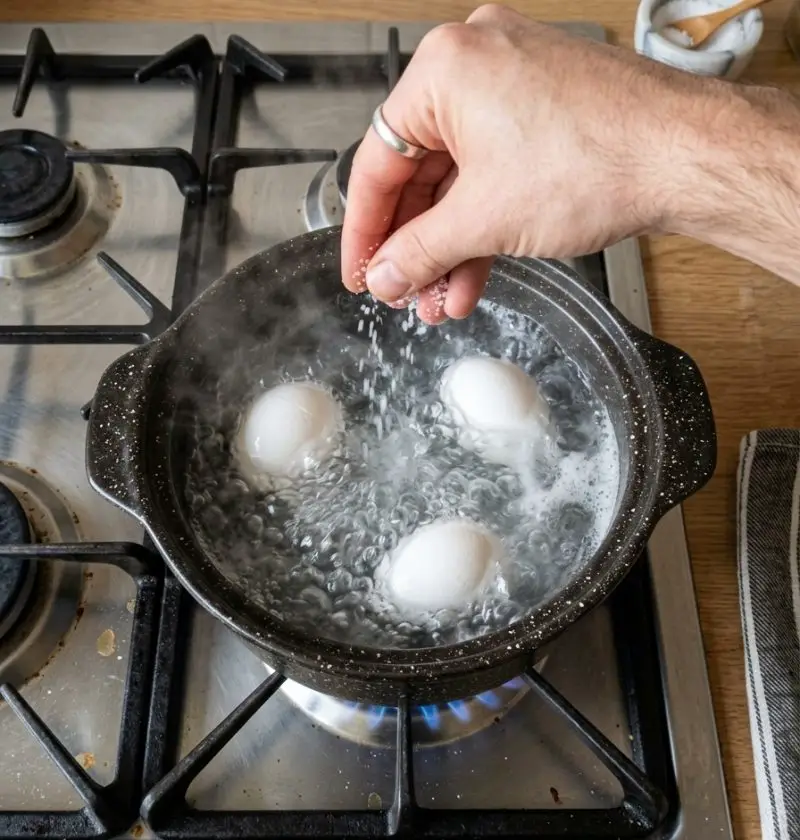
I was at a friend’s house—nothing fancy, just one of those slow weekend brunches where coffee keeps getting refilled and nobody’s in a rush. She was making boiled eggs, chatting away, and without thinking twice, she tossed a pinch of salt into the pot before the water even heated up.
I noticed. Of course I noticed.
And I had that moment—you know the one—“Wait… have I been doing this wrong my whole life?”
Because honestly, boiling eggs feels like the simplest thing in the kitchen… until it isn’t.
Boiling Eggs Should Be Easy… So Why Isn’t It?
Here’s the thing—eggs are deceptively tricky.
On paper, it’s just water + heat + time. But in reality? You’ve got:
- shells that crack at the worst moment
- whites that leak out like they’re escaping
- yolks that go from perfect to chalky in what feels like seconds
It’s a bit dramatic for such a humble ingredient.
What’s happening behind the scenes is actually pretty interesting. As the egg heats up, the proteins—especially in the white—start to tighten and set. That’s what turns it from liquid to solid. But if the shell cracks early, those proteins spill out into the water before they’ve had a chance to firm up.
And that’s where salt enters the conversation.
So… What Does Salt Actually Do Here?
Let me explain in simple terms.
When you add salt to the water, you’re not just seasoning it (because let’s be honest, the shell blocks most of that anyway). What you’re really doing is slightly changing how the water behaves.
And more importantly—how the egg behaves if something goes wrong.
If an egg cracks, even just a tiny hairline crack, the salted water can help the egg white firm up faster as it hits the hot water. Instead of drifting away in wispy strands, it kind of “sets” near the shell.
Is it magic? No.
Does it help a little? Yeah… it actually does.
But Wait—Does Salt Make Water Boil Faster?
This is where things get a little… overhyped.
You’ve probably heard that salt raises the boiling point of water. That part is true. It’s basic kitchen science.
But here’s the part people don’t always mention:
The amount of salt you’d need to make a noticeable difference? It’s a lot. Like, way more than anyone would reasonably add to a pot of eggs.
So in everyday cooking, the difference is tiny. Almost negligible.
In other words:
- Will salt make your eggs cook faster? Not really.
- Will you notice a timing difference? Probably not.
It’s one of those things that sounds impressive but doesn’t change much on your stove.
The Real Reason People Add Salt (It’s Not What You Think)
If you strip it down, most people add salt for one practical reason:
👉 To deal with cracked eggs.
That’s it.
Because if you’ve ever had an egg burst open mid-boil, you know how frustrating it is. The white leaks out, turns cloudy, and suddenly your pot looks like a science experiment.
Salt can help reduce that mess. Not eliminate it—but reduce it.
And honestly? Sometimes that’s enough.
Does It Make the Shell Stronger?
You might hear people say that salt “strengthens” the shell.
That’s… kind of a stretch.
There might be a very slight effect, but it’s not something you’d rely on. If your eggs are going to crack—because of temperature shock, rough handling, or tiny fractures—they’ll crack.
A more reliable trick?
- Let eggs sit out for a few minutes before boiling
- Don’t drop them straight into aggressively boiling water
- Or start them in cold water and bring it up gently
Those steps matter more than the salt ever will.
Other Little Tricks People Swear By
Salt isn’t the only thing people toss into the pot. If you ask around, you’ll hear all kinds of methods—some practical, some… questionable.
A few common ones:
- Vinegar:
Similar idea to salt—it helps egg whites coagulate faster if the shell cracks. Slightly more effective, but you might catch a faint smell. - Steaming instead of boiling:
This one’s actually worth trying. Steamed eggs tend to peel easier and cook more evenly. - Ice bath after cooking:
Not optional in my kitchen. It stops the cooking immediately and helps prevent that gray ring around the yolk.
Funny enough, everyone has their “one trick,” and they’ll defend it like it’s family tradition.
So… Should You Add Salt or Not?
Here’s the honest answer:
It won’t hurt.
It might help a little.
But it’s not essential.
If you’ve had issues with eggs cracking and leaking, adding a pinch of salt is a simple habit that can make things slightly smoother. Nothing dramatic—but noticeable enough.
If your eggs already turn out just how you like them? You’re not missing anything.
Final Thought (Because This Is One of Those Small Kitchen Habits…)
You know what I’ve realized?
Cooking is full of these tiny rituals—things we pick up from family, friends, or random moments like that brunch I mentioned. Some are backed by science, some are just habit, and most fall somewhere in between.
Adding salt to boiling eggs?
It’s one of those in-between things.
Not necessary. Not useless. Just… quietly helpful.
And honestly, those are often the best kitchen tricks—the ones that don’t try too hard but still make your life a little easier.