
Save This Recipe
Holiday meals have a rhythm to them, don’t they?
Same serving dishes, same stories, same “someone always overcooks the Green Beans” situation. And right in the center of it all—like it owns the table—is that glossy, honey-glazed ham. Sweet, predictable, comforting.
Which is exactly why I messed with it.
Not in a dramatic, “reinvent the whole meal” kind of way. Just a small, slightly questionable swap: I used Coca-Cola instead of honey for the glaze. And I’ll be honest—when I first said it out loud, it sounded like something you’d dare someone to try, not serve to guests.
But here’s the thing… it worked. Better than I expected. Maybe better than it should have.
Let me explain.
Wait—Why Cola? (It’s Not as Random as It Sounds)
At first glance, cola and ham don’t exactly feel like natural partners. One belongs at a barbecue, the other at a holiday table.
But if you stop and think about it—just for a second—it starts to make sense.
Coca-Cola isn’t just sweet. It’s got that deep, almost caramel flavor hiding under the bubbles. There’s acidity, too, which doesn’t shout but definitely shows up when heat gets involved. And that combo? Sweet + acid + heat? That’s basically the backbone of a good glaze.
I’d seen versions of this floating around—especially in Southern-style recipes—and the curiosity stuck with me. Not in a “this will change my life” way. More like, huh… I kind of want to see what happens.
So I did.
Building the Glaze (and Trusting the Process… Kind Of)
I started simple.
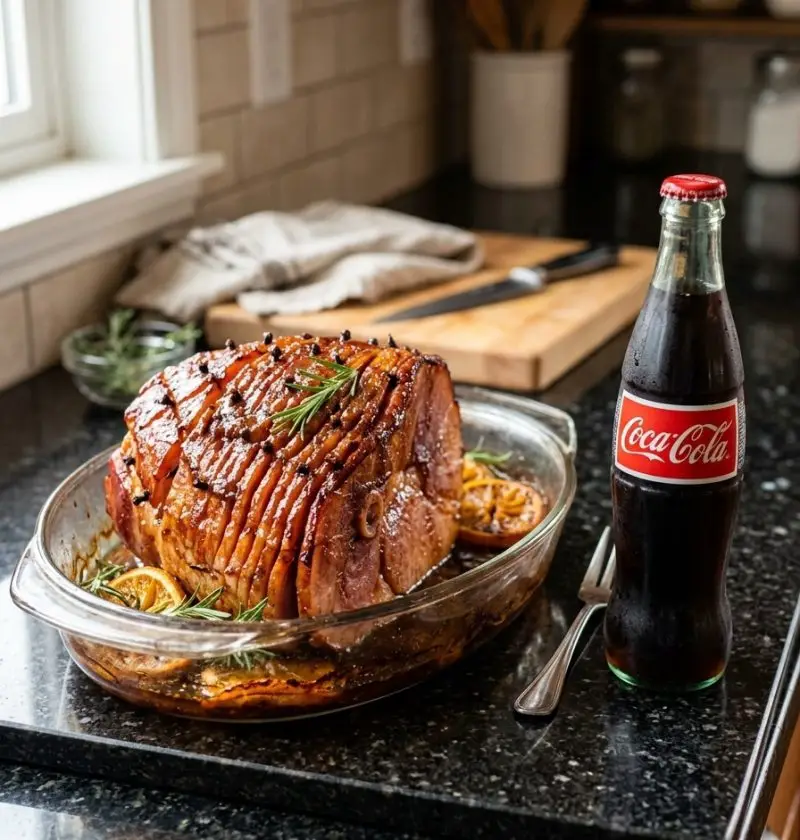
A full liter of Coca-Cola went into a saucepan. It looked… normal. Maybe a little too normal for what I was hoping would become something rich and sticky.
Then I added:
- A spoonful of Dijon mustard
- A pinch of ground cloves
- About half a cup of brown sugar
Nothing fancy. Just enough to nudge the flavor in the right direction.
As it simmered, something interesting happened. The smell changed. Not dramatically, but enough to make me pause. It wasn’t soda anymore. It was warmer, deeper—like caramel starting to form, with a little spice trailing behind.
After about 40–45 minutes, it thickened into something that actually looked like a glaze. Not identical to honey, but close enough to feel like, okay… this might actually work.
Into the Oven: When Things Got Real
I scored the ham (that crisscross pattern—part habit, part ritual), brushed on the glaze, and slid it into the oven.
And then… I waited.
The first hour told me everything I needed to know.
This glaze behaves differently.
It caramelizes faster—noticeably faster. The sugars in the cola don’t mess around. Within an hour, the surface was already turning this deep, rich brown. Not burnt, but definitely heading in that direction if I ignored it.
So I didn’t.
Every 30 minutes, I basted it. Not obsessively, but enough to keep things glossy and controlled. There’s a bit of babysitting involved here—but honestly, that’s part of the fun. You feel like you’re actually cooking something, not just reheating tradition.
A Little Kitchen Science (Nothing Too Nerdy, Promise)
Here’s the part that surprised me most.
Cola isn’t just flavor—it’s chemistry.
It contains acids (like phosphoric acid), which gently break down proteins in the meat. That’s what helps with tenderness. Not in a dramatic, fall-apart way—but enough to notice.
Then there’s the sugar. A lot of it. As it heats, it caramelizes and forms that sticky, slightly crisp crust we all secretly love.
And the carbonation? It fades during cooking, but early on, it helps carry flavor into the surface of the meat.
So no, it’s not magic. But it’s doing more than you’d expect from a soda.
The Big Reveal (You Know This Part Matters)
After about three hours, I pulled it out.
And I’ll say this—the look alone got people’s attention.
The ham had this deep, glossy, mahogany finish. Not the light golden sheen of honey. Darker. Richer. Almost like it had been slow-smoked, even though it hadn’t.
The smell? Sweet, but not one-note. Caramel, a little spice, a hint of something almost smoky.
And there was that quiet sizzle—just a soft crackle as the glaze settled. You know that sound? It’s the one that makes everyone suddenly hover around the kitchen.
The Taste Test (Okay, Here’s the Truth)
I wasn’t sure what to expect with the first bite.
Honestly, I was ready for it to be “interesting but not repeatable.”
It wasn’t that.
It was… good. Really good.
The crust had that perfect balance—sweet, slightly tangy, with more depth than honey usually gives. Not overpowering. Just layered. Like the flavor had a little more to say.
And the inside? Still juicy. Tender without being soft.
There was even a subtle smokiness that I didn’t plan for. It just happened. Probably from the way the sugars caramelized over time.
Texture Check: The Part I Was Worried About
This was my biggest concern going in.
Would the soda dry it out? Make it weirdly soft? Do something unpredictable?
It didn’t.
If anything, it helped the ham stay moist. The acids and sugars worked together in a way that felt… balanced. Each slice held its shape but cut easily.
No dryness. No strange texture.
Just good, solid ham—with a slightly upgraded personality.
What Worked… and What I’d Quietly Change Next Time
Not everything was perfect.
The biggest issue? Burn risk.
That sugar content is no joke. If you walk away too long, it will catch. Covering the ham with foil toward the end helped a lot—next time, I’d do that a bit earlier.
I’d also:
- Add a splash of apple cider vinegar for a little extra brightness
- Maybe play with spices—cinnamon or allspice could be interesting
- Slightly reduce the added brown sugar (the cola already brings plenty)
Small tweaks. Nothing major.
Let’s Talk Sugar (Because Someone Will Ask)
Yes—there’s sugar. A lot of it.
Coca-Cola brings quite a bit, and adding more doesn’t exactly turn this into a “light” dish. But let’s be honest—holiday ham isn’t meant to be light.
It’s a once-in-a-while thing. A centerpiece. A treat.
So no, it’s not healthier than honey. But it’s not wildly different either when you look at how much glaze actually gets eaten.
Moderation still applies. Same as always.
The Guests Said It All
Here’s where it got interesting.
People noticed.
At first, there was hesitation—“Wait, you used what?”—but after one bite, that changed quickly.
A few went back for seconds. One asked for the recipe before finishing their plate. And someone—who normally insists on tradition—said they actually preferred it.
That was the moment I knew this wasn’t just a one-time experiment.
So… Would I Do It Again?
Yeah. I would.
Not every year. There’s something to be said for the classic honey glaze—it’s familiar for a reason.
But when you feel like shaking things up just a little? When you want people to pause mid-bite and say, “Wait, what is that?”
This is a fun way to do it.
It’s Unexpected. It’s a little bold. And somehow, it still feels right at home on a holiday table.
And honestly? Those are the recipes that tend to stick around.