
Save This Recipe
We'll email this post to you, so you can come back to it later!
Meatloaf is one of those meals you don’t overthink.
You mix it, shape it, maybe glaze it with ketchup if you grew up that way, and call it a night. It’s dependable. Not exciting, but comforting in that very specific, “Sunday evening, nothing fancy” kind of way.
So I’m not entirely sure what possessed me to reach for grape jelly.
It wasn’t planned. It wasn’t a recipe I found. It was more like—what if this actually works? And also a little bit of, this might be a terrible idea but I’m already halfway in.
Anyway. I did it.
And an hour later, I had… opinions.
Why Grape Jelly Even Crossed My Mind
I wish I could say this was some brilliant flavor strategy.
It wasn’t.
I’ve seen people use sweet glazes before—brown sugar, honey, even those cocktail meatballs with grape jelly and chili sauce. So the idea wasn’t completely out of left field. Just… slightly questionable in this context.
But grape jelly has that specific thing going on. Sweet, obviously, but also a little tangy. And when you heat it, it turns glossy in a way that just looks good on food.
So I figured, worst case? I waste a meatloaf.
Best case… maybe something interesting happens.
The Meatloaf Itself (Nothing Weird Here)
I didn’t mess with the base too much. If this was going to go wrong, I wanted it to be because of the jelly, not everything at once.
- Ground beef + a bit of pork (about 2 pounds total)
- Breadcrumbs, milk, one egg
- Garlic powder, onion powder, smoked paprika
- A sautéed onion because I’ve learned the hard way raw onion doesn’t always soften enough
Mixed it, shaped it, onto a lined baking sheet.
Into the oven at 350°F.
At this point, everything felt normal. Safe. Predictable.
The Moment It Got Weird
After about 30 minutes, I pulled the meatloaf out.
It was already holding its shape, starting to brown a little—basically right where you’d normally add ketchup or BBQ sauce.
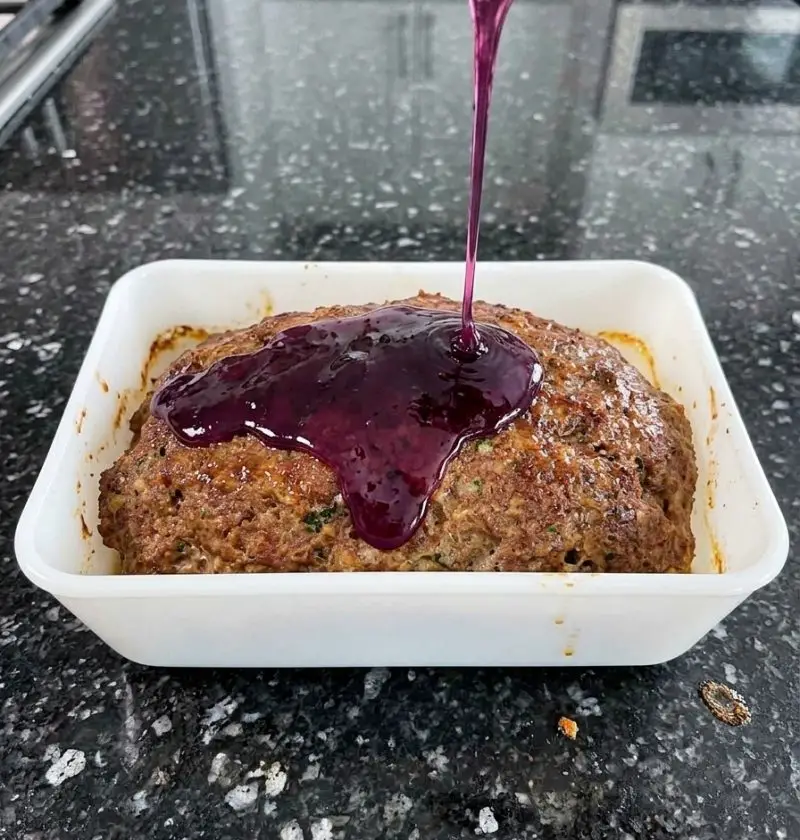
Instead, I had a small saucepan with melted grape jelly.
I remember hesitating for a second.
Because it looked like… well, purple syrup.
But I brushed it on anyway. A pretty generous layer too. No half measures at that point.
Back into the oven it went.
What Happened Pretty Much Immediately
Within maybe 10–15 minutes, the smell changed.
Not in a bad way. Just… different.
Sweeter, obviously, but also kind of deeper. Like the sugars were starting to cook down and blend with the meat. It didn’t smell like dessert. That’s what I was worried about. It still smelled like dinner.
And the surface started bubbling slightly.
That’s when I thought, okay, something is happening here.
The Crust Was Not What I Expected
By the time it finished cooking, the outside had turned into this glossy, slightly sticky layer.
Not runny. Not jam-like.
More like a thin, caramelized coating.
And the color—this deep reddish-purple—honestly looked better than I expected. Rich, almost like a lacquered glaze.
When I cut into it, the knife had that slight resistance on the outside, then went straight through the soft center.
That contrast alone was… kind of satisfying.
The Taste (This Is Where It Could’ve Gone Wrong)
Here’s the part I was ready to hate.
But I didn’t.
It wasn’t overly sweet. That’s the first thing. The meat kind of balanced it out. You got that savory, slightly fatty richness first, and then the sweetness came in after.
Not strong. Just there.
And weirdly—it worked.
It reminded me a little of those sweet-and-savory sauces you get with meatballs or even some barbecue sauces that lean sweet. Just… less smoky, more subtle.
I kept taking bites trying to figure out if I actually liked it or if I was just surprised.
I liked it.
Texture Was Probably the Best Part
This is the thing I didn’t expect to notice as much as I did.
The outside had this slightly sticky, almost lightly crisp edge in spots. Not crunchy like fried food—but enough to contrast with the inside.
And the inside stayed soft, juicy, exactly how meatloaf should be.
That combination? That’s what made it feel different from a regular meatloaf. Not just the flavor.
The Real Test: Other People
I wasn’t trusting my own judgment at that point.
So I had other people try it.
Initial reactions were exactly what you’d expect:
“Wait… grape jelly?”
But after the first bite, the reactions changed pretty quickly. Not dramatic, just… surprised.
One person said it tasted “like something you’d get at a potluck but slightly upgraded,” which weirdly felt accurate.
Nobody thought it was strange once they tasted it. That’s probably the best way to put it.
Why This Actually Works (Even If It Sounds Wrong)
I thought about this after, because it really shouldn’t work as well as it does.
But it comes down to a few simple things:
- Sugar caramelizes when it heats up, which adds flavor
- A little acidity (which grape jelly has) balances rich meat
- That sticky texture helps form a glaze instead of soaking in
It’s basically doing what a sweet barbecue sauce does—just from a different angle.
What I’d Change Next Time
Because yeah, I’d make it again.
But I’d tweak a couple things:
- Maybe mix the jelly with a little mustard or vinegar to cut the sweetness slightly
- Use a thinner layer—mine was generous, borderline excessive
- Possibly add herbs to the meat (thyme or rosemary could work)
Nothing major. Just small adjustments.
So… Would I Recommend It?
Honestly?
Yeah.
Not as your only way to make meatloaf. But as something to try when you’re bored of the usual version.
It’s one of those ideas that sounds like it shouldn’t work—but then it quietly does.
And once you try it, you kind of stop questioning it.
The Bottom Line (If You’re On the Fence)
If you’re curious, try it.
Worst case, it’s a slightly sweet meatloaf and you go back to ketchup next time.
Best case… you accidentally find a version you like better.
And honestly, that’s kind of the fun part of cooking anyway.