
Save This Recipe
You know what? Some of the most stubborn kitchen arguments don’t start over big things. They start over small, everyday habits. How to store bread. Whether pasta water should be salty like the sea. And, yes, what that long metal rod in the knife block is actually doing.
If you’ve ever watched someone swipe their knife a few times on a honing rod and proudly say, “All sharpened,” while someone else quietly raises an eyebrow, you already know where this is headed.
It sounds technical, but it’s really not. It’s more about language and expectations than anything else. And once you sort that out, the whole thing gets a lot less tense and a lot more useful.
So let’s talk about it, the friendly way, like we’re leaning against the counter waiting for the onions to finish sautéing.
Why Sharp Knives Matter More Than We Like to Admit
First things first. Sharp knives aren’t about showing off or pretending you’re on a cooking show. They’re about comfort and safety.
A dull knife:
-
Needs more pressure
-
Slips more easily
-
Smashes food instead of slicing it
That last part might sound harmless, but it changes how food cooks and even how it tastes. Tomatoes get crushed. Herbs bruise. Chicken tears instead of cutting clean.
And safety? A dull blade is more likely to skid off food and toward your fingers. Not exactly what anyone wants on a Tuesday night making stir-fry.
So yes, keeping knives in good shape matters. It makes cooking calmer. Less fight, more flow.
The Big Mix-Up: Why Honing and Sharpening Get Confused
Here’s the heart of the problem: we use the word sharp to describe how a knife feels. And honing often makes a knife feel sharper, even though it’s not technically sharpening it.
That’s where the wires get crossed.
So someone uses the rod, the knife cuts better, and naturally they think, “Well, I sharpened it.” Fair enough. From their point of view, something worked.
But what really happened is a little different.
What a Honing Rod Actually Does (Plain and Simple)
Inside every knife edge, there’s a very thin line of metal. Over time, that edge doesn’t just wear down. It also bends. Tiny amounts, but enough to matter.
Picture a row of grass after people have walked through it. The blades are still there, just leaning in different directions.
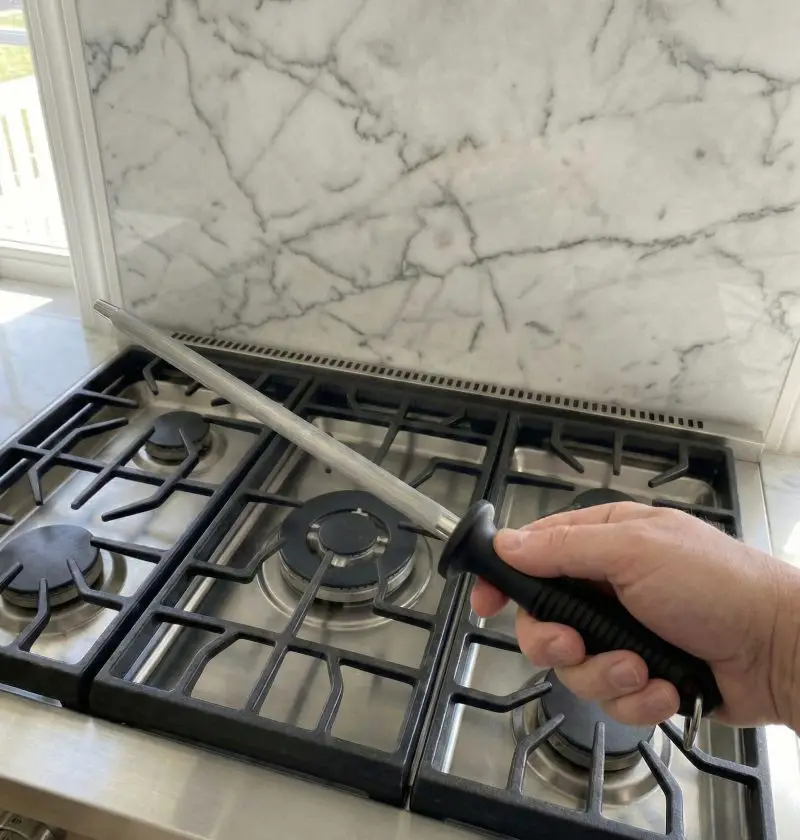
A honing rod:
-
Pushes that bent edge back into line
-
Straightens what’s already there
-
Makes the blade feel crisp again
It doesn’t grind away metal. It doesn’t rebuild the edge. It just tidies it up, so to speak.
That’s why chefs use honing rods so often. A few quick swipes during service keep knives behaving nicely between real sharpening sessions.
So yes, honing is helpful. Very helpful. It just isn’t the whole story.
What Sharpening Really Means (and Why It Feels Different)
Sharpening is where metal actually gets removed from the blade. Just a tiny bit, but enough to form a brand-new edge.
This happens when you use:
-
Sharpening stones
-
Pull-through sharpeners
-
Electric sharpeners
All of these have abrasive surfaces that reshape the blade. They take off dull metal and leave behind a fresh, clean edge that comes to a point again.
That’s why sharpening takes longer and feels more serious. Because it is.
And it’s also why you don’t need to do it every week. A good knife doesn’t need constant grinding. That would wear it down too fast.
Why Honing Alone Can’t Rescue a Truly Dull Knife
Here’s where family debates often get stuck.
If the edge is just bent, honing works wonders. But if the edge has actually worn away, there’s nothing left to straighten. You can swipe that rod all day and it won’t bring back what isn’t there anymore.
It’s like trying to comb hair that’s been cut too short. The comb isn’t the problem. There’s just nothing to fix.
That’s when sharpening becomes necessary. Not because someone did something wrong, but because the knife has simply reached that stage.
How Often Should You Hone vs Sharpen?
This part surprises people.
Honing?
You can do that often. Every few cooking sessions if you want. Some folks do it every time they cook.
Sharpening?
Much less often. For most home kitchens, every few months is plenty. Maybe more if you cook daily. Maybe less if the knives don’t get much action.
If your knife feels better after honing, great. Keep doing it. But when honing stops making a difference, that’s your sign it’s time for sharpening.
No drama required.
A Little Story (Because These Things Are Never Just About Knives)
I once watched a perfectly polite discussion turn into a full-blown standoff between two people who both cared very much about feeding the family well.
One insisted the rod was all anyone needed. The other kept saying, “No, it’s still dull.”
They were both right, in their own way.
One was talking about maintenance. The other was talking about repair.
Once that clicked, the whole mood changed. We sharpened the knife, had a laugh, and moved on to dessert.
Funny how fast things calm down when everyone feels heard.
How to Tell What Your Knife Actually Needs
You don’t need special tools for this. Just a little observation.
Try these:
-
Paper test: Can it slice cleanly through a sheet of paper?
-
Tomato test: Does it pierce the skin easily, or does it skid?
-
Honing test: Does the rod noticeably improve things?
If honing helps, great. If it doesn’t, sharpening is the next step.
No judgment attached. It’s just maintenance, like rotating tires.
Different Ways People Sharpen at Home
Now, sharpening can sound intimidating, but it doesn’t have to be.
Some options folks use:
-
Sharpening stones: Old-school, very effective, takes practice
-
Pull-through sharpeners: Simple, quick, good for busy kitchens
-
Electric sharpeners: Fast and consistent, though a bit aggressive on blades
Purists love stones. I admire them. Truly. But not everyone wants to stand at the counter learning angles after a long day. And that’s okay.
What matters more than the method is that sharpening actually happens at some point.
A Few Myths That Refuse to Leave the Kitchen
Let’s clear up a couple things while we’re here.
Myth: The honing rod sharpens the knife.
It helps, but it doesn’t create a new edge.
Myth: You can’t ruin a knife with home sharpeners.
You absolutely can if you’re too rough or use poor tools.
Myth: Only expensive knives need sharpening.
All knives do. Cheap ones just lose their edge faster.
And no, rubbing your knife on the bottom of a coffee mug isn’t a long-term plan. Clever in a pinch, sure. But not exactly a care routine.
Talking About This Without Starting a Kitchen Cold War
Here’s the thing. Most people aren’t wrong. They’re just using different words for different jobs.
So instead of saying, “That’s not sharpening,” try:
-
“Honing keeps it going, but sharpening brings it back.”
-
“This rod straightens it, the stone rebuilds it.”
Or better yet, just show the difference. A quick pass on a sharpener followed by a tomato test usually makes the point without saying much at all.
Food tends to settle arguments faster than lectures.
Small Habits That Keep Knives Happier Longer
While we’re at it, a few quiet habits can save you sharpening sessions down the road.
-
Use proper cutting boards. Wood or rubber, not glass or stone.
-
Don’t toss knives in the sink. They bang around and dull faster.
-
Store them safely. Blocks, magnetic strips, or blade guards all help.
It’s not about being fancy. It’s about not undoing your own hard work.
So, Who’s Right in the Honing vs Sharpening Debate?
Honestly? Both sides usually care about the same thing: having knives that work well.
Honing keeps an edge behaving.
Sharpening rebuilds an edge that’s worn down.
They’re partners, not competitors.
Once you see it that way, the argument kind of melts away. And what’s left is just a better knife and, hopefully, a calmer kitchen.
And if this little bit of know-how saves even one family dinner from turning into a quiet standoff over the cutting board, I’d say that’s a win worth keeping.
After all, we’ve got better things to argue about. Like whether cornbread should be sweet. But that’s a conversation for another day.