
Save This Recipe
We'll email this post to you, so you can come back to it later!
You’ve probably seen it somewhere — a quick DIY remedy involving castor oil and Baking Soda, usually described as a kind of miracle fix. Clearer skin, less pain, better hair… it almost sounds too neat, doesn’t it?
Well, here’s the thing. It’s not magic. But it’s not nonsense either.
Somewhere between old-school home remedies and modern curiosity, this combination has stuck around for a reason. And honestly? When you understand what each ingredient actually does, it starts to make a lot more sense.
Castor Oil: Thick, Sticky… and Surprisingly Useful
Let’s start with castor oil. It’s one of those ingredients people either swear by or avoid completely because of its texture.
Derived from the seeds of Ricinus communis, it’s rich in ricinoleic acid — a fatty acid that’s known for calming inflammation and dealing with microbes. That’s the technical side. In real life, it means this:
- It helps soothe irritated skin
- It locks in moisture like a barrier
- It carries other ingredients deeper into the skin
That last part? It matters more than people think.
Because castor oil doesn’t just sit on the surface. It kind of… lingers. And while it’s there, it helps whatever you mix with it stay in contact longer.
Baking Soda: Not Just for the Kitchen Shelf
Now baking soda — or sodium bicarbonate — is a different story.
It’s dry, powdery, and honestly a bit harsh if used the wrong way. But in controlled amounts, it has a few interesting traits:
- It gently exfoliates (think: removing dead skin buildup)
- It shifts pH levels slightly, which can affect bacteria
- It absorbs odors and excess oil
That’s why you’ll find it in everything from toothpaste to deodorants.
But here’s where things get tricky. On its own, baking soda can be too abrasive, especially for sensitive skin. And that’s exactly where castor oil changes the equation.
So… What Happens When You Mix Them?
It’s not some chemical breakthrough. There’s no dramatic reaction bubbling in a bowl.
What actually happens is simpler — and maybe more practical.
The oil softens the intensity of the baking soda. The baking soda adds a mild exfoliating and cleansing effect to the oil. Together, they create a paste that:
- Stays on the skin long enough to do something
- Scrubs gently without being overly aggressive (if used properly)
- Helps clean pores while keeping the skin from drying out too fast
It’s a balance. Not perfect, but interesting.
Let’s Talk About the “10 Benefits” — With a Bit of Honesty
You’ve probably seen bold claims. Let’s tone them down just enough to keep things real.
1. Acne and blemishes
Yes, it can help clean pores. But overuse? That might irritate your skin instead.
2. Joint and muscle discomfort
The warmth + massage effect matters here as much as the ingredients.
3. Skin hydration
This one’s mostly the castor oil doing the heavy lifting.
4. Hair and scalp care
It may help with dryness. But it’s not a miracle growth serum.
5. Natural deodorant
Baking soda handles odor; oil prevents dryness. Simple.
6. Digestive support
Let’s be clear — this mixture is not meant to be eaten.
7. Skin balance
It can shift surface conditions slightly, but your body regulates pH on its own.
8. Soothing irritation
Helpful for mild cases, not a substitute for proper treatment.
9. “Detox” claims
This is where things get exaggerated. Skin doesn’t “pull toxins out” like that.
10. Oral health
Baking soda alone? Sure. This mix? Not really recommended.
See the pattern? Useful — but not miraculous.
Making the Mixture (No Lab Required)
Honestly, this part is refreshingly simple.
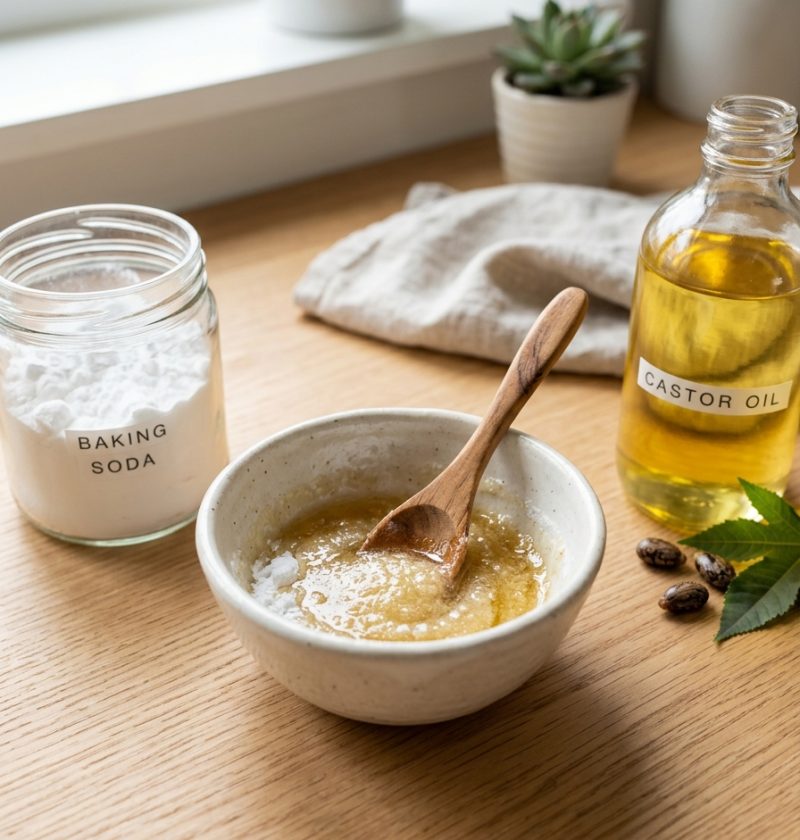
- 1 tablespoon castor oil
- 1 teaspoon baking soda
Mix until it forms a paste. That’s it.
If it feels too gritty, add a bit more oil. Too runny? A pinch more baking soda.
No need to over-engineer it.
How People Actually Use It
This is where intention matters more than quantity.
- For skin: apply lightly, leave for 15–20 minutes
- For scalp: massage gently, rinse well after
- For sore areas: apply and cover with a warm cloth
And here’s a quiet truth — using it less often usually works better.
Once or twice a week is plenty.
A Quick Reality Check (Worth Reading, Honestly)
Natural doesn’t always mean harmless.
A few things to keep in mind:
- Baking soda can irritate sensitive skin
- Overuse can disrupt your skin barrier
- This is not a replacement for medical care
- Patch testing isn’t optional — it’s necessary
If something feels off, stop. Simple as that.
So, Is It Worth Trying?
Here’s the balanced answer.
If you’re curious about simple, low-cost remedies — yes, it’s worth experimenting with carefully. The ingredients are accessible, the prep is easy, and in some cases, the results are genuinely helpful.
But if you’re expecting dramatic, overnight changes… you might be disappointed.
And maybe that’s the point.
Sometimes the value of these remedies isn’t in big transformations. It’s in small, consistent improvements — the kind you notice gradually, almost by accident.
Final Thought: Simple Doesn’t Mean Basic
There’s something oddly reassuring about remedies like this. No fancy branding, no complicated routine — just two ingredients people have trusted for generations.
Does it solve everything? Not even close.
But used with a bit of awareness, it can still earn its place on the shelf.
And honestly, that’s more than enough.