
Save This Recipe
There are certain internet hacks that sound ridiculous right up until the moment you try them yourself. Soaking your feet in blue mouthwash definitely falls into that category.
Honestly, the first time I heard about it, I laughed. Mouthwash belongs in your bathroom cabinet beside toothpaste and floss—not sloshing around in a foot basin like some kind of spa treatment from a late-night infomercial. But the more I looked into it, the more curious I became.
People online were swearing it softened cracked heels, reduced foot odor, soothed soreness, and even helped with funky toenails. Big claims for something that usually burns your gums at 7 a.m.
So I tried it. Five days straight.
And weirdly enough? Some of the results were better than I expected.
Wait… Why Would Mouthwash Work on Feet?
Here’s the thing: blue mouthwash isn’t just minty water. Most formulas contain antiseptic ingredients meant to kill bacteria inside your mouth. Feet, as it turns out, have a bacteria problem too. A sweaty one.
Foot odor usually happens when bacteria break down sweat trapped inside socks and shoes. Add moisture and warmth, and suddenly your sneakers become a tiny greenhouse for microbes. Gross, yes—but normal.
That’s where mouthwash enters the picture.
Many popular brands contain ingredients like:
- Ethanol (alcohol)
- Menthol
- Thymol
- Eucalyptol
- Methyl salicylate
Those ingredients sound like they belong in a chemistry set, but together they create antibacterial and antifungal effects. Menthol also gives that icy-cool sensation people associate with “clean.”
In theory, soaking your feet in it could reduce bacteria, dry excess moisture, and freshen skin at the same time.
It sounded half science experiment, half grandma remedy. Naturally, I was in.
My Setup Was Almost Embarrassingly Simple
No fancy spa gadgets. No expensive foot masks.
I poured:
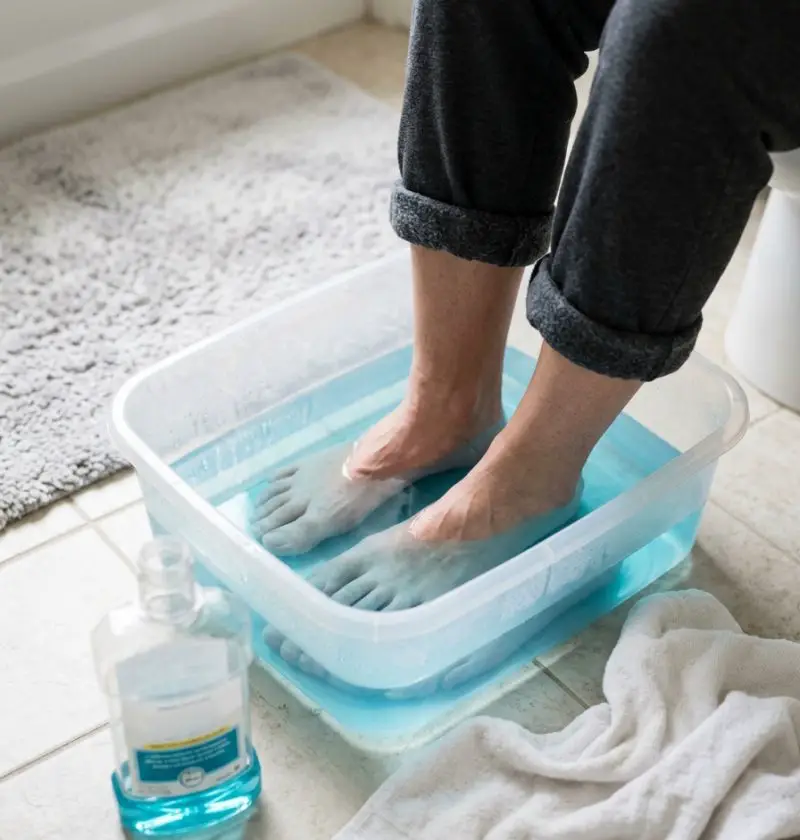
- 1 cup blue mouthwash
- 2 cups warm water
into a plastic basin and soaked my feet for about 20 minutes every evening.
That was it.
Well, technically I also grabbed a towel, put on a podcast, and pretended I had my life together for those twenty minutes. Tiny details.
The warm water mattered more than I expected. It helped relax my feet after long days and seemed to make the whole treatment feel less harsh. Straight mouthwash would’ve been intense.
One thing I made sure to do afterward: dry my feet completely. Especially between the toes. Moisture hanging around too long defeats the whole point.
Day One: Cold, Tingly, Surprisingly Refreshing
The first sensation hit immediately—that icy menthol feeling.
If you’ve ever used peppermint foot cream after a long walk, it felt similar. Cooling. Sharp. Weirdly energizing.
There was also a mild tingling from the alcohol content, but nothing painful. No burning, no redness, no “why did I do this to myself?” moment.
My feet felt extremely clean afterward. Not softer yet, necessarily. Just… fresh. Like they’d been pressure-washed with mint.
And yes, the smell was intense. My bathroom briefly smelled like a dentist’s office.
By Day Three, Things Started Changing
This is where I got genuinely surprised.
The rough skin around my heels started feeling smoother. Not magically baby-soft, obviously, but noticeably less dry. The flaky patches around the edges of my feet looked calmer too.
I think the combination of soaking plus the alcohol and oils gently loosened dead skin over time. Sort of like a mild exfoliation effect.
Now, I should say this clearly: it didn’t replace a proper pumice stone or a real pedicure. Let’s not get carried away. But for something that cost less than a coffee? Pretty decent.
And then there was the odor situation.
Gone. Almost completely.
That might’ve been the most dramatic improvement of the whole experiment.
The Odor Difference Wasn’t Subtle
Usually after a full day in sneakers, there’s at least some lingering smell. Especially during warmer weather.
By the second day, I noticed my feet stayed fresher longer. By day five, even my shoes smelled better—which I honestly wasn’t expecting.
The antibacterial ingredients are probably doing most of the heavy lifting there. Less bacteria means less odor. Pretty straightforward.
And unlike vinegar soaks—which absolutely work but smell like a salad dressing accident—mouthwash leaves behind a cool mint scent that actually feels pleasant.
Small win, but still a win.
What About Toenails?
I wasn’t expecting much here, but my toenails did look cleaner and slightly brighter by the end of the experiment.
Nothing dramatic. No miracle before-and-after transformation worthy of a TV commercial.
Still, the antifungal properties in some mouthwash ingredients may help create a less friendly environment for fungus over time. That’s probably why this hack keeps popping up in discussions about athlete’s foot and nail care.
That said, if someone has a real fungal infection, this probably shouldn’t replace medical treatment. Home remedies can help with mild issues, but they’re not magic. Sometimes TikTok forgets that part.
The Part Nobody Talks About Enough
The relaxing ritual itself might be half the benefit.
Seriously.
There’s something oddly calming about stopping for twenty minutes and taking care of your feet. Most of us ignore them until they hurt. Then suddenly we’re buying insoles at a pharmacy like we’re negotiating a hostage situation.
The warm soak forced me to slow down at the end of the day. The cooling menthol helped tired feet feel less heavy. Even mentally, it felt restorative.
Kind of like how making tea tastes better when you’re stressed—not because the tea changed your life, but because you finally paused for a second.
But There Are Downsides
I can see this going badly for some people.
The alcohol content can absolutely dry out sensitive skin if used too often. By day five, I noticed a little tightness around my heels. Not painful, just dry.
If someone already struggles with cracked skin, eczema, or irritation, this might backfire fast.
And definitely avoid it if you have cuts or blisters. Mouthwash in open skin sounds exactly as unpleasant as you think it does.
A patch test is probably smart if your skin reacts easily to products.
Also—and this should go without saying—don’t use boiling water. Your feet are not potatoes.
How It Stacks Up Against Other Foot Soaks
I’ve tried Epsom salt soaks before, and they’re excellent for soreness and swelling. Vinegar soaks are strong against odor and fungus but smell awful.
Mouthwash sits somewhere in the middle.
It doesn’t soothe muscles as deeply as Epsom salt, and it’s probably less aggressive than vinegar for fungal issues. But it wins in freshness and overall experience.
It feels cleaner. Cooler. Less medicinal.
Plus, it’s already sitting in most bathrooms, which makes it one of those oddly convenient hacks people keep coming back to.
So… Would I Actually Recommend It?
Surprisingly, yes.
Not as a miracle cure. Not as a replacement for proper foot care. But as a simple, affordable home treatment for odor, mild roughness, and that “my feet feel gross after work” feeling? It genuinely helped.
I’d probably use it once or twice a week instead of daily. That seems like the sweet spot.
And honestly, that’s the funny part about these strange internet remedies. Most are nonsense. Some are wildly overhyped.
But every now and then, one turns out to be oddly effective in a very ordinary, human way.
This one? I didn’t hate it.
Not even close.