
Save This Recipe
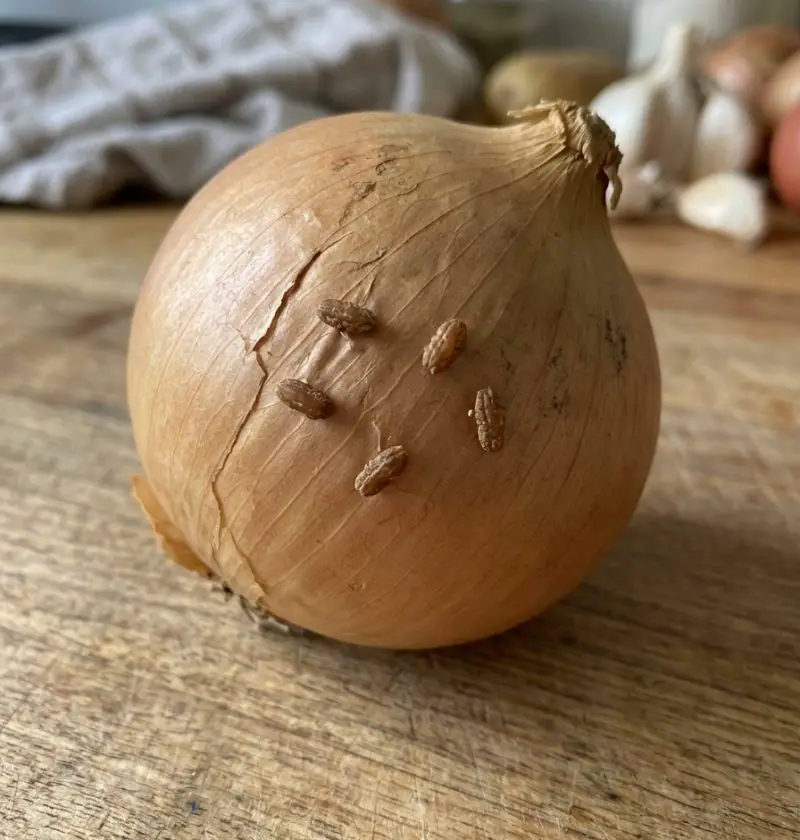
There’s a special kind of kitchen panic that happens when you pick up an onion—something you’ve handled a thousand times—and notice tiny brown specks stuck to the papery skin.
At first glance, they almost look like grains of brown rice.
And then your brain starts doing that thing.
Is this eggs? Bugs? Mold? Why is this on my food?
Honestly? Fair reaction.
Most people have a brief “burn the whole pantry down” moment before taking a closer look.
But here’s the good news: while unsettling, those little specks are often explainable—and fixable.
And no, it doesn’t automatically mean your kitchen is under siege.
So… what are those little brown things?
In many cases, those rice-shaped bits are fruit fly pupae.
Yep. Fruit flies.
Those annoying little hoverers that seem to appear out of nowhere every summer—or anytime a banana gets too ambitious on the counter.
Fruit flies go through four life stages: egg, larva, pupa, adult.
That pupa stage? It looks weirdly like a tiny grain of brown rice.
Nature can be oddly specific that way.
They’re usually:
- Brown to tan
- About 3–4 millimeters long
- Slightly tapered at the ends
- Hard-shelled, almost capsule-like
And yes, they can cling to produce skins.
Not exactly the pantry surprise anyone ordered.
But wait—why onions?
People associate fruit flies with bananas, peaches, maybe a suspicious bowl of tomatoes.
Onions feel… unlikely.
But here’s the thing.
Fruit flies aren’t only after sweetness. They’re drawn to fermentation and breakdown. A bruised onion, a soft spot, a hidden bit of moisture in a produce basket—that can do it.
Especially if an onion has:
- A nick in the skin
- A damp outer layer
- A soft or aging spot
- Been stored near overripe fruit
One overripe avocado nearby can sometimes start the whole circus.
And once larvae feed, they often crawl to a drier spot to pupate—which may be right on the onion’s outer papery skin.
Kind of gross. Also weirdly efficient.
Are you sure it isn’t just… rice or debris?
Good question, because pantry dust can play tricks.
Real brown rice tends to be:
- Longer
- More uniform
- Slightly translucent
- Smooth and consistent
Fruit fly pupae look more like tiny capsules.
Less polished.
A little more… biological.
If they’re attached firmly to the onion skin instead of loose in the bag, that’s another clue.
And if you’ve seen fruit flies buzzing around lately?
Well.
That starts to tell a story.
Could it be another pest?
Possibly, though fruit fly pupae are often the main suspect.
Other lookalikes can include:
- Onion maggot pupae — unpleasant, but possible
- Small beetle casings
- Certain pantry weevil remnants (less likely on fresh onions)
This is where people sometimes spiral into “my whole pantry is infested.”
Usually… it’s not that dramatic.
Usually.
Can you still eat the onion?
Often, yes.
And this surprises people.
If the onion itself is firm, smells normal, and has no mushy spots, the inside is generally fine.
Peel off the outer layers.
Rinse well.
Use it.
Done.
Onions have protective outer skins for a reason.
That papery jacket does a lot more work than it gets credit for.
When I’d toss it instead
Now—small contradiction here.
I just said you can often keep it.
But sometimes? Throw it out.
And I would.
Discard the onion if you notice:
- Soft, slimy texture
- Sour or fermented smell
- Dark wet spots
- Mold
- Heavy infestation across multiple layers
At that point, it’s not worth playing produce detective.
An onion costs less than the stress.
Check the pantry too (don’t skip this part)
Here’s where people make a mistake.
They remove the weird onion and call it solved.
Maybe.
But maybe not.
Check nearby produce:
- Potatoes
- Garlic
- Tomatoes
- Citrus
- Bananas
- Forgotten fruit bowl casualties (we all have them)
And give your storage area a quick clean.
Warm water and vinegar works well.
No need for a hazmat suit.
Just wipe shelves, remove anything soft or overripe, and dry everything thoroughly.
Fruit flies love moisture almost as much as they love neglect.
Maybe more.
Storage tricks that quietly help
This part sounds boring.
It matters.
A lot.
Store onions:
- In a cool, dry, ventilated place
- In mesh bags or open baskets
- Away from ripening fruit
And please—don’t refrigerate whole onions unless cut.
That often creates moisture issues.
People do it thinking they’re extending life.
Sometimes they’re doing the opposite.
A simple wire basket can outperform fancy storage gadgets.
Funny how that works.
Some people tuck in bay leaves or whole cloves as natural pest deterrents. Does it work perfectly? Hard to say.
But kitchens have leaned on those little folk remedies forever.
And some old tricks hang around for a reason.
If fruit flies are already partying, try this
Apple cider vinegar trap.
Classic.
Still works.
Pour some vinegar into a small jar.
Add a drop of dish soap.
Cover loosely with plastic wrap, poke tiny holes.
Done.
Fruit flies go in.
They don’t do much coming out.
There’s also the paper cone trap with overripe fruit, which feels almost science-fair-ish, but works surprisingly well.
Honestly, sometimes one forgotten potato is the real villain and no trap can fix that until you find it.
Check under things.
Seriously.
When should you call pest control?
Usually? You won’t need to.
Fruit flies are annoying, but rarely a “call the professionals immediately” situation.
But if:
- Infestations keep returning
- You’ve cleaned repeatedly with no change
- You see multiple pest types
- Produce damage is widespread
- There may be hidden moisture or structural issues
Then yeah—have someone look.
Persistent pests sometimes point to a deeper issue.
Leaky pipe.
Wall void moisture.
Rotting forgotten food behind appliances (this happens more than people admit).
Sometimes the problem isn’t the onion.
The onion was just tattling.
How to avoid this ever happening again
A few habits help more than fancy solutions:
Inspect produce before buying.
Especially onions sold in bags.
Use older produce first.
Simple rotation matters.
Don’t let one bruised tomato sabotage the whole basket.
Take out compost regularly.
Huge one.
Wipe sinks and drains.
Fruit flies love drains. Love them.
And maybe most important—
Trust your eyes.
If something looks off, investigate early.
Small problems stay small that way.
Final thought (because this happens to more people than you think)
Finding little brown “rice grains” stuck to an onion feels alarming.
It feels worse than it usually is.
Most often, it’s fruit fly pupae, a minor pest issue, and a sign your produce storage needs a quick reset—not a kitchen catastrophe.
Clean a little.
Check nearby produce.
Set a trap if needed.
Move on.
And maybe give your onions a slightly closer look next time at the store.
Poor onions. They didn’t ask for this reputation.