
Save This Recipe
You’d think after years of cooking—making weeknight Pasta, holiday casseroles, scrambled eggs half-awake on a Monday morning—we’d have the kitchen thing mostly figured out.
And honestly? Most of us do.
But some habits slip in quietly. Little shortcuts. Things we watched our parents do. Things we started doing when we were rushing to get dinner on the table and… never questioned again.
That’s how bad kitchen habits stick.
And here’s the funny part: many of them don’t look wrong. They feel practical. Efficient, even. But over time? They dull knives, wreck plumbing, make food taste worse, shorten appliance life, and sometimes make cooking harder than it needs to be.
I learned some of these the annoying way. A clogged sink from bacon grease. Mushy rice I blamed on the brand. Chicken cooked unevenly because my Oven runs hotter than it claims (rude, honestly).
Small habits. Big consequences.
So let’s talk about the common kitchen mistakes people make all the time—often without realizing it—and how a few tiny shifts can make your kitchen run smoother, your food taste better, and maybe save you a repair bill while we’re at it.
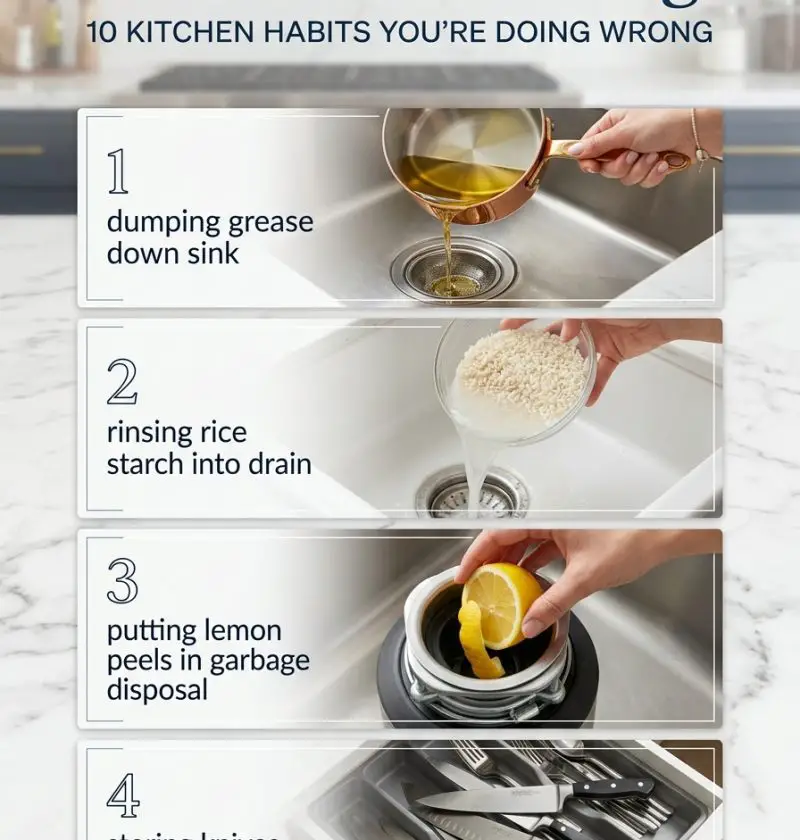
1. Pouring Grease Down the Drain (Please Don’t)
This one feels harmless in the moment.
The pan is hot. You’re tired. The sink is right there.
Down it goes.
But grease cools. It hardens. It clings to pipe walls like culinary cement.
And then? Clogs.
Expensive ones.
Even small amounts build up over time. Especially bacon fat, beef drippings, frying oil—those are repeat offenders.
A better move:
Let grease cool a bit, pour it into an old can, jar, or even foil-lined bowl, let it solidify, toss it.
For tiny amounts, wipe the pan with paper towels before washing.
Simple.
Also—and this is a side note but worth saying—saved bacon grease in a jar in the fridge? Southern grandmas knew what they were doing.
That stuff can flavor half your life.
2. Skipping the Rice Rinse
This one divides people.
Some swear rinsing rice is optional.
Well… sometimes.
But often? Not really.
Extra surface starch makes rice gummy and sticky when you wanted fluffy grains.
That’s why rinsing matters.
Swish it in cold water until the water goes from cloudy to mostly clear. Takes a minute or two.
That’s it.
And suddenly:
- Better texture
- Cleaner flavor
- Less clumping
Especially for jasmine or basmati? Huge difference.
You know what’s funny? People will obsess over seasoning rice and ignore the step that fixes texture before cooking even begins.
Start earlier.
The pot will thank you.
3. Treating the Garbage Disposal Like a Black Hole
A disposal is not a magical food portal.
It is not.
People feed them coffee grounds, celery strings, potato peels, eggshells…
Chaos.
Fibrous scraps wrap around parts.
Starches swell.
Grease coats everything.
Coffee grounds turn weirdly sludgy.
And suddenly your sink growls.
Use it lightly.
Safer rule:
Soft scraps only.
Compost or trash the rest.
And run cold water while using it. Cold helps fats stay solid so they chop rather than smear.
That little trick matters more than people realize.
4. Tossing Good Knives Into a Drawer
This hurts me.
A sharp chef’s knife casually banging around with can openers and peelers?
No.
That blade dulls.
Edges chip.
And reaching into that drawer becomes a game nobody wants to play.
Good knives deserve better.
Knife block.
Magnetic strip.
Blade guards.
Anything but the junk drawer.
And let me say something mildly contradictory:
People think sharp knives are dangerous.
Actually, dull knives often cause more accidents because they slip.
Sharp is safer.
Sharp is kinder.
Sharp is sanity.
5. Packing the Fridge Like a Grocery Store Display
A full fridge feels responsible.
Prepared.
Productive.
Sometimes it’s just… crowded.
Cold air needs room to move.
When every inch is jammed, cooling gets uneven.
Milk in one spot too warm.
Produce forgotten in a back corner.
Mystery leftovers become science.
You know the drawer I mean.
Try keeping the fridge about three-quarters full.
Enough stocked.
Not overstuffed.
And remove bulky cardboard packaging where possible—it steals space.
Little thing, big improvement.
Also, leftovers need visibility. If you can’t see them, you won’t eat them.
That’s just human nature.
6. Using One Cutting Board for Everything
Raw chicken.
Then salad.
Same board.
No wash.
Please no.
Cross-contamination is one of those invisible kitchen mistakes that can matter a lot.
A good system helps:
- Wood for bread, fruits, veggies
- Plastic or composite for raw meats
- Sanitize after use
Simple.
Also, glass cutting boards?
Pretty maybe.
Terrible for knives.
Like dragging your blade across a sidewalk.
Pass.
7. Trusting Your Oven Like It Never Lies
Ovens lie.
There, I said it.
Mine says 350.
Sometimes it means 325.
Sometimes apparently 390.
Who knows.
That’s why cookies burn “for no reason.”
Get an oven thermometer.
Cheap little thing.
Massive payoff.
Especially for:
- Baking
- Roasting
- Bread
- Anything fussy
Honestly, once you realize your oven runs 20 degrees hot, a lot of kitchen mysteries solve themselves.
It’s oddly emotional.
Like closure.
8. Wrapping Everything in Plastic Wrap
Plastic wrap has its place.
But it gets used for everything.
And sometimes it’s not helping.
Loose seals trap moisture.
Leafy stuff wilts.
Leftovers dry out anyway.
It’s kind of mediocre at being universal.
Airtight containers usually do better.
Reusable silicone covers too.
Better freshness.
Less waste.
Less wrestling with cling wrap that somehow attaches to itself, your sleeve, and the dog.
That can’t just be me.
9. Loading the Dishwasher Like a Puzzle You’re Trying to Win
We’ve all done it.
Trying to fit one more bowl.
One more pan.
One more somehow sideways spatula.
Then dishes come out dirty.
Because water has to reach surfaces.
If everything is jammed together, it can’t.
Leave space.
Angle bowls.
Don’t block spray arms.
And utensils? Mix directions if your machine allows—some up, some down—so they don’t spoon together.
Little adjustments.
Cleaner dishes.
Less rewashing, which somehow feels personally offensive.
10. Keeping Ancient Spices Forever
Open the paprika.
Smell it.
Anything?
Exactly.
Spices don’t spoil dramatically the way milk does.
They just fade.
Quietly.
And then your chili tastes flat and you blame the recipe.
It wasn’t the recipe.
Ground spices often lose punch in 6–12 months.
Whole spices last longer.
Store them away from heat and sunlight.
Not right over the stove, even though everybody does that.
That cabinet looks cute.
It’s ruining your cumin.
Sorry.
11. Skipping Preheating Because “It’ll Heat While It Cooks”
This one feels efficient.
It usually isn’t.
Especially for baking.
Putting food into a half-heated oven throws timing off immediately.
Cookies spread weird.
Roasts cook unevenly.
Casseroles take forever.
Even pizza suffers.
And life is too short for sad pizza.
Let the oven fully preheat.
Ten minutes. Maybe fifteen.
Worth it.
Always.
Actually—almost always.
(See? Mild contradiction.)
Some Slow roasts can start cold.
But for most everyday cooking?
Preheat.
Do it.
Funny How Small Habits Change Everything
None of these are dramatic culinary secrets.
No chef tricks.
No fancy equipment.
Just habits.
That’s what makes them powerful.
Cooking often improves not through huge breakthroughs, but through tiny corrections.
Rinse the rice.
Store the knife right.
Give the oven a thermometer.
Stop pouring grease down the drain, for the love of your pipes.
And suddenly food tastes better.
Tools last longer.
The kitchen feels easier.
Lighter.
More under control.
And maybe that’s what good kitchen habits really do—they remove friction.
They make cooking feel less like work and more like what it ought to be.
Pleasure.
Comfort.
A little everyday magic.
And honestly?
That’s worth changing a few habits for.