
Save This Recipe
We'll email this post to you, so you can come back to it later!
There’s something uniquely aggravating about discovering a winter draft coming from the garage just as a cold snap hits. It starts subtly — maybe you notice the floor near the mudroom feels icy, or the garage suddenly feels more like a walk-in freezer than a storage space. Then you realize it: cold air is pouring in under the garage door.
And of course the repair company says they can’t come until after New Year’s.
Perfect timing, right?
Honestly, this is more common than people think. Garage door bottom seals wear out, concrete shifts, doors settle, tracks move a hair out of alignment. It doesn’t take much. Even a half-inch gap can let in a surprising amount of freezing air, and if your garage shares walls with the house, that chill can creep indoors too — which means your heating system ends up working harder (and your utility bill notices).
The good news? You do not have to sit there for two weeks watching heat escape while waiting for a technician.
There are several practical things you can do today — cheap fixes, improvised fixes, even a couple “why didn’t I think of that?” fixes — that can help block the cold until professional repairs happen.
Let’s go through them.
First… where exactly is the cold sneaking in?
Before piling towels at the door and hoping for the best, spend five minutes figuring out the problem.
It might not just be the bottom seal.
Check:
- Under the garage door bottom
- Along the side edges
- Across the top seal
- Around door panels
- At corners where concrete may have settled unevenly
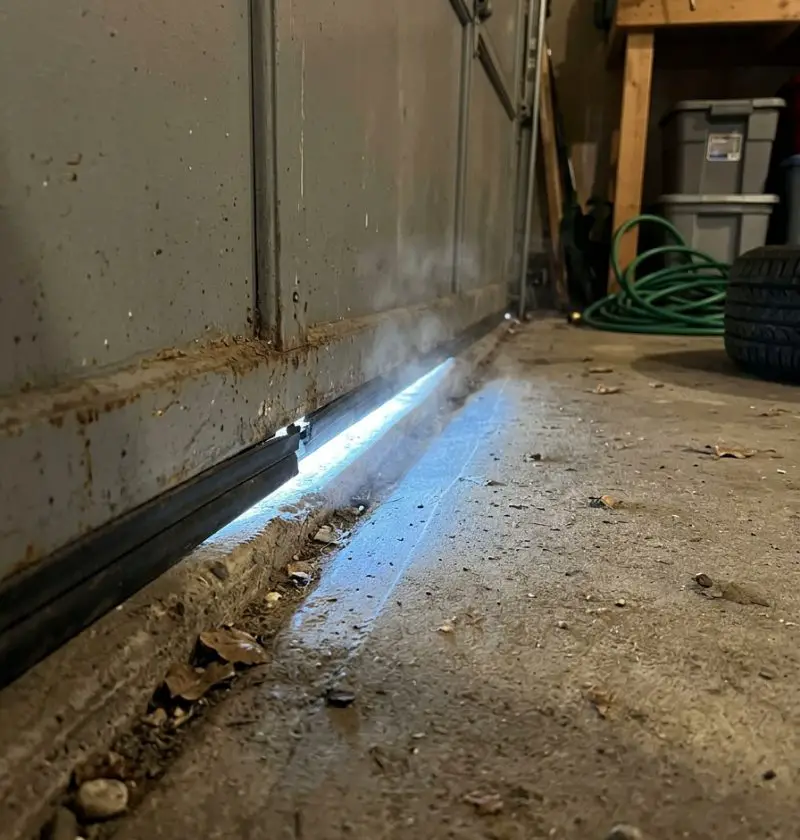
A simple flashlight test works wonders.
Turn off the garage lights at night and have someone shine a flashlight from outside while you look from inside. Any visible light usually means air is getting through too.
Another old-school trick? Hold a lit candle or lighter (carefully) near suspected gaps. If the flame flickers, there’s your draft.
Sometimes what looks like “cold coming under the door” is really side seals leaking.
And that matters, because your quick fix depends on where the problem lives.
Pool noodles. Yes, really. They work.
You know what? Pool noodles may be one of the great unsung heroes of emergency winter fixes.
Slice one lengthwise and press it along the bottom gap inside the garage.
Or use foam pipe insulation — same idea.
Secure it with duct tape if needed.
It looks a little ridiculous.
It also works.
The foam blocks airflow surprisingly well, especially if your gap is consistent across the door.
If you’ve got no pool noodle lying around, pipe insulation from a hardware store costs almost nothing.
Sometimes the low-tech fixes are the smartest ones.
Old towels and rugs can save the day
This sounds too simple, but rolled-up towels or old bath mats can make a solid temporary draft snake.
Layer them right against the inside bottom edge of the door.
For extra weight, roll blankets around a broom handle or PVC pipe.
Heavy fabric slows cold air infiltration fast.
No, it isn’t pretty.
But neither is your garage turning into Antarctica.
And honestly? For a week or two, ugly is fine.
Temporary weatherstripping tape buys time
If the bottom seal is worn but mostly intact, grab temporary weatherseal tape.
It’s inexpensive, fast to apply, and can cut drafts dramatically.
Look for:
- Rubber weatherseal tape
- Adhesive foam strips
- Temporary door-bottom sealing tape
Press it along problem areas for an emergency seal.
Just don’t treat it like a permanent repair. Moisture and freezing temps can make adhesives give up sooner than you’d like.
Still — for a holiday-week fix? Very solid.
Build a quick threshold (sounds fancy, isn’t)
Here’s a trick many homeowners overlook.
Cold often enters because the floor slopes slightly away from the seal.
Creating a temporary threshold can help.
Use:
- Scrap plywood
- Thick cardboard layered together
- A leftover door saddle threshold
- Even a 2×4 wrapped in weatherproof tape
Set it where the door meets the floor.
Instant wind block.
Sometimes stopping air isn’t about sealing the door — it’s about giving the air nowhere to travel.
Small difference. Big effect.
Plastic sheeting can act like a second wall
This one feels a little “winter storm prep,” but it works.
Hang heavy plastic sheeting or a tarp a few feet behind the garage door.
Basically, create an interior wind barrier.
Cold may still enter at the door…
…but it hits a second layer before moving farther into the garage.
Same principle as storm windows, really.
Painter’s plastic, contractor plastic, even a heavy drop cloth can help.
Especially if you use the garage as a workshop or have pipes nearby you’re trying to protect.
Don’t ignore side gaps — they’re often the real culprit
People obsess over the bottom seal.
Meanwhile side gaps leak like crazy.
Take a look at the vertical edges.
If you see daylight, use:
- Foam weather strips
- Painter’s tape (great temporary option)
- Draft seal tape
- Rolled foam tucked into wider openings
Painter’s tape sounds flimsy, but surprisingly? It can stop a surprising amount of airflow in a pinch.
And it removes cleanly later.
Sometimes the simplest fixes are weirdly satisfying.
Add insulation to the door itself
If the garage feels like an icebox, it may not just be drafts.
Your door may be radiating cold.
Foam board insulation panels or reflective insulation can help a lot.
Cut pieces to fit door panels.
Press or tape them in place.
Done.
It’s one of those improvements that feels almost too easy for how much difference it makes.
Kind of like putting on slippers and suddenly realizing your whole body feels warmer.
Same idea.
Thinking about a space heater? Be careful. Really.
A space heater can help take the edge off.
But garages are tricky spaces.
Be smart:
- Keep it away from cardboard, gasoline, paint, and clutter
- Use one with tip-over shutoff
- Plug directly into a wall outlet
- Never run it unattended
- Never use extension cords
I know. This sounds obvious.
But winter emergency fixes have a way of turning into “I’ll just do this one unsafe thing for tonight…”
Don’t.
Warmth isn’t worth a fire.
Protect the door into your house too
This part gets overlooked constantly.
If your garage connects to the house, protect that door.
Add:
- A draft stopper
- Stick-on weatherstripping
- Rolled towel at the threshold
- Even a heavy curtain as backup insulation
Because sometimes it’s easier to keep cold from spreading than to stop every ounce of cold at the garage door.
Containment matters.
A lot.
Bottom seal crumbling? Patch it for now
If the rubber seal is split or brittle, you may be able to patch it temporarily.
Duct tape can work.
Honestly — good duct tape fixes half the world.
You can also use adhesive rubber strips as emergency patching.
If you’re handy, replacing the bottom seal yourself may even be doable before the repair company arrives.
Many home centers carry universal garage door bottom seals.
And it’s less intimidating than it sounds.
One odd trick people forget: snow itself can make drafts worse
Quick tangent — but important.
Packed snow or ice buildup outside the door can prevent the seal from sitting flush.
Brush it away.
Break up frozen ridges.
Clear the threshold.
Sometimes the “broken seal” is partly frozen slush.
Winter loves those little surprises.
When it’s time for the repair tech, ask these questions
Once the company comes out, don’t just ask them to “fix the draft.”
Be specific.
Ask about:
- Replacing the bottom seal
- Adjusting door alignment
- Replacing side weather seals
- Track or spring balance issues
- Threshold seal options
- Garage door insulation upgrades
Sometimes a $20 seal is the whole issue.
Sometimes it’s a door adjustment.
Good to know before someone starts replacing things you don’t need.
The bottom line? You’ve got options.
A freezing draft under the garage door feels urgent because… well, it is.
But it doesn’t have to be a disaster while you wait for repairs.
Pool noodles.
Rugs.
Foam strips.
Plastic sheeting.
Temporary thresholds.
Simple stuff, mostly.
And simple often works.
Honestly, winter home fixes are often less about perfection and more about buying yourself comfort until the real repair happens.
That’s enough.
Block the draft. Protect your indoor heat. Keep the garage from becoming a freezer.
Then let the repair company handle the permanent fix after New Year’s.
And maybe keep a pool noodle around.
You never know.