
Save This Recipe
Let’s be honest for a second—leftovers have a reputation problem.
You cook something great, everyone loves it, you carefully pack it away… and then two days later? It’s either weirdly dry, suspiciously soggy, or you’re standing there sniffing it like a detective trying to solve a case. Is this still okay?
Here’s the thing: leftovers aren’t the problem. The way we store them usually is.
Once you understand a few simple rules—nothing fancy, nothing complicated—you can actually make leftovers taste almost as good the second time around. Sometimes better. And yes, that’s not an exaggeration.
Let me explain.
That “Danger Zone” No One Talks About Enough
Food safety sounds technical, but it really comes down to one idea: temperature matters. A lot.
There’s a range—roughly between 40°F and 140°F—where bacteria grow quickly. Not Slowly. Quickly. That’s the window you want to move through as fast as possible.
So when dinner’s over, don’t let food sit out for hours while you scroll your phone or “clean up later.” We’ve all done it. Still… not ideal.
- Refrigerate leftovers within 2 hours
- If it’s hot outside (think summer BBQ), aim for 1 hour
- Keep your fridge at 40°F or lower
It sounds strict, but once it becomes habit, you stop thinking about it. Like locking your door.
Containers: It’s Not Just About What Fits
You know that random drawer full of mismatched plastic containers? Yeah… we’re all guilty.
But here’s where it matters more than you’d think.
Airtight containers are your best friend. They keep moisture in (so your food doesn’t dry out) and keep outside air—and bacteria—out. Glass containers are especially nice because they don’t absorb smells and can go straight into the microwave or Oven.
One small thing people forget: size matters.
If you store a tiny portion in a big container, you’re trapping extra air inside. More air = faster spoilage. It’s subtle, but it adds up.
And for soups or stews? Leave a little space at the top. They expand when frozen—learned that the hard way once with a cracked lid.
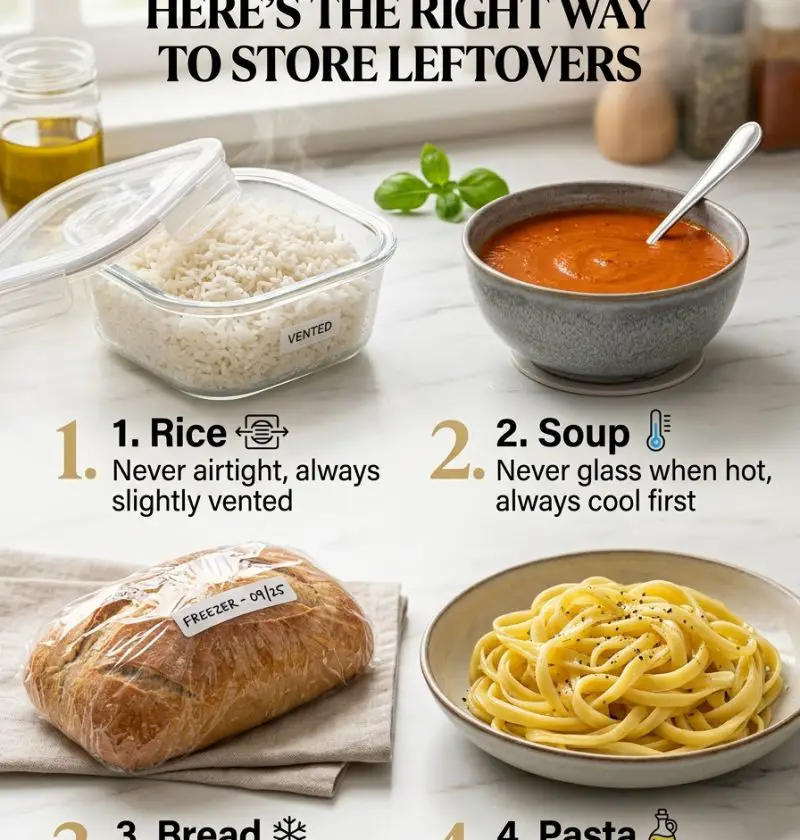
Rice Is a Little… Different
Okay, this one surprises people.
Rice isn’t dangerous because it’s rice—it’s because of a bacteria called Bacillus cereus. It can survive cooking and multiply if rice sits around too long.
So the trick isn’t panic. It’s speed.
- Cool rice quickly (spread it out if needed)
- Don’t leave it sitting at room temp
- Store it loosely covered at first to let steam escape
- Eat it within 1–2 days
Honestly, rice is one of those foods where being a little extra careful really pays off.
Hot Soup + Cold Glass = Bad Idea
You’d think pouring hot soup into a glass container is harmless. It’s not always.
Sudden temperature changes can cause glass to crack. Not dramatically, not like in movies—but enough to ruin your container (and your soup).
Better approach?
Let it cool a bit first. Or divide it into smaller portions so it cools faster. Shallow containers help a lot here.
It’s one of those small adjustments that feels unnecessary… until you deal with a broken container.
Bread: The Fridge Isn’t Your Friend
This one feels counterintuitive.
You’d think refrigerating bread keeps it fresh longer. It doesn’t. It actually makes it go stale faster due to something called retrogradation—basically, the starches tighten up and lose that soft texture.
Freezer is the better move.
Wrap bread well (plastic + foil if you want to be thorough), freeze it, and then:
- Let it thaw naturally
- Or toast it straight from frozen (honestly, works great)
You keep the texture. You keep the flavor. No weird dryness.
Pasta Clumping? There’s an Easy Fix
Cold pasta has a habit of turning into one solid mass. Not exactly appealing.
A tiny bit of oil solves most of it.
Just toss cooked pasta lightly with olive oil before storing. It creates a thin coating so the strands don’t glue themselves together.
When reheating, add a splash of water. It brings back moisture and loosens everything up.
Simple, but effective.
Labeling: Future You Will Thank You
This sounds like overkill… until it isn’t.
You open the fridge, see three identical containers, and suddenly you’re guessing: Was this from Monday? Or last Thursday?
That’s how food gets wasted.
A quick label—just a date and maybe what’s inside—takes five seconds. But it removes all the guesswork later.
And honestly, it feels oddly satisfying. Like your fridge is finally under control.
Your Fridge Temperature Might Be Lying to You
Most people trust their fridge settings. But built-in thermostats aren’t always accurate.
If you want to be precise, a small appliance thermometer is worth it. Not expensive, and it gives you peace of mind.
Also—don’t overpack your fridge.
Cold air needs space to circulate. If everything is crammed in, some spots get warmer than others. And that affects how long your food stays safe.
Portion Now, Thank Yourself Later
There’s something about reheating a giant container of food that just feels… inefficient.
Portioning leftovers right away solves that.
- Faster reheating
- Less waste
- Easier meal prep during busy days
And let’s be real—on a tired weekday evening, grabbing a ready-to-go portion feels like a small win.
Reheating Without Ruining Everything
Reheating is where a lot of good food goes downhill.
Microwaves are convenient, but they can dry things out or heat unevenly. A few small tweaks help:
- Cover food to trap moisture
- Stir halfway through
- Add a splash of water for dry dishes
And for things like pizza or fried food? Skip the microwave. Use an oven or toaster oven instead. You’ll keep that texture instead of ending up with something limp.
A Few Smart Tricks That Are Actually Worth It
You’ve probably seen those viral kitchen hacks—some are gimmicks, but a few genuinely help.
- Freeze sauces or herbs in oil using ice cube trays
- Store leafy greens with a paper towel to absorb moisture
- Use shallow containers to cool food faster
Nothing complicated. Just small adjustments that make a noticeable difference.
So… Are Leftovers Worth It?
Absolutely.
Once you get the basics right, leftovers stop feeling like second-rate meals. They become part of your routine—easy, reliable, and honestly kind of comforting.
There’s something nice about opening the fridge and knowing exactly what’s in there, how fresh it is, and how it’s going to taste.
Not a mystery. Not a gamble. Just good food, ready when you need it.