
Save This Recipe
The holiday table has a funny way of stretching time.
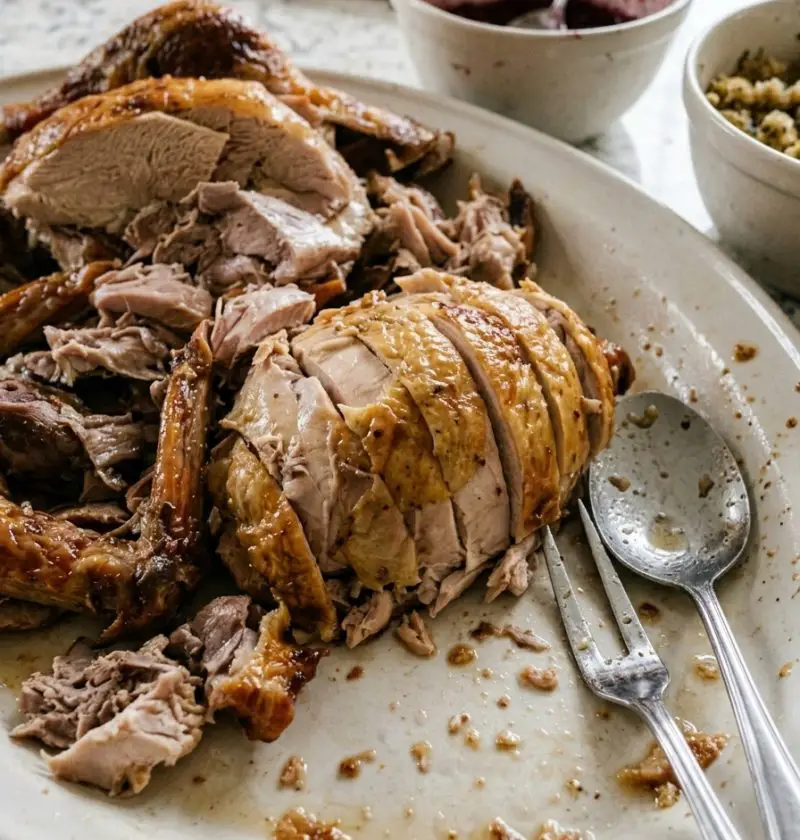
One minute, you’re carving turkey while someone asks for “just a little more gravy,” and the next, it’s hours later—plates are still out, people are lounging, and that beautiful roasted turkey? Still sitting right there on the counter.
Honestly, a lot of us grew up like this. Someone always says, “It’s fine, we’ll put it away later.” Maybe your aunt does it. Mine definitely does.
But here’s the thing—what happens after the meal can matter just as much as the meal itself.
Let me explain.
The Part Nobody Talks About (But Should)
We tend to think of food safety as something that happens during cooking. Did it reach the right temperature? Is it fully cooked?
But the real risk often shows up after the meal—when food is left sitting out longer than it should be.
Cooked turkey, like most meats, doesn’t stay “safe” forever once it’s out of the oven. It slowly moves into a temperature range where bacteria feel very comfortable. Too comfortable, actually.
And no, this isn’t about being overly cautious. It’s just how food behaves.
That “Danger Zone” Everyone Mentions—Here’s What It Really Means
You’ll hear food safety experts talk about the “Danger Zone,” which sounds dramatic—and, well, it kind of is.
It’s the temperature range between 40°F (4°C) and 140°F (60°C).
In that range, bacteria like Salmonella and E. coli don’t just sit there… they multiply. Fast. Sometimes doubling in as little as 20 minutes.
So when your turkey is sitting on the counter, cooling down slowly, it’s passing right through that zone—and potentially staying there longer than it should.
That’s where the trouble begins.
So… How Long Can Turkey Sit Out?
Here’s the simple rule most food safety guidelines agree on:
- 2 hours max at room temperature
- 1 hour if it’s hot (above 90°F / 32°C)
That’s it.
After that, it’s not about whether it looks okay or smells fine. The risk goes up, whether you notice anything or not.
And yeah, I know—two hours feels short, especially during a long holiday gathering. But that window closes faster than you think.
“But It Looked Fine…” — The Risky Assumption
This is where a lot of people get tripped up.
Spoiled turkey doesn’t always wave a red flag. Sometimes it doesn’t smell bad. Sometimes the texture hasn’t changed yet.
That’s because harmful bacteria aren’t always detectable by your senses.
So relying on smell or appearance alone? It’s a bit like guessing whether milk is still good without checking the date—you might get away with it, or you might regret it later.
What Happens If You Eat It Anyway?
Sometimes… nothing.
And that’s exactly why people keep taking the risk.
But other times, it can lead to foodborne illness—things like nausea, stomach cramps, fever, the whole unpleasant package. In more serious cases, it can be worse, especially for kids, older adults, or anyone with a weaker immune system.
It’s not guaranteed. But it’s not worth gambling on, either.
A Few Myths We’ve All Heard (And Maybe Believed)
Let’s clear up a couple of common ones:
- “Reheating will fix it.”
Not quite. Heat can kill bacteria, but it won’t remove toxins they’ve already produced. - “If it’s covered, it’s safe.”
Covering helps keep things clean, sure—but it doesn’t stop bacteria from growing inside. - “It’s been out before and I was fine.”
That’s the tricky one. Past luck doesn’t guarantee future safety.
What Actually Works (Without Making It Complicated)
You don’t need a lab setup in your kitchen—just a few simple habits:
- Put leftovers away within 2 hours (sooner is even better)
- Use shallow containers so food cools faster
- Divide large portions into smaller ones
- Keep your fridge at 40°F (4°C) or below
And honestly? Even loosely covering and getting it into the fridge quickly is better than waiting until “after everyone leaves.”
About Those Viral Leftover Hacks…
You’ve probably seen them—vacuum sealing, freezing turkey in broth, storing it in creative ways.
Some of these are genuinely helpful. Vacuum sealing, for example, can slow down spoilage by limiting air exposure.
But here’s the catch: none of them replace the basics.
If the turkey sat out too long before you sealed or froze it, the damage may already be done. These methods help preserve food—not rescue it.
When Refrigeration Isn’t Immediate (Real Life Happens)
Sometimes things don’t go perfectly. Maybe the fridge is packed, or you’re not home.
In those moments, small steps help:
- Use ice packs or a cooler temporarily
- Keep food in a cooler area (not near heat sources)
- Don’t stack hot food tightly—let it cool slightly first
It’s not perfect, but it buys you time.
The Takeaway (Simple and Honest)
Here’s the bottom line:
If turkey has been sitting out for more than two hours, it’s safer to let it go.
I know—that’s not the answer anyone wants, especially after a big meal. Throwing away food feels wasteful. But food poisoning? That’s worse.
So next time the table lingers a little too long, maybe take a quiet minute, grab a few containers, and start packing things up.
Future you—the one opening the fridge the next day—will be glad you did.