
Save This Recipe
There’s always that one kitchen trick that makes you stop and go—
“Wait… is that genius or a terrible idea?”
This one definitely falls into that category.
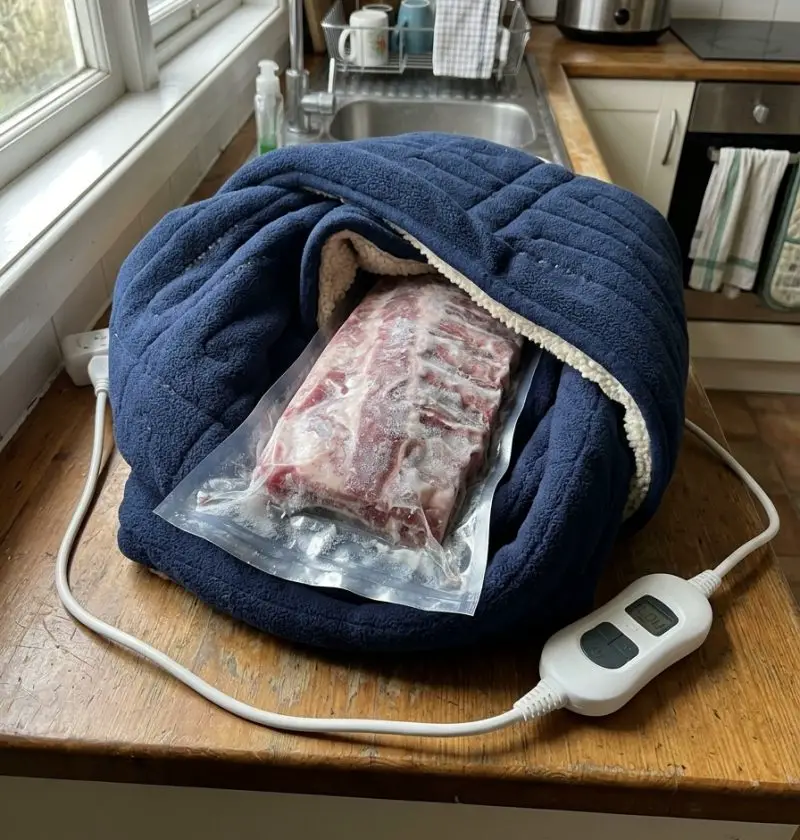
A grandpa—somewhere, probably just trying to get dinner moving faster—wrapped a rack of frozen ribs in an electric blanket to thaw them. No sink, no waiting overnight, no planning ahead. Just plug it in and let it warm up.
And honestly? At first glance, it kind of makes sense.
But also… it doesn’t.
So let’s talk About it—because this is one of those situations where something feels clever, but might quietly be working against you.
Why This Blew Up Online (It’s Not Just About the Ribs)
People didn’t share this because it was safe.
They shared it because it felt relatable.
You forget to thaw something. It’s 4:30 PM. Everyone’s hungry. You start looking around the kitchen like, what can I use right now to fix this?
Hairdryer? Maybe.
Warm water? Risky.
Electric blanket? …huh.
It’s that kind of logic.
And there’s also something comforting about it. It feels old-school, resourceful, a little bit “grandparent wisdom.” The kind of thing that sounds like it should work because it came from experience, not a rulebook.
But food safety doesn’t really care about vibes.
The Part Nobody Talks About: The “Danger Zone”
Here’s where things shift.
Food safety experts (including the United States Department of Agriculture) use this term—the danger zone—to describe temperatures between 40°F and 140°F (4°C to 60°C).
And yeah, it sounds dramatic. But it’s accurate.
That’s the range where bacteria like Salmonella and Escherichia coli infection start multiplying quickly. Not slowly. Not eventually. Quickly.
So the goal is simple:
don’t let food sit in that range for long.
Now here’s the problem with the electric blanket idea…
That’s exactly the temperature range it creates.
Electric Blankets Weren’t Designed for… Ribs
Electric blankets are made to keep humans warm—not to thaw dense, frozen meat.
They run at relatively low, gentle heat. Which sounds safe, right? But that gentle heat sits right inside the danger zone.
So what ends up happening is kind of awkward:
- The outside of the ribs starts warming up
- The inside stays frozen for a long time
- The surface just hangs out in that bacteria-friendly temperature
It’s like thawing… but in slow motion, and in the worst possible temperature range.
The Uneven Thawing Problem (This Is the Real Issue)
This is where it gets a bit more concerning.
Ribs aren’t thin. They’re dense. There’s bone, fat, muscle—all layered.
So when you wrap them in something warm:
- the outer layer softens fairly quickly
- the inside stays icy
Which means the outside might sit in that danger zone for an hour… maybe two… maybe more, depending on thickness.
Meanwhile, bacteria are like, “Great, we’re active now.”
That uneven thawing is the core problem. Not just the method itself.
“But It’s Warm, Not Hot… Isn’t That Safer?”
You’d think so.
But here’s the weird contradiction:
too cold is safe, and fully hot is safe—but warm in the middle is not.
Freezing slows bacteria down. Cooking kills them.
But that in-between stage? That’s where things grow.
So using gentle heat feels cautious—but it actually creates the exact conditions you’re trying to avoid.
What Happens If You Actually Try This?
Let’s say someone does it anyway.
Best-case scenario?
The ribs thaw unevenly, you cook them thoroughly, and nothing bad happens.
Worst-case?
Parts of the meat sit long enough in the danger zone for bacteria to multiply, and now you’re relying completely on cooking to fix something that didn’t need to happen in the first place.
And here’s the thing—most food safety issues don’t look obvious. No smell, no warning sign. That’s what makes them tricky.
The Methods That Actually Work (Even If They’re Less “Creative”)
This is where the boring advice wins.
If you want safe thawing, you’ve really got three solid options:
- Fridge thawing — slow, steady, no risk
- Cold water method — faster, but you have to stay a little involved
- Microwave thawing — quick, but you need to cook right away
None of them are exciting. None of them go viral.
But they work. Consistently.
A Quick Reality Check—We’ve All Tried Weird Kitchen Hacks
Let’s be honest for a second.
Everyone has done something questionable in the kitchen at some point.
Left meat out a little too long.
Tried to “speed thaw” something in a way you wouldn’t admit out loud.
Trusted a trick that felt right, even if you weren’t 100% sure.
So this isn’t about judging the electric blanket idea.
It’s just about understanding what’s actually happening when you do it.
So… Is the Electric Blanket Trick Worth Trying?
Honestly?
No.
It’s creative. It’s clever in a way. But it puts the meat in that uncomfortable middle ground where bacteria can grow, especially on the surface.
And the payoff—saving a bit of time—isn’t really worth the risk.
The Simple Way to Think About It
If you’re trying to thaw meat safely, you want one of two things:
- Consistently cold (fridge or cold water)
- Or moving quickly to cooking (microwave → cook immediately)
Anything that keeps meat sitting warm for a while—especially unevenly—is where problems start.
Final Thought
The electric blanket trick feels like something that should work. That’s why people share it.
But food safety isn’t really about what feels right—it’s about what consistently avoids risk.
So yeah, it’s a clever idea.
Just not one you want to turn into a habit.
Better to plan ahead… or at least stick to methods that don’t make your kitchen a science experiment.