
Save This Recipe
You’ve probably seen it a hundred times and never really thought about it.
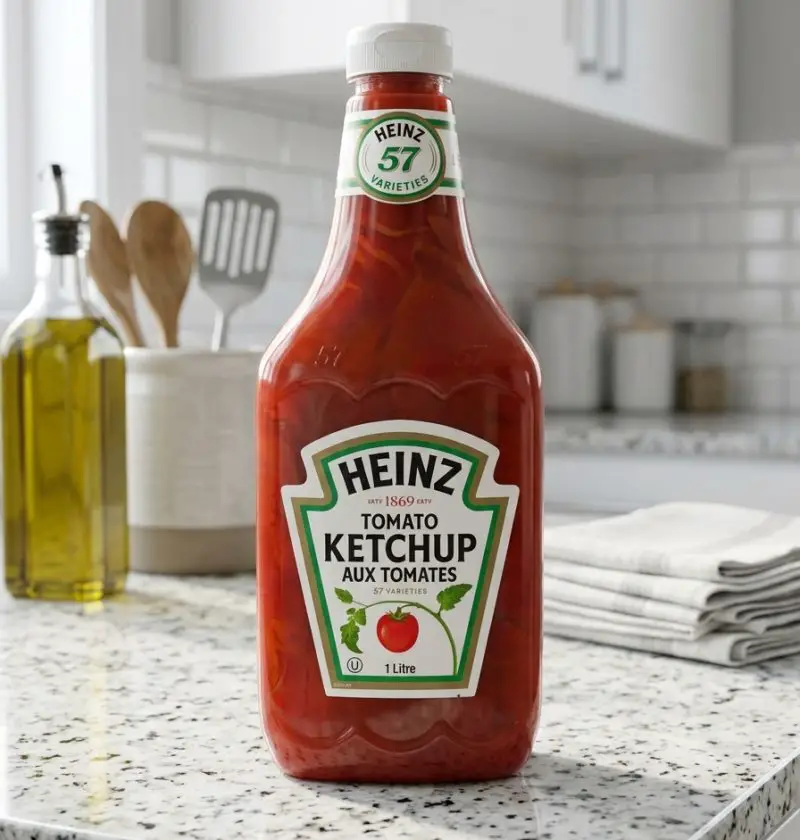
That little “57” on the neck of a Heinz ketchup bottle.
It’s just… there.
Not big enough to demand attention, not explained anywhere obvious—just stamped into the glass like it’s supposed to mean something. And somehow, that makes it more interesting.
Because once you notice it, you can’t really un-notice it.
And then the question shows up: why 57?
The First Guess Is Almost Always Wrong
Most People assume it must be something practical.
Number of ingredients, maybe. Or the number of recipes. Or factories. Or countries.
Something measurable.
That would make sense.
Except… none of that is true.
The number isn’t based on anything concrete like that, which is honestly the part that throws people off the most.
It Actually Started With an Advertisement
This goes back to the late 1800s.
Henry Heinz—the guy behind the brand—was looking for a way to make his products stand out. Not just in quality, but in how people remembered them.
And apparently, he saw an ad for “21 styles of shoes.”
For some reason, that stuck.
So he borrowed the idea—but instead of picking a number that matched reality, he picked one that felt right.
At the time, the company had more than 60 products already. So the number wasn’t accurate even then.
But Heinz liked how it sounded. Thought it was catchy.
And that was enough.
Which Is Kind of Funny, If You Think About It
A number that doesn’t actually mean anything… becoming one of the most recognizable details in food branding.
It shouldn’t work, but it does.
“57 varieties” just sticks in your head. It has rhythm. It feels specific without being complicated.
And once people hear it a few times, it becomes part of how they see the brand.
That’s not accidental. That’s good marketing—before marketing was even really a formal thing.
The “57” Didn’t Go Anywhere (Even When It Could Have)
Over time, Heinz expanded. A lot.
More products, more countries, more everything.
They could have updated the number. Made it more accurate.
But they didn’t.
Because by that point, “57” wasn’t about counting anymore—it was identity.
Changing it would’ve felt like changing the brand itself.
So it stayed.
And Then There’s the Weirdly Practical Part
This is the part people usually hear about later—and it feels almost like a bonus detail.
That “57” isn’t just decorative.
It’s actually the spot you’re supposed to tap when ketchup won’t come out of the bottle.
Not the bottom. Not random shaking.
Right there—on the neck, where the “57” is.
Apparently, that’s the “sweet spot” for getting the ketchup to flow properly.
Which, if you’ve ever struggled with one of those glass bottles, makes this detail way more useful than expected.
There Are Still a Lot of Myths Around It
Even now, people keep coming up with explanations.
- “It’s the number of ingredients.”
- “It’s how many products they sell.”
- “It’s a secret formula code.”
None of those hold up.
But they keep circulating anyway.
Which kind of shows how powerful a simple number can be when it’s left unexplained.
People fill in the blanks themselves.
It Somehow Became Part of Pop Culture Too
This is the part that sneaks up on you.
The “57” isn’t just a brand detail anymore—it shows up in movies, references, jokes, nostalgia pieces.
It’s tied to this idea of classic, reliable, old-school Americana.
Not flashy. Not modern in a loud way. Just… familiar.
And that familiarity sticks.
Why This Works (Even Today)
Here’s the interesting part.
Modern branding tends to over-explain everything. Features, benefits, numbers that need to be justified.
But “57” doesn’t explain itself.
It doesn’t need to.
It’s memorable, slightly mysterious, and consistent.
And somehow, that’s enough.
Final Thought (The Kind You Don’t Expect From Ketchup)
It’s just a number on a bottle.
But also… not really.
It’s a reminder that sometimes things stick not because they’re accurate or logical—but because they feel right and people remember them.
And once something is remembered long enough, it becomes part of the story.
Even if it started as a completely arbitrary choice.